Sep 28, 2016 |
 By AfterEpiphany.
For the longest time after I returned home from the convent, I was afraid to move in a fixed direction or put down any roots. I didn’t want to commit to anything unless I was sure. Once burned, twice shy… that’s how it felt. I had given everything I could of myself when I was “living the life” in my community. I had committed entirely on an interior level, so when the call back out to the world came it hit me like a ton of bricks. The sense of purpose that I had prior to discerning out of religious life was a hard act to follow. Unless I could find a similarly purposeful direction to move in, I didn’t want to be tied down.
3 years after returning home, I moved out of my parents’ home and took out a lease on an apartment. I decided to allow myself to ENJOY setting up my new home. I went for uncluttered without being minimalist, with a few soft furnishings and bits and pieces to create a pleasant place to relax or to entertain… even a few prints of paintings by local artists of places to which I have travelled in my past… each one, a memory. It sure won’t be gracing the pages of any interior design mags, but it’s home.
Why is investing time, effort and $ in homemaking, even important, you might ask?
I’d invite you to pick up your Bible and flick to Jeremiah 29. No… not verse 11… that quote about a hope and a future that so many people explore on blogs like this one! Let’s have a look at something different! Go right back to the beginning of the chapter to where God addresses Himself to the exiles in Babylon.
 He tells them to build houses, plant gardens, settle down, get married, seek the good of the society within which they are living. He told them that this exile was PART of His plan for them, that it wasn’t a thwarting of His plan. He reassured them that they were exactly where He willed for them to be, and gave them the confidence they needed to get on with living their exile well.
I’m still in the process of trying to work out how to do this well in my own context, and I dare say that this is going to look different for every one who has returned to the world from the convent. I know this much – putting my life into a holding pattern in the hopes that some wonderful life mission or purpose will materialise out of nowhere is not what He is asking me to do. Gabriel didn’t appear to our Blessed Mother in a waiting room. He delivered God’s message to her when she was at work.
So again, I invite you – sit down with this passage – and if possible, do so before the Blessed Sacrament. How is He speaking to you through this passage?
I pray you’ll find reassurance and peace!
Pictured Rocks, MI – captured by a local artist. It hangs on my wall to remind me of a wonderful memory kayaking under that archway with a dear friend of mine!
Q: What is “From My Inner Cell” all about?
A: From My Inner Cell: Conversations with God for convent-leavers
Sep 22, 2016 |
By Cinnamon.
I call it almost-discernment: where you’ve been bruised by a brush with convent life and are in no particular rush to repeat the experience, but at the same time, the idea of becoming a sister is like a distant phone in the background of your life that never stops ringing. Like when you hear about a new religious community and think, simultaneously,
a) I wonder if that will be the community God wants me to join?
and
b) I hope not because I don’t really want to be a sister anymore,
and
c) but I wish I could stop thinking about becoming a sister. (That phone is starting to drive me berserk: Lord, I’d answer it if I could figure out where it is. Could You please either point me in the right direction, or make it stop ringing?)
Discerning a religious vocation the first time around wasn’t easy by any means, but at least it was comparatively straightforward. The explanation I came up with for my spiritual director was this: the first time you enter religious life, it’s like turning a compass slowly until the needle points north and everything falls into alignment. God is the magnetic pole Who draws you to Himself, and you need only keep your eyes on the compass and follow the path north to Him.
Leaving the convent is like dropping the compass.
Of course, you pick it up again, and it looks fine on the outside – the glass unbroken, the case undented – but when you try to follow it, sooner or later you’ll find it’s been jarred out of alignment. The needle swings back and forth without stopping, on any bearing, let along north. God is still out there somewhere, and you keep waiting more or less patiently for the compass to settle down and start pointing you in the direction He wants for your life… and when it doesn’t, there’s no option but to start walking regardless, because that phone is just going to keep on ringing until you do. Discernment the second time around means having the courage to take even a single step forward, knowing that you have no real idea whether you’re heading north or south-south-west.
My post-convent discernment path has been largely comprised of zig-zags, punctuated occasionally by an “oof!” as
my faulty compass guides me straight into a tree. (I went on a nine-day orienteering camp when I was fourteen. Didn’t like it. Can you tell?) Our Lord told us, though, to keep on asking, seeking, and knocking; without a functioning compass, the walk will take longer, but one day – in His time – the underbrush will part suddenly and a clear path to Him will become visible. And He asks us to trust that, when each one of us gets to heaven and looks back down on the times when we felt most lost and helpless, meandering pointlessly in the scrub, we will see only one set of footprints.
Jul 6, 2016 |
By Amata.
I was a sophomore in college, haunted by a persistent idea. Could I be called to religious life? This thought had persisted since I was eleven years old, but the urgency was new. At January’s March for Life, I met some amazing religious sisters. Before I knew it, I was finishing my sophomore year, bidding farewell to my close-knit community of friends and professors. I entered that order the following August. Leaving family and friends to enter religious life was the hardest thing I had done. Through the tears, I was still able to see Christ bidding me to come to Him, to walk upon the waters. During the months that followed, I was able to truly put out into the deep and bask in the light of His love. Through this, I experienced the relationship that is possible through prayer and silence.
A year and a half later, I was again invited to leave the boat. I had loved my time in the convent, but the summons came to go home to my family and, from there, to discern the possibility of cloistered life. I left my habit, my community, and my religious life behind to follow the call. Readjusting to life “in the world” was particularly challenging. There were many moments of sinking into the waters, but through it I learned that, although I felt like I had lost so much, my only security was in the person of Christ. I learned that I needed to rely on Him even more than before, and to trust Him as I navigated these waters.
Seven cloister visits later, my world shifted again. I was on my third visit to a cloister, and during this visit was seriously discussing the application and potential entrance dates with the mother superior. And then the call came again. This time, He was inviting me to step out onto the waters of lay life and to be open to the vocation of married life. This change was completely unexpected. However, a deep peace was present, just as it had been the previous two times. Within a short time after this visit, I had a car, an apartment, and a full-time job.
Now, several years later, as I look back on these three events, I notice how much I have grown through them. My “fiat” cannot just apply to one event. If I say yes to whatever God wants in my life, then I must be open to all of the very different, crazy things that He can ask of me. My time with the active order taught me about the powerful and relentless way that Christ loves each one of us. As I left the convent, I learned that He, and He alone, is my rock in this world. And as I look back on the cloister that I almost joined, I can only laugh. I laugh at God’s surprising way of guiding my life and turning it upside down time and time again. I laugh at the way He somehow has access to my heart to guide it so well. I marvel at the way He always, always guides me with a sense of peace. And the next time I am called to step out of the boat to follow Him, I will probably laugh at the idea. Indeed, God has given me laughter.
Oct 24, 2015 |
By Cinnamon.
I’ll start with a confession: I’ve never been much good at Lectio Divina. Or any kind of slow, meditative reading, for that matter. In my community, every time a postulant or novice finished a book she was using for spiritual reading, she was supposed to present the superior with a written review of it. Now, with half an hour of spiritual reading every day, I’d be through the average book in about a week, and the reviews had started taking precious time away from my essays. So I wised up and started scouring the library for the longest, heaviest spiritual books ever written, and that cut down dramatically the number of reviews I had to write. Easy-peasy!
More recently, my spiritual director instructed me to SLOW DOWN in my reading of Scripture, though which I had hitherto been going at quite a clip. Reading one sentence in the time it would normally take me to read fifteen is a struggle against my own impatient nature, but it has been worth it – a couple of days ago, I was stopped in my tracks by something I’d otherwise have skipped over blithely!
In fulfilment of His own purpose He gave us birth by the word of truth, so that we would become a kind of first fruits of His creatures. James 1:18.
The first fruits? Me?
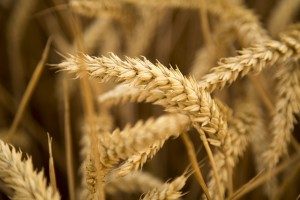
In Scripture, the first fruits are a sacrificial offering that you bring to God, collected on the first day before it has time to become damaged, as Abel brought the best among the firstborn lambs of his flock as a sacrifice. Furthermore, according to bibledictionary.com, the first sheaf of wheat was brought to God as a guarantee that the rest of the harvest was coming – a symbolic offering of the whole.
Objectively, I’m still young. But I don’t feel young – and moreover, as I start to close in on thirty, which is the cut-off age for aspirants in many religious communities, I’m more and more aware of an uneasy sense of time running out. Do I have anything left to offer God that is fresh, bright and hopeful, and which hasn’t been frayed or tarnished in some way since I left the religious life?
My answer: I have no idea. I hope so.
God’s answer, as given in Scripture: that’s not how it works. We don’t give the first fruits. We are becoming the first fruits. I’m not the one who took the initiative here: the marks of Baptism and Confirmation stamped on my immortal soul – invisible to me in this life, but seen clearly by His eyes – are the first gifts of His love for me.
I remember being told in the convent that everything we give to God is the result of an actual grace that He has bestowed on us, meaning that if I pray, it’s because the Holy Spirit has given me the grace to want to pray, and then another grace to follow through on that desire. I also remember how incredibly tiny it made me feel at the time, but now I see more than ever the beauty of it.
Undeniably, the offering I can make to God is cringe-worthy when viewed in and of itself: a mass of half-formed good intentions, lingering wariness and skim-reading impatience, for the most part. But forget that for a moment. I don’t decide that I’m going to make an offering to God – the Holy Spirit decides, and prompts me to do it until, hopefully, I cooperate. The first fruits are not my offering, but His. I hitch my forlorn prayers to the grace of the Holy Spirit, and the Father receives both with love. Hebrews 7:25 adds this:
(Jesus) is able for all time to save those who draw near to God through Him, since He always lives to make intercession for them.
That’s another highlight from my slow-motion Lectio: the Holy Spirit gives us the grace to pray in spite of our weaknesses, and then Jesus brings our prayers to the Father, having sprinkled us with His own blood to make us acceptable before Him (Hebrews 9:13-14).
It also struck me that in John 17:9, Jesus says to the Father, “I pray for those You have given Me, for they are Yours.” The Father gives us as a gift to the Son, the Holy Spirit gives us the grace to love the Son, and the Son then presents us to the Father as His brethren (2:11-12), the first fruits of His Passion. We were created out of nothing for this. And, once created, our souls are immortal – if we are faithful to the graces He has given us, when the sun expands into a cold red giant millions of years from now, you and I will watch it happen. When the seventh seal breaks and heaven falls silent for half an hour, we will be there to hear it. When the final war rages against Satan, and Saint Michael and the angels drive him into hell and slam the gates closed at the end of time, your voice and mine will join in the praise of God. We are the first fruits of that new creation which is to come, something infinitely larger than ourselves in which we are given the grace to participate, as a sign of the rest of the harvest that will follow.
Sep 7, 2015 |
By Guadalupana.
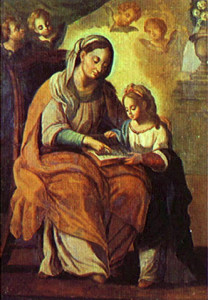
September 8th, the Feast of the Nativity of Mary, was an important day for me in religious life. Not only was it the day that I had entered religious life, but it also became my personal feast day. Sisters discerned their feast days and I chose this one.
Reflecting on my time in religious life, I am struck by how Mary was interceding for me. I underwent a LOT of trials in the couple of years and especially the couple of months before entering religious life as well as during my time as a postulant and novice. WOW! I could focus on the cross or I could focus on how Jesus revealed His love for me more intimately during times of difficulty and how Mary became more of a mother to me.
When not “feelin’ much love” from one sister in particular whom I looked to for guidance and at times fearing that God would not love me in my many imperfections & weaknesses, Mother Mary at times gently stepped in to console me of God’s love for me, to remind me of the importance of prayer, and to stir into flame a desire more for motherhood, spiritual as well as perhaps physical. It was on two different Marian feast days that I had such a painful desire to have children. At the time I thought I was being asked to sacrifice this but now that I am no longer in religious life, perhaps my heart was really being prepared for something else: time will tell on that one! What I will speak to now is spiritual motherhood. This call grew in my heart while in religious life. I didn’t realize then that this is something all women are called to, not just religious sisters.
There is a quote about spiritual motherhood that I came across much later after leaving religious life. It’s from a book titled Discovering the Feminine Genius: Every Woman’s Journey by Katrina Zeno. The quote goes like this: “Spiritual motherhood…means nurturing the emotional, moral, cultural, and spiritual life in others. All women are called to give birth-physically and/or spiritually. All women are called to be Christ-bearers, to receive divine life in the womb of their souls and bear Christ to the world. All women are called to see in Mary’s spiritual motherhood a reflection of their own lives. If all women embraced the call to spiritual motherhood they would ignite a nuclear reaction that would spread the culture of life through the whole world. The feminine genius would set the world on fire!”
I felt the need to “just be” more after religious life and not get too involved with things. Slowly though through various life circumstances & even misunderstandings, I’ve found myself in different roles and involved in ministries where this call to spiritual motherhood could be further developed & lived out more. Keeping in mind that God could always re-open the door, I’ve shut the door to religious life and feel that I am in a sense “waiting”, perhaps waiting for my future spouse (while God is also still my Spouse!) while living life and allowing my heart to continue to heal & grow more. “God only knows” if one day I will give birth physically to children, but I have given birth to Mary more in my heart and she has helped me to give birth more to Christ in my own life & in the lives of others. This is all still very much a work in progress though!
There have been times when I’ve wondered if being in religious life for almost three years had any purpose. This may especially be true when I look back through the lens of all the personal sufferings I’ve experienced! However, I need to trust that a greater good came from suffering and that my time there bore fruit. Besides learning how to boil water and growing more in prayer, there was something that happened on my last day when taking a walk with the sisters in my “class” a couple of hours before leaving that struck me. Never had we seen anything like this before, but as we were walking (and it was a short walk in a residential area near the convent), we saw a set of little twins. We then walked a little further and saw another set of young twins. Near the end of our short walk, we came across three kids with their parents and one of my sisters stated that we should ask if two of them were twins. As it turns out, they were triplets! priest I shared this story with later seemed to think that this was God’s way of showing me that my time in religious life was not wasted. It gave life to others.
May we each give birth to Mary more in our hearts and ask for her intercession to help us carry Christ more & more inside of us and to bear Him to the world.
Sep 3, 2015 |
aka the Should Syndrome.
By Grace.
Transition TimeLion
noun: The anxious/nagging/unsettled/perturbed feeling that arises when one experiences tension between current reality and where they think they ought to be
synonym: “Should Syndrome”, examples may include:
I should be ready for a job. I should be ready to date. I should be ready to go out with friends on a Friday night. I should be able to pray like I used to. I should be able to stop crying. I should be ok with shopping in stores or being out in large crowds.
Taming the Transition Time(line)lion and, consequently, Should Syndrome is no small feat. Often it rears its roaring head or utters its almost inaudible growls at the most inopportune times. This concept is in no way specific to the unique experience of transitioning from religious life to the lay state. Those who are going through the process of grieving a loved one’s death experience this, stay at home moms as the size of their family increases, those who struggle with infertility, professionals changing jobs or careers; all experience this phenomenon at some point in their life. The focus of this little reflection, however, will be directed toward the specifics of what you and I have been uniquely called to – continuing our relationship with God after discerning a different path to Heaven outside of religious life.
Three years later, with some time to process and a bit of distance, I offer these thoughts. In the early days after leaving the community I discerned with, almost every moment was a reminder that I wasn’t there. Not a day went by that I didn’t think of the sisters, that I didn’t have dreams that I was supposed to be in habit and wasn’t and that while there was great freedom without an horarium, being devoid of any schedule was ultimately offsetting. The only prayer I could utter for months was simply the name of Jesus. The mere sight of a Breviary broke my heart in two and the Transition TimeLion growled, “It’s been 6 months already, I should feel more stable than I do. I need to re-enter the workforce, but I feel incapable of entering the previous career I had. Surely, I should be ready by now.”
The interesting thing I found with the Transition TimeLion is that the expectations I felt pressured by or the things I felt I ought to be doing were not coming from anyone other than myself. I was the one disregarding the need of my heart that simply called for time and space to transition. The roaring and growling were insecurities that arose because I felt uncomfortable in this place of utter vulnerability that I had never encountered before. I wanted out! I wanted the fog to lift and the heartache and the unknowing to be over. However, this was an invitation to something deeper, to a new stage of my relationship with the Lord – to suffer being patient with myself. To trust, truly trust, that He has my greatest good at heart. I often am not able to see it in the moment, but those grueling, agonizing moments are the “stuff” of redemption. So are the moments of great joy and peace that follow.
Many times in the last three years, the TimeLion has appeared and reappeared in my life. So, what does one do in these moments and how does one tame this creature? I offer only the aids I have come to know through personal experience. You perhaps also have insightful wisdom which I welcome you to share for the Timelion can be tamed in a multitude of ways.
- Laugh. Yes, even if it is a forced laugh. I envision Beast from Beauty and the Beast when he is getting gussied up for his dinner with Belle and dons ridiculous curls with bows as one of the possible hair do’s. Puts the whole roaring lion of the interior life into perspective.
- Enter into beauty. Beauty allows us to encounter new aspects of our Creator that surprise us and almost immediately lift the soul, in delight, out of itself. Beauty will look different for each of us (and our Creator knows that). For some it will be a majestic sunset over the mountains, for others the smell of fresh baked chocolate chip cookies out of the oven, the giggle of a niece or nephew or a blossoming wild flower we unexpectedly encounter on our path. Whatever it is, He created it for you.
- Recreate. I apologize if even the sight of this term we encountered in religious life makes you cringe, but stick with me. Engage in activities you loved doing before you entered religious life and do them just for the sake of doing them (and because you can). Paint, play your musical instrument, go for a run, canoe, drink a cup of coffee while you’re getting ready in the morning. Utilize some of those new gifts/skills you learned in religious life for fun now. I learned to sew and now thoroughly enjoy making all of my niece’s gifts by hand.
- Trust. God has never been, is not now and will never be in crisis about your vocation. All of what He allows us to experience in this transition is part of Plan A. There isn’t a Plan B. It is not the case that we discerned incorrectly or failed. In fact, this discernment was actually successful despite the possible feeling that the Lord duped us (and perhaps, like me, you let yourself be duped). He loves us infinitely and has given us a particular grace specific to only those who transition from religious life to lay life. There will be a time and a place when He reveals the details of our vocation to us, but for now, He is simply calling each of us more closely to Himself.
So, when the Transition TimeLion begins to roar, know that you are already infinitely loved by the Triune God who loved you into existence and desires to be in relationship with you regardless of how quickly you get back on your feet, what you do or don’t do, achieve or don’t achieve. Let us rest a bit, be gentle with our hearts and take our time discovering who we are in the eyes of the Father.

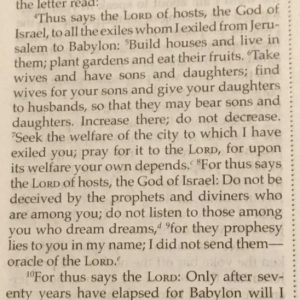 He tells them to build houses, plant gardens, settle down, get married, seek the good of the society within which they are living. He told them that this exile was PART of His plan for them, that it wasn’t a thwarting of His plan. He reassured them that they were exactly where He willed for them to be, and gave them the confidence they needed to get on with living their exile well.
 By Cinnamon.
 my faulty compass guides me straight into a tree. (I went on a nine-day orienteering camp when I was fourteen. Didn’t like it. Can you tell?) Our Lord told us, though, to keep on asking, seeking, and knocking; without a functioning compass, the walk will take longer, but one day – in His time – the underbrush will part suddenly and a clear path to Him will become visible. And He asks us to trust that, when each one of us gets to heaven and looks back down on the times when we felt most lost and helpless, meandering pointlessly in the scrub, we will see only one set of footprints.
 By Amata.
 By Cinnamon.
 here: the marks of Baptism and Confirmation stamped on my immortal soul – invisible to me in this life, but seen clearly by His eyes – are the first gifts of His love for me.
 And, once created, our souls are immortal – if we are faithful to the graces He has given us, when the sun expands into a cold red giant millions of years from now, you and I will watch it happen. When the seventh seal breaks and heaven falls silent for half an hour, we will be there to hear it. When the final war rages against Satan, and Saint Michael and the angels drive him into hell and slam the gates closed at the end of time, your voice and mine will join in the praise of God. We are the first fruits of that new creation which is to come, something infinitely larger than ourselves in which we are given the grace to participate, as a sign of the rest of the harvest that will follow.
 By Guadalupana.
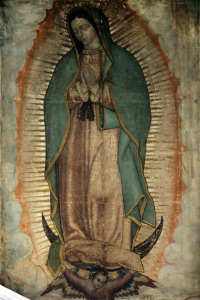 Every Woman’s Journey by Katrina Zeno. The quote goes like this: “Spiritual motherhood…means nurturing the emotional, moral, cultural, and spiritual life in others. All women are called to give birth-physically and/or spiritually. All women are called to be Christ-bearers, to receive divine life in the womb of their souls and bear Christ to the world. All women are called to see in Mary’s spiritual motherhood a reflection of their own lives. If all women embraced the call to spiritual motherhood they would ignite a nuclear reaction that would spread the culture of life through the whole world. The feminine genius would set the world on fire!”
 was something that happened on my last day when taking a walk with the sisters in my “class” a couple of hours before leaving that struck me. Never had we seen anything like this before, but as we were walking (and it was a short walk in a residential area near the convent), we saw a set of little twins. We then walked a little further and saw another set of young twins. Near the end of our short walk, we came across three kids with their parents and one of my sisters stated that we should ask if two of them were twins. As it turns out, they were triplets! priest I shared this story with later seemed to think that this was God’s way of showing me that my time in religious life was not wasted. It gave life to others.
Recent Comments