Nov 11, 2015 |
 Here’s the final post in Lucia’s beautiful Theology of the Body series!
After knowing of God’s immense love, a woman can go forward with finding out what God calls her to. This response is not immediately one of vocation to married or religious life, but rather a call to respond to God’s love.
When one knows that they are loved by another, they desire to give themselves completely to that person in love. It is in such an act that we truly find out who we are. As St. John Paul II points out, “Man cannot fully find himself except by making a sincere gift of himself”. By receiving God’s love and then giving ourselves in love and trust to Him, we truly become who we were created to be.
I started out my second blog post with the theme of hope. Hope: What do I mean by this? How does this relate to the Theology of the Body and how it expresses the Gospel message?
“The virtue of hope responds to the aspiration to happiness which God has placed in the heart of every man: it keeps man from discouragement; it sustains him during times of abandonment; it opens up his heart in expectation of eternal beatitude. Buoyed up by hope, he is preserved from selfishness and led to the happiness that flows from charity.” (Catechism, 1818)
Amidst your experience, whether it is one of joy and freedom or pain, suffering, and low self-esteem, how is God leading you to hope? How is He calling you to happiness and the desires of your heart? You have great desires for to love and be loved, and He has put those desires in your heart for a reason. Allow Him to guide you ever closer to Himself through these desires!
God wants to marry us. St. John Paul II expressed this beautifully, “With an act of redemptive love, Christ loved the Church and gave himself up for her. By the same act he is united with the Church in a spousal manner, as the husband and wife are reciprocally united in marriage instituted by the Creator.” (TOB, Audience 93). Even if you are not giving your life in the radical vocation of religious life, this still is very true. God created each of us for a deep and intimate union with Him, and our vocation is only the means by which we enter into a deeper relationship with Him.
Now, ask yourself, “Do I truly believe this and live this out? Do I believe  that even if I am not a religious that God is still calling me to a deep personal relationship, and not only that, but that He has a particular and irrepeatable mission for me? Do I believe that I am called to an intimate relationship with Christ, based not on what I do, but rather the fact that He loves me unconditionally?” Sit with the Lord and go through asking these questions with Him. Allow Him to stir the deep desires of your heart that are so beautifully put there by Him, and He will lead you to find out who you truly are.
“For I know the plans I have for you, says the Lord, plans for welfare and not for evil, to give you a future and a hope. Then you will call upon me and come and pray to me, and I will hear you. You will seek me and find me; when you seek me with all your heart, I will be found by you, says the Lord.” (Jeremiah 29:11)
The other two posts in this series are available here:
https://www.leonieslonging.org/theology-of-the-body-faith/
and here:
https://www.leonieslonging.org/theology-of-the-body-hope/
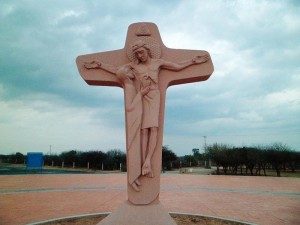
The image of the Schoenstatt Unity Crucifix in this post is used under a Creative Commons Licence, and the owner is Enrique Lepez-Tamayo Biosca.
Oct 17, 2015 |
The canonization of Louis and Zelie Martin, parents of Saint Therese, is set for October 18th, 2015!
To celebrate, here is a post about the difficult and beautiful process of growing toward sainthood as a family, written by mother of four Elissa Jasko.
Several months ago I was asked to write a couple blogs about growing in holiness through family life. I don’t think of myself as an expert in such areas, but when I sat down to write the first one, Motherhood: A path to holiness, I found the Lord was working in my life and the process of writing allowed me to organize and meditate on what He was teaching me. What a blessing! I looked forward to working on the second, which was to be a reflection on how we help our kids discern their vocation and obtain sainthood.
I want to let you know that what I am sharing today is different from what I thought I would share when I began writing this blog. Instead of an explanation of how my husband and I are working to grow virtue in our children, I will share where God has taken me in the days since I first opened this document and began typing.
When I started, I wrote out all kinds of great thoughts about being made in the image of God and how God calls all of us, no matter our age, to live the life of love. I believe parents can help their children live as images of God by recognizing and celebrating the amazing, innocent way children can spread love and joy. One of my personal favorites is how many people are so moved by the miracle of life that they are uncontrollably compelled to touch or even kiss the pregnant belly of a complete stranger. It is not easy to welcome this gesture, but I chose to see this invasion of personal space as a way I am allowing my unborn child to touch hearts.
I continued my blog with more examples of how I have encouraged and observed my children to receive God’s love and let it flow to those around them, but something wasn’t right. I couldn’t figure out how to finish. I had complete writer’s block.
And then naptime ended.
Back to the reality of life with four kids ages five and under, and I hadn’t completed the blog. As my children started running around and playing, all the thoughts and convictions about letting the love of God flow into your life and through you to others flew right out the window. The rest of the afternoon went poorly. I was frustrated and irritable. My mood deteriorated so much that by evening I not only doubted my qualifications to write a blog about raising holy children, I doubted my qualifications to parent children at all.
By the grace of God, the day ended with an honest, quiet bedtime conversation with my 4-year-old daughter about
how hard it is for me to be a good mommy. I told her I want to be patient and let God’s love flow through me to her and her brothers. I apologized for failing, and asked her to pray for me. Then she shared that obeying and being kind is hard for her, and I promised to pray for her. That time of sharing was invaluable. I hope we have many more real moments like that together.
“A saint is a sinner who keeps on trying.” I found this saying the first time I attempted to write this blog, but I dismissed it as irrelevant. I wanted readers to be left with my positive message “encourage children to live the life of love God is calling them to now so it comes naturally when they are making permanent vocation decisions.” The idea of “keep on trying, you’ll get ’em one day” seemed like an unnecessary downer.
It turns out that God had His own message in mind. He has shown me that this saying is one of hope. God knows life is hard and our flesh is weak. He knows we will fail. Learning to pick ourselves up and continue on is a critical lesson to learn. The fact that He forgives and strengthens us for our journey says so much about His Love. Thank you Jesus for your mercy and forgiveness. Thank you for continuing to show me perfection is not a prerequisite for parenting. By sharing the ups and downs of my weak efforts to grow in holiness I am modelling to my children how to grow in love with You.
This lesson applies to more than just parents. I think we could all learn more about God’s love by honestly sharing with each other our own struggles to be loving. Yes, we should strive to be patient and always act in love, but the truth is, we all fail at it. None of us is a saint yet, but the Lord who began His good work in us is faithful. In humility, we admit our failings. In love, we receive forgiveness and healing. In grace, we are given strength to try again.
I pray that as my children grow, they will not be discouraged by failure. I pray they will realize that living a life of love is worth dusting off your pants and trying again. I pray that together as a family we will take time to celebrate love’s victories. In doing this, I have faith that we will find where God is calling us to love and grow in union with Him.
Saints Louis and Zelie Martin, pray for us!
Sep 30, 2015 |
Ever seen Kung Fu Panda?
I watched the movie with my postulant class and felt at the time like it pretty much described our early religious experience. Rigorous training and self-discovery were on the menu, served up with bok choy and steaming, hot rice. It got me thinking about what it is to prepare oneself for a life of service to Him. The Ignatian idea of soldiers for Christ comes to mind here. The similarities between military and religious life are manifold, after all:
– Early mornings.
– Obedience to Superiors.
– Intense discipline.
– Frequent exhaustion.
– Detailed schedule.
– Ordered sleeping quarters.
– Standard issue clothing.
– B-grade coffee **grin**
Even the standing, sitting, following in the breviary and bowing in unison of praying the Office together is somewhat analogous to the experience of ceremonial drill with synchronised marching and weapon handling.
By way of further illustration, allow me to share my own personal occasion of deja vu.
People had been murmuring all afternoon, you see. It was rumoured that there would be a midnight training exercise. We had been moved out of the Officer’s quarters for that evening, which was unusual. We were shifted to the enlisted flats. Unusual just doesn’t happen in the military. Routine happens. Predictability happens. People are squared away.
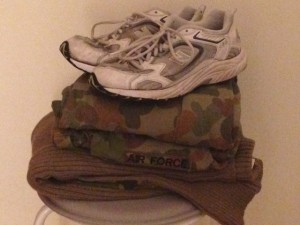
Instinct told me to go to bed partially dressed, and it is just as well that I did. At approximately 3.30am the following morning, the peal of an aluminium whistle simultaneously sounded with the thud of a shoe being whacked against the door of my quarters. We were ordered to report downstairs on the grass outside the flats, in full DPCUs (disruptive pattern camouflage uniforms) but with our running shoes instead of our boots, formed up in rank and file. Initially I congratulated myself. I was almost completely dressed – I only had to pull on and button up my camouflage shirt and pull my shoes on… wait… what shoes? I had my boots, but not my running shoes. My running shoes were in the trunk of my car, parked downstairs outside the flats.
I grabbed my car key and ran like a mad thing in bare feet out onto the dew-kissed grass to grab my shoes. I ran to my place in the line, secured my car key in a cargo pocket and managed to get one shoe on before time was up. It was mostly dark, and I put the other shoe on the ground partially on top of my unshod foot as we stood to attention and listened to the Warrant Officer brief us on the exercise that was about to take place. I played it cool and counted on poor visibility and the hope that an inspection would not take place to survive the next 5 minutes… and was grateful when we were given a minute between the briefing and the commencement of our first task, which was enough time to get the shoe on. My failure to be properly prepared had miraculously flown under the radar that morning. What followed was a “character building” road run of many miles, where we were required to drop to the side of the road every few miles to do pushups, where our hands held the curb, but our bodies had to go down a further 6 inches lower than the level of our hands in order to allow our noses to brush the asphalt. Such was the cruel creativity of our task masters. We were then required to travel a certain distance in walking lunges before teaming up with a fellow Officer Cadet and retrieving, in pairs, heavy ammunition boxes with the objective of getting them from one side of a deep water obstacle to another. All in all, these torments continued for approximately 90 minutes, at which point we were given leave to shower and get ourselves to the Officer’s Mess for a well-earned breakfast and some liquid gold.
Fast forward some 4 years.
I had been wearing a uniform of a very different kind for approximately 2 weeks. I was now a baby postulant.
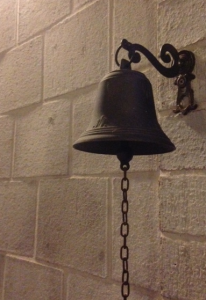
At approximately 1.15am, the morning bell rang. I woke and groggily looked at my clock. Seeing the time, I was quite sure it was just a dream and I turned back over in my bed and went back to sleep. Meanwhile, more savvy and obedient sisters than I were dressing in the neighbouring cells, despite the hour. Rushing between cells and bathrooms transpired over the few minutes that followed before the message made it around the dorms that we were to go back to bed. Suffice it to say that rising at 5am after the drama a few hours earlier was… “sanctifying.”
After breakfast the following morning all novitiate sisters were asked to meet in the Community Room where the Novice Mistress addressed us to debrief the incident of the night before. It so happened that a sister who often struggled to wake to an alarm or a bell was responsible for ringing the bells that week to regulate the horarium. Her anxiety had been building over the course of the week, so determined was she to do her duties well for love of her sisters. She woke in the middle of the night, panicked and thought she had missed the time that she was supposed to ring the bell to wake the house, pulled on her slippers and her robe and ran out to ring the bell, not realising that we were still entitled to a further 4 hours and 45 minutes of sleep. Seasoned by my prior military experience, and skeptical about the explanation we had just been offered, I raised my hand and when the Novice Mistress called upon me, asked her directly in front of the rest of the novitiate: “Sister – are we being hazed?”
You can imagine the laughter that ensued.
Anecdotes aside, where is the point of distinction between “character building” and “sanctifying” ?? What makes two types of life with so many shared experiences remain so radically different in character??
I think the answer resides in a fascinating tension between love and duty, between glorification of God and glorification of self.
In my experience there is a sort of perfectionistic quality about the typical military officer, more pronounced in some than in others, coexisting with a desire to serve. The typical officer takes great pride in a polished appearance, in elite physical conditioning and in finely honed discipline. The typical officer seeks to be better, faster, stronger, smarter, more courageous… because the life of self and of others may depend upon that one day. This need not lack virtue if ordered correctly under God, but often this is not the case. Ordering one’s betterment within the framework of God’s plan and created order is certainly not the focal point of the training, that is for sure! Duty is the fulcrum and assiduous training the lever as the officer aspires to be propelled toward a successful military career. Duty. Training. Discipline. Courage. Loyalty. These are all good things, but at the service of oneself they are sold short!
There is, however, a good that is objectively higher: love.
There are still temptations in religious formation to want to glorify self, temptations to a disordered perfectionism that quite simply kills the love between sisters and bears no fruit. Yet opportunities abound to grow in love, and the community construct is uniquely fitted to the task of helping to motivate sisters to authentically love and to serve rather than to simply to better one’s capability. The eternal life of self and others may depend on that predisposition to love and serve in response to His grace, one day!
As one grows in obedience and self-knowledge, (perhaps without the bok choy and rice,) one learns to live by the dictum I first heard from my Postulant Mistress:
“Do the best that you can with the time you have for the love of God.”
My former superior used to speak of religious life as a school of love… but isn’t ALL of life that, really? Novitiate was like LOVE101. Back out here, in the world, amidst family, friends and coworkers? I feel like it’s just an extension of that other school of love – definitely the intermediate class!
So what has this former Air Force Officer learned so far?
I’m just a little one.
I don’t have to be better, faster, stronger, smarter or more courageous, as good as all of those qualities are.
All I need to do is learn to love in response to Love.
by Bek.
Aug 19, 2015 |
By Lucia.
This is the first instalment of a three-part series on the Theology of the Body of Pope John Paul II, and its special meaning for women who have left the religious life.
“For my power is made perfect in weakness” (2 Cor 12:9) Have you ever thought of these words, especially as you struggle day by day, or even moment my moment in your transition home from the convent? In my own life, my time of coming home from the convent helped me to see how utterly helpless I was, and there were times that I felt so overburdened with my fragility that I wondered how God would bring good out of it. While I believed the mystery of the cross – that God brings good out of every evil and weakness – I found such difficulty experiencing it in my own life.
I doubt I was the only person that experienced immense guilt, fear, shame, and acceptance when I came home. Honestly, speaking with many of the young women from my class who also left, it is a common experience. Even though I made the decision to leave the convent after much discernment, I constantly doubted myself if I did the right thing. Before I knew it, I was absorbed in fears of making any decisions due to an immense feeling of shame.
While I knew these were lies from the evil one, I could not seem to shake off all these struggles, even as months went by. It was then that I knew that that God was calling me to abandon all to Him and to let Him take my weakness. I knew that He had the most perfect plan for me from before I was born and so would take my weakness and use it for His glory. It was amidst all this that God reached out to me and healed me through St. John Paul II’s catechesis called Theology of the Body.
I came across Theology of the Body in St. John Paul II’s “Letter to Women” in a Catholic study group called Endow (Education on the Nature and Dignity of Woman), and this began to touch the deep recesses of my heart. Amidst my pain and suffering of trying to figure out who I was again, St. John Paul II encouraged me that I had an immense gift to give to the world as a woman. Through his letter to women, this saint led me to encounter the heart of God the Father in a profound way.
In my own life experience of coming home from the convent and adjusting, God called me to know ever more deeply of my immense dignity as His child, and to trust in His Divine Providence. When coming face-to-face with my own fears and inwardness, God touched me with the beauty of human relationships and what it truly means to love through Theology of the Body. I hope to share that with you in the coming posts of how this catechesis led to deep healing in my experience of coming home from the convent, along with how it might help you in your journey. I pray that in this blog series, God speaks to your heart in how he calls you to love and communion with Himself in your experience of coming home from the convent.
Jul 16, 2015 |
On the Feast of Saints Anne and Joachim, parents of the Blessed Virgin Mary, Elissa Jasko reflects on her vocation to motherhood and finding holiness within the family.
A child running by half clothed, a baby crying, bathwater puddles on the floor and toilet, a toothpaste painting all over the lower half of the mirror, and a frustrated child trying to put an upside down and inside out pajama shirt on like pants. This is a common scene at our house between 7:30 and 8:30pm. Chaotic? Yes. Unnerving? Yes. Beautiful? Absolutely. It is beautiful because if you look closer you may see a father helping one child brush her teeth while patiently listening to another enthusiastically describing a superhero, ninja turtle, firefighter who fights villains with tube sock nunchucks. You may hear a 2 year old quietly singing to the baby while trying hard to do it all “myself!” I hope you would see a mother closing her eyes, taking a deep breath and choosing to act in charity instead of frustration.
The family is a path to holiness. Siblings are one of the greatest gifts you can give your children. The family is a domestic church. I have heard each of these phrases many times. As parents, my husband and I have a continuing dialogue about all the choices we make for our family. During one recent conversation, we began to internalize what I think these phrases about family are trying to describe: the only goal that really matters is doing everything in love. It does not matter if our kitchen floor more closely resembles the before shot in a Lysol commercial or if we manage to pull off a Pinterest perfect birthday party for each of our children every year. What matters is taking every opportunity to teach our children to love God and others even when the baby is screaming. Even when water is dumped all over bathroom floor. Even when there is a month’s worth of Kid’s Crest artfully spread across the mirror. Even when we really just need the kids to get in bed so we can fold the laundry without the piles being used as step stools to get onto the couch. Instead of focusing on everything in our life that is not “going right” we need to use all of these naturally occurring opportunities to teach our children to love each other, to value people over task lists, and to have peace. Lord help us!
We pray that as we move toward our eternal destination, we prepare our kids to know Jesus and to let His Love into their hearts so it can overflow to everyone they meet. While this responsibility is huge, we are discovering that must be accomplished through minute by minute choices to “do small things done with great love.”
Apr 26, 2015 |
By Petra Stella
Are you one of the many former religious who will sit in Mass this Sunday hearing Father mention that it is the World Day of Prayer for Vocations, and immediately feel that painful twinge in your heart? It probably feels like yet another painful reminder of the “Year Of Not Me” all over again!
It’s easy to fall into that trap… thinking this is not about you.
After all – this is the Year of Consecrated Life, and it’s the World Day of Prayer for Vocations.
But if you think this isn’t about you, you aren’t paying attention! You – and I – and all the women in our situation: we need the graces and guidance that will come of the World Day of Prayer for Vocations as much as anyone else… perhaps more than anyone else!
About 2 weeks before I returned back to the world, I was sick in bed with influenza, and remained in my cell for a few days. During that time, I re-read Christifideles Laici. At this stage I already knew I’d be approaching my superior about returning home when I was well and she was back from her retreat… and so I read it with very much a searching mindset. And with a great deal of hope and excitement, not yet tinged by the grief of loss that was to come after actually leaving.
As I read this beautiful gem from among the legacy of St John Paul the Great, I was struck by the important reminder that ALL of us are consecrated. Our Baptism is a consecration, and religious life is one very beautiful way of deepening that consecration. It is not the only way.
So how do I live out MY consecration? I may one day be called to marriage, or I may be called back to religious life down the track… but if I’m consecrated by virtue of my Baptism, then I need to be living out this consecration NOW… not just waiting to deepen it some way in the future. Christifideles Laici reminds us that there are many different kinds of workers in the Vineyard of the Lord, and there is much work to be done. How can I bear fruit if I stand around idle all day? I want to bear fruit for Him!!
I gave my “yes” once upon a time to the Lord when He asked. This “yes” hasn’t changed, and every so often on special occasions, I renew this “yes” to Him. Wrapped up in this response was a realisation that even though I thought I was assenting to religious life, I didn’t really know what the future would hold, but I said “yes” to it all – everything He asked of me, no matter how little, how big, how crazy. I meant it then. I mean it now. Like Therese, I choose all. My “now” is part of this all. I’m out in the world again because He asked me to be. He has a purpose in this, and He wants me to be fruitful. Yes, Lord. I choose and embrace this “now” in which I find myself. Bless the work I undertake out here in Your Vineyard. May You bring this work that You have begun in me to completion!
I would really recommend following the link above to the Vatican website and reading Christifideles Laici prayerfully, if you are seeking guidance as to how to live your “now” fruitfully. I’d also prayerfully read – and take comfort in – Chapter 15 of John’s Gospel. This advice was given to me by a wise friend last year, and it brought me much comfort and guidance in my own situation.
And so I exhort each of you – as you lend your voice to the many that are praying for vocations today… realise that YOUR vocation, whatever that is, is every bit as much the target of any resulting grace. :) Today is a World Day of Prayer for YOU.

 that even if I am not a religious that God is still calling me to a deep personal relationship, and not only that, but that He has a particular and irrepeatable mission for me? Do I believe that I am called to an intimate relationship with Christ, based not on what I do, but rather the fact that He loves me unconditionally?” Sit with the Lord and go through asking these questions with Him. Allow Him to stir the deep desires of your heart that are so beautifully put there by Him, and He will lead you to find out who you truly are.

 I want to let you know that what I am sharing today is different from what I thought I would share when I began writing this blog. Instead of an explanation of how my husband and I are working to grow virtue in our children, I will share where God has taken me in the days since I first opened this document and began typing.
 This lesson applies to more than just parents. I think we could all learn more about God’s love by honestly sharing with each other our own struggles to be loving. Yes, we should strive to be patient and always act in love, but the truth is, we all fail at it. None of us is a saint yet, but the Lord who began His good work in us is faithful. In humility, we admit our failings. In love, we receive forgiveness and healing. In grace, we are given strength to try again.
 Ever seen Kung Fu Panda?
 Instinct told me to go to bed partially dressed, and it is just as well that I did. At approximately 3.30am the following morning, the peal of an aluminium whistle simultaneously sounded with the thud of a shoe being whacked against the door of my quarters. We were ordered to report downstairs on the grass outside the flats, in full DPCUs (disruptive pattern camouflage uniforms) but with our running shoes instead of our boots, formed up in rank and file. Initially I congratulated myself. I was almost completely dressed – I only had to pull on and button up my camouflage shirt and pull my shoes on… wait… what shoes? I had my boots, but not my running shoes. My running shoes were in the trunk of my car, parked downstairs outside the flats.
 Mistress addressed us to debrief the incident of the night before. It so happened that a sister who often struggled to wake to an alarm or a bell was responsible for ringing the bells that week to regulate the horarium. Her anxiety had been building over the course of the week, so determined was she to do her duties well for love of her sisters. She woke in the middle of the night, panicked and thought she had missed the time that she was supposed to ring the bell to wake the house, pulled on her slippers and her robe and ran out to ring the bell, not realising that we were still entitled to a further 4 hours and 45 minutes of sleep. Seasoned by my prior military experience, and skeptical about the explanation we had just been offered, I raised my hand and when the Novice Mistress called upon me, asked her directly in front of the rest of the novitiate: “Sister – are we being hazed?”
 By Lucia.
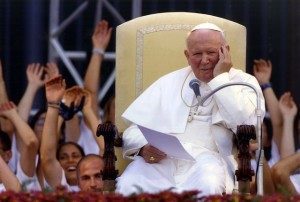 (Education on the Nature and Dignity of Woman), and this began to touch the deep recesses of my heart. Amidst my pain and suffering of trying to figure out who I was again, St. John Paul II encouraged me that I had an immense gift to give to the world as a woman. Through his letter to women, this saint led me to encounter the heart of God the Father in a profound way.
 On the Feast of Saints Anne and Joachim, parents of the Blessed Virgin Mary, Elissa Jasko reflects on her vocation to motherhood and finding holiness within the family.
 By Petra Stella

Recent Comments