May 23, 2021 |
 12 lessons I learnt from my first leaving, that made my second so much easier.
By Catherine.
When I was twenty, I was set for life. I was a happy and confident young woman excited to begin my postulancy in an active religious order.
Fast forward to twenty-one, and it was a very different picture. After a very difficult year, I’d been shown the door. I didn’t cope very well with this: I really struggled to process and accept this ‘catastrophe’ and have hope for my future again.
But five years after leaving my first community, God led me into another one. Life was good, and I was flourishing in this new (and much psychologically healthier) environment.
But, as you’ve probably guessed, this community didn’t work out either. I could’ve come out the other side from this community in an even worse state than I was after leaving the first time. But praise be to God, I’m actually handling things much better this time around! Less than a year on, and I’m in a place where I’m genuinely happy, fulfilled, stable, and generally content with life – probably the best I’ve been since before joining the first time. I definitely felt that having learned a bunch of lessons the hard way a few years ago, this leaving has been a lot easier to navigate. So I thought I’d share some of the things I’ve learnt, so that maybe this can help a few others who find themselves in similar situations.
- God will provide what you need
Leaving can be scary, especially if it happens suddenly (like it did to me). You’re probably homeless and income-less, you don’t know what you’re stepping out into, you don’t have a plan, and you don’t have a safety net. Except for God.
My experience of my first leaving was that God truly did provide. Door after door kept opening just at the right time. I felt like I just walked into accommodation, employment, and a really great community.
When I left this time, I was homeless in the middle of a pandemic. But that didn’t trouble me. I knew that if we keep on turning to God, He does provide all our needs. And he didn’t let me down this time, either.
2. You need time to grieve and adjust
Leaving a convent is a major life event. It’s sort of like being divorced, losing your family and losing your job all in one hit – while also suffering the culture shock of being catapulted from the middle ages into the 21st century. You probably have mixed feelings about leaving: there can be hope and confidence and relief, but also grief, confusion and a crisis of meaning. Don’t expect the next year or so to be an easy one.
So go easy on yourself during this time! Give yourself the time and space to process all your emotions: to cry and rage and just sit with the sadness. Be careful not to take on too much. Be discerning about which friendships you will keep up or invest in: not every friend from your pre-convent life is going to be the right friend for you now. Make sure you are well supported, and get at least a couple of sessions of counselling.

3. God has a plan for you and He is in control
– even though it might seem like the devil has triumphed this time. He’s God. Just because you can’t see where He’s leading you, it doesn’t mean that you’ve fallen ‘outside’ of His plan or that He’s not going to lead or provide for you.
There’s a beautiful prayer written by Thomas Merton which has often helped me in times of tested faith:
O Lord God, I have no idea where I am going, I do not see the road ahead of me, I cannot know for certain where it will end. Nor do I really know myself, And that fact that I think I am following Your will Does not mean that I am actually doing so. But I believe That the desire to please You Does in fact please You. And I hope I have that desire In all that I am doing. I hope that I will never do anything Apart from that desire to please You. And I know that if I do this You will lead me by the right road, Though I may know nothing about it. Therefore I will trust You always Though I may seem to be lost And in the shadow of death. I will not fear, For You are ever with me, And You will never leave me To make my journey alone.
4. Nothing is ever wasted and God works all things to good
Again, it won’t often feel like this! But it’s not a shallow cliché, it’s a powerful truth. Look at the lives of the Saints: one of the common themes in their stories seems to be experiences of great suffering (in fact, I regularly consoled myself by remembering that God only seems to treat His special favourites like this!).
God’s much more powerful than anything of the devil. He can and does bring good out of the worst of experiences – much more good than there ever was evil in that event. But Rom 8:28 has a condition: God works all things to good for those who love Him. The choice to love and serve God in the midst of all their trials and sufferings was the difference that made the Saints.
I have seen in my own life how God has brought about so many amazingly good things that would have been impossible if I hadn’t left my first community. I don’t know if would’ve been better off staying there. To be honest, I don’t really care any more, because I’ve learnt to embrace a different set of goods for my life. And this new life isn’t just ‘good’, it’s great.
5. You have to forgive
Even though this can be really, really hard, it’s absolutely necessary. Unforgiveness will only hold you back, and make you bitter, twisted and resentful. You’ll be allowing the people who hurt you to keep you stuck in a miserable life.
One thing which held me back from fully forgiving was that it offended my sense of justice. Both times, I’d been very badly treated, and then left to deal with the consequences alone while it seemed like the people who hurt me could just move on as though nothing had happened. It didn’t feel fair.
But eventually I saw that in this attitude, I was trying to take God’s rightful place as their judge, and by Grace I was able to give that role back to Him. He’s God, He doesn’t let sin and injustice get ‘swept under the carpet’. Some day, somehow, they’ll each have to own their part in what happened. Maybe this confrontation has already occurred somehow in a way I’m not aware of. Maybe it will be at the moment of their particular judgement. Either way, the point is that I don’t have to be their judge. And that’s a great freedom.
6. Don’t miss the Grace of this time
This is a very unique time in your life. There are going to be particular Graces here, which won’t be available anywhere else. The experience of leaving can be a great Cross: but the Cross never comes without the Resurrection. In fact, I’ve found in my life that the Resurrection is very ‘Cross-shaped’!
It’s important to intentionally choose make the very most you can of this time and these Graces. When I finally made this decision three years after my first leaving, it was a major turning point. Nothing in my outward situation changed, but Grace started flowing, wounds began to heal, new possibilities were opening up, my happiness was increasing. I was truly experiencing a new springtime after a long winter.
This time around, too, this was a decision I needed to make: to stay close to the Cross, with all its Grace and all its challenges, over escaping all of this and living a numbed-out sort of existence. But no matter how challenging the road of the Cross is, it’s also infinitely more beautiful.
7. Take responsibility for yourself
God often uses dreams to tell me harsh truths about myself, probably because I don’t argue back when I’m asleep! A couple of weeks after my second leaving, I had a dream where I met someone else in my same situation. My advice to them was to ‘stop moping, and start doing the things which will set you up for the best possible life’. It was the kick up the backside I really needed!
It’s very easy to fall into the trap of blaming other people for our problems instead of taking responsibility for the direction of our life. But this is another attitude which will only hold you back. If you’re as wrecked as I was, you’ll only be able to take small steps at a time. That’s ok, just do what you can. Even a small step forward is a step in the right direction!
8. Keep up some form of apostolate
This might not be appropriate for everyone, but keeping up (a reduced level of) ministry was really good for me after both leavings. Loving and serving others takes you outside of yourself, brings joy and meaning, and can help keep you balanced and well connected with reality.
I’ve also found that staying in the same ministry after leaving is good for the people you reach out to as well. Just ‘disappearing’ will probably cause grief, disappointment and confusion. Continuing to have a ministry presence avoids all those things, provides reassurance that you do genuinely care, and gives them a chance to show their love and care for you.
9. You can choose your meta-narrative
Being part of, and then leaving a religious order, can be a very significant life event. But it doesn’t have to be what defines your life. It can be, if that’s what you choose. But I wouldn’t recommend that. Instead, you can choose to live in your true identity as a beloved daughter of God, in a meta-narrative of hope, of salvation, of Resurrection. It is a bit cliché, I know, but it’s true – and a much better way to live.
10. Seek full healing
Maybe you had a great experience in religious life. I really hope you did. But it’s not uncommon to walk away with a significant amount pain and anger – it’s just what comes of living in close relationship with a bunch of other broken and imperfect people.
If you’re one of the ones who are walking away wounded, I really encourage you to seek full healing. Don’t aim for anything less for yourself. You don’t want the effects of the bad experiences to keep on holding you back in life, or to be stuck in unhealthy patterns, or transferring negative emotions and expectations to new people and situations. It can be a long, hard process, but it’s totally worth it.
Although I’ve been through a lot of healing, I still haven’t made this full journey yet. I came into my second community still carrying a lot of baggage from my first. Maybe if I was more healed it could have worked out. Or at least not ended quite so badly. But with the help of God’s Grace, I’ll get there.
11. Your life/happiness isn’t over
Probably the hardest thing about the first leaving was that I felt that I was loosing my happiness, and that my life after this would just be a botched-together plan B, never quite as good as the life that I was really meant to have. After all, you can only be truly happy when you’re living your vocation, right?
I was once moping to my spiritual director about not having a charism to live out anymore made me feel very unanchored in life. His challenge back to me was to focus on developing my sense of my personal charism. Even if I were still in religious life, this was something I would have to do: as members of a community, we are not meant to be ‘carbon copies’ of the founder, but take up the charism in a way which is both unique and personal to us, and faithful to the spirit of our community.
God’s made you with a unique spirituality and mission. For me, I’ve found that my ‘personal charism’ hasn’t really changed over the course of my life as I go in and out of different communities and ministry roles. In fact, I’ve come to see the two communities I was part of as two ways in which I could live out my sense of charism. And now I’m discovering a third in single life. And I don’t feel like my vocation – or my happiness – is being compromised because of this change of state.
12. Your happiness isn’t in your temporal vocation anyway
This is probably the most important lesson! Don’t forget that you’re most important and fundamental calling is your Baptismal vocation: to know, love and serve God, and live forever with Him in Paradise. It’s God Himself Who is your joy, and loving and serving Him which is your fulfilment. Every other vocation is a particular way of living out this most important vocation, the only ‘essential’ vocation you’ll ever have.
So when a door like this closes – even if it was against your wishes and your discernment – it doesn’t mean game over for your life. It only means that God will provide another way to live out your ‘real’ vocation. A temporal vocation is a gift, an immensely great gift, but it’s not the gift-Giver Who we are called to seek above all things and find our true happiness in. Your happiness definitely isn’t over: perhaps, like I found, in being forcibly detached from a temporal vocation I was too attached to, your true happiness is only just beginning.
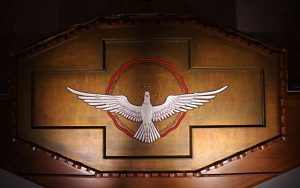
The dove painting featured in this article is used under Creative Commons Licence.
Attribution: Nheyob, CC BY-SA 3.0 <https://creativecommons.org/licenses/by-sa/3.0>, via Wikimedia Commons
Mar 28, 2021 |
By LumenChristi
I was on a very difficult discernment visit with a community, when a priest in confession assigned me to pray Psalm 23 as my penance.
“The Lord is my shepherd, I shall not want. . .”
As a 22-year old cradle Catholic, the words were so familiar that they had lost their meaning. But in this moment, they really took on new significance. In the midst of this stressful period, I felt Jesus reassuring me that he was there with me even though I didn’t feel it. He had led me here; he had started this journey with me and he would see me through.
He guides me along right paths for His name’s sake,
Even though I walk through the shadow of the valley of death,
I shall fear no evil, for you are at my side. . .
As I continued to read, in the chapel, before the giant crucifix that the community had behind the altar, the final verses of the psalm struck me like a lightning bolt:
You anoint my head with oil;
My cup overflows. . .
And I will dwell in the house of the Lord all the days of my life.
This hit me strongly, with both peace and anticipation. I sensed that the Lord was really getting my attention about something. I deeply felt a call from him, that despite the difficulties, he truly was calling me to enter this community and “dwell in His House” – this house. My cup did “overflow” with joy in response to this, and as I looked at the crucifix, it seemed to me that despite the struggles and sufferings I had encountered there, he had great graces to give me also, in that particular place with that community.
Fast-forward to the following spring, when I applied to this community, and despite the revelation I thought I had received, was not accepted.
If the experience in the chapel was a lightning-bolt showing me the way ahead, the rejection letter was a thunderbolt, appearing out of nowhere and painfully throwing me to the ground. I felt jolted by this on multiple levels. Not only were there the feelings of hurt and rejection, but there was something else, even deeper. I really had – so I thought – learned to recognize and listen to the Lord’s voice and followed an instruction direct from Him. And then, it would seem, he did not keep His promise. I fulfilled my end, and he failed to uphold his.
This disturbed me even more than the circumstances and misunderstandings that led to not being accepted by the community. For if something that I clearly heard God say was not Him, how could I ever trust Him again? More importantly, how could I ever trust myself again, in believing that he spoke to me?
I learned to pray anyway, even if it was more often complaining than anything else. I learned to go to Mass anyway even though my heart felt dead rather than alive in the Lord. I learned to go through the motions of my life, seeking his will for me in practical ways (job searching, finding God in friends and family). I took comfort that St. Francis too, thought that God spoke to him (“rebuild my church”) and it meant something completely different than he thought – in fact greater than what he thought. But something was missing, completely gone, to the point where I didn’t think it would come back and barely remembered what it was in the first place.
Fast-forward again to six years later. . . I had reached a place in my spiritual life that was more peaceful. I had learned to see the Lord in my daily life, even while I was unsure about the future. I had accepted that some things about his workings with us remain a mystery in this life; but it didn’t mean they weren’t real. Yet I still felt annoyed whenever I “ran into” Psalm 23. Like an old injury or pain that is mostly gone, but “flares up” under the right conditions, Psalm 23 was a sticking point in my relationship with God. I avoided it by skimming through when it came up in any reading I was doing, thinking about something else when it came up during Mass, and generally writing it off as a part of the Bible where God had something to say to everyone except me.
Then one cold winter day, I was sitting at my kitchen table with a warm cup of tea, doing my prayer-time for the day, and generally experiencing a pleasant time with the Lord. I opened the scripture readings for that day, and lo and behold, waiting for me was That Psalm. Its’ words jumped out at me from the page and danced before my eyes. They seemed to taunt me, reminding me how I didn’t trust God enough, reminding me how much I sucked at listening to him, and how prone I was to “getting it wrong” when it came to his message for my life. Oh no, not That Psalm! I thought. Not today. I will read the gospel instead.
Normally the gospels provide me much food for meditation. But that day it just left me restless. “That Psalm” kept distracting me. So I thought, perhaps, the Lord wanted me to go there after all. I turned the page, took a deep breath, and asked Him what he wanted to say. Then, by some small yet magnificent miracle of grace, when I read the words over again, they were no longer taunting at all. They came washing over me, like gentle waves that wore away at my resistance and washed over the hurt in my heart.
The Lord is my shepherd, I shall not want. . .
He guides me along right paths for His name’s sake,
Even though I walk through the shadow of the valley of death,
I shall fear no evil, for you are at my side. . .
“This is still true,” he seemed to be saying to me. “I am still your shepherd. I always have been. Through the “deaths” of rejection and confusion, still I have been beside you. Even though you have stumbled in the dark, still you have not strayed from ‘right paths’ because I have been with you.”
You anoint my head with oil,
My cup overflows. . .
You spread a table before me in front of all my foes. . .
I realized I had been anointed. Literally. At my baptism. That was where he had chosen and called me. And that call in itself, was unique and beautiful. He had not chosen me for religious life; at least at that time, in that community. But he had chosen me to be baptized. And he called me and chose me still, out of all the others on earth who could be privileged to know His name and yet, by some mystery, hadn’t been. It was a great honor and a great responsibility. “My cup overflowed” again, for different reasons, but even more so than the first time.
I felt in that moment too, that he had “spread a table in front of all my foes” because the darkness and the devil were vanquished, in a very significant way. The “fear of being wrong” in prayer began to lose its’ power.
And then finally. . .
Only goodness and kindness follow me, all the days of my life, and I will dwell in the house of the Lord forever.
Previously I had misinterpreted this to mean “only blessings follow me” (in my relationships with other people) all the days of my life. But now I realized, these words were not the Lord’s promise to me. They were my promise to Him, in return for His goodness as my shepherd. I would choose to be kind, to bless others, that even the smallest encounter with me would grant them an encounter with Him. And “his house” – beyond being the Church I was privileged to belong to — was also His presence. In that, I could choose to dwell always, regardless of success or failure.
These revelations were profound for me. That Psalm that taunted me was transformed into the first place I now go for consolation. When other storms have come, that is where I have found Him.
I pray that this experience of mine grants His peace to each of you reading it. I hope that it gives you a foretaste of the healing he has for you and the nearness he wishes to restore to you, even in the scriptures or devotions that you now find most painful. He makes all things new, even the thing you find most “ruined” at the moment.
Nov 29, 2020 |
An Advent reflection by Emma.
As I watched Disney’s Frozen II I felt, at some level, understood. Some friends who saw the movie also noticed themes that resonate very much with what it is like to discern religious life, or to have a friend who is discerning religious life. The below is less of a review and more of a spiritual exploration of a few of those themes through soundtrack lyrics paired with scripture. To those who may feel a little frozen in their discernment journey after having left the monastery, I hope these reflections help you to see that you are not alone – that others are frozen too – and that there is hope, for indeed “We know that in everything God works for good with those who love him” (Romans 8:28)
I’ve had my adventure, I don’t need something new
I’m afraid of what I’m risking if I follow you
Into the unknown
“Lord, if it is you, command me to come to you on the water.” Matthew 14:28
Elsa rules peacefully rules over Arendelle in the company of her dear sister Anna and friends. She already had an adventure of self-knowledge, self-acceptance, and sisterly love, yet there is still more to be learned and growth to be had. She still doesn’t understand why she has cryokinetic powers and is simultaneously longing for a life where having such a gift makes sense, but that might mean leaving behind her tranquil, easy-going life… again.
Similarly, many of us who have been in religious life may feel like we have already had our adventure. We already made the sacrifice. We left home behind and followed Jesus out onto the water. We followed the calling with everything we had, and everything the Spirit was willing to give us. We grew in self-knowledge and matured in other ways through living religious life.
And now we’re back.
It’s too easy to think that I have already had the adventure of religious life and I don’t need anything new. It is hard to listen and discern when I’m not sure if I trust those movements in my heart anymore. It is be hard to consider risking everything… again. Yet I do have the qualities of a contemplative soul and desire to find a place where those gifts fit in. I am different. Not many people would be willing to leave family, friends, career, and everything else to wake up before 5 am every day and never again be able to choose what’s for breakfast. Of course, the secret is that underneath the sacrifice is a deep love and longing for God – a spousal love.
And so the call remains… to something. I remain confident that Jesus is calling me to consecrated life, yet the context remains unclear. So I try to trust. And ask Jesus to bid me come to Him on the water if indeed He is the one who is calling.
And with the dawn, what comes then?
When it’s clear that everything will never be the same again.
Then I’ll make the choice to hear that voice
And do the next right thing.
“But on the first day of the week, at early dawn, they went to the tomb, taking the spices which they had prepared.” Luke 24:1
Another theme that appears in Frozen II is grief. This is definitely an emotion that I felt after leaving the monastery, especially toward the sister I was. Each sister is so unique in the way she loves God and the way she loves the other sisters, and the way she is loved by God and is loved by the other sisters. The fact that I left means that there will never be a sister in that monastery who is like that. Indeed, when a sister leaves the monastery or convent, things will never be the same again, and I remember wondering what is on the other side of grieving that loss.
I encourage you, wherever you find yourself, to do the next right thing. Perhaps the next right thing is spending a few minutes in prayer. Perhaps it is reaching out to a friend or priest for guidance. Perhaps it is going to Mass or Adoration. Perhaps it is simply finding enough motivation to go for a walk. The next right thing may not seem particularly remarkable, but each step taken out of love for Jesus is heroic. I encourage you, like Mary Magdalene and the other Mary, to go to the tomb. Because if you do, you will find the Resurrection – it just might not be right away though. Things will never be the same again, and that’s okay.
Show yourself
I’m dying to meet you
Show yourself
It’s your turn
Are you the one I’ve been looking for
All of my life?
Show yourself
I’m ready to learn
“Jesus said to her, ‘Woman, why are you weeping? Whom are you looking for?'” John 20:15
I’ll refrain from commenting on the context of this song so as to avoid spoilers, yet I wanted to include it because of how it mirrors contemplative prayer so well (note: the full song does contain spoilers). More than anything else after having left religious life, I needed to re-encounter the God I fell in love with. I needed to know that I was still loved by Jesus, when my emotions after leaving the monastery had me feeling rejected and abandoned. I found much healing here through praying in a way described by a bishop. His prayer in difficult moments was, “Lord show me how you are good here. Lord I want to see you in this situation” and he assures that when we pray in this way “God always comes through. And I mean always.” Through this prayer I was asking Jesus to show Himself, which is at the heart of the cry of a contemplative soul. I wanted to learn how he loved me through the difficult moments. I wanted to see how He was living His mysteries within my own life. I wanted to see God. As I began to pray in this way, moments of great suffering turned into moments of great intimacy with Jesus, and I’ve grown much in understading who I am to Him and who He is to me.
Where the north wind meets the sea
There’s a mother full of memory
Come, my darling, homeward bound.
When all is lost, then all is found.
“And Mary kept all these thing, pondering them in her heart.” Luke 2:19
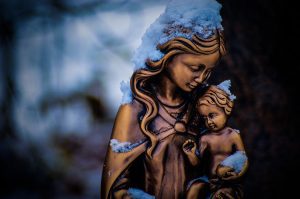
This opening song of the film actually makes quite a beautiful Marian hymn. Mary, our mother, is full of memory. She watches over us and ponders moments of our lives in her heart. As St. Mary of Jesus Crucified says, “Mary counts your steps.” We have a mother who cares for us. Loves us. Nurtures us. Heals us. This Advent, I invite us to ask Mary to lend us her heart. I invite us to ask her to permit us to see as she sees. To feel as she feels. To know as she knows. To hear as she hears. To love as she loves. To ponder as she ponders. We have a Mother who is counting our steps to our eternal home, where truly all that we long for will be found.
Nov 9, 2020 |
By Emma.
“You don’t need to fold it.” Mother said.
“Too late.” I replied from the inside the infirmary bathroom as I fiddled with the bandana, trying to cover my shorn hair as best I could. I was glad I already folded the habit, before a sense of obedience would have bidden me leave those holy garments in a deflated heap of brown and white. Street cloths felt so unusual now. Especially a short sleeve shirt. ‘Good enough,’ I thought as I stopped adjusting the bandana. I gently picked up the clothing I wished I was wearing off the counter, opened the door, and placed it on the large windowsill of the cloister corridor. I felt stripped. We walked past the cloister door where I entered the monastery, and came to a stop at the turn door, where I would leave.
“I am the door; if any one enters by me, he will be saved, and will go in and out and find pasture.”
– John 10:9
Doors mark a entering, or a leaving. They provide access to shelter and security. They can provide a hiddenness. An open door is an invitation. A closed door can feel like an inpenetrable barrier. Doors can mark a change, a transition, or a new space. Those Holy Doors of Mercy were the floodgates of grace thrown wide and a passage to a new beginning. Entering the door of the monastery seemingly marked the end of one life and the beginning of another. Three knocks, the click of a bolt, and a few steps brought many of us within a world we could only enter through our imagination. Doors carry importance in our hearts and our minds. In fact, research conducted by Gabriel Radvansky at the University of Notre Dame indicates that we do have a memory lapse when we walk through a doorway. Doors do mark a change, a transition into something or someplace new. In identifying Himself as the door, Jesus is itentifying Himself as that new beginning, as that source of shelter and security, as that invitation newness of life.
Jesus also says that if we enter by Him, we will “go in and out and find pasture.” I find this to be a very heartening phrase for those of us who have left religious life. In these words, Jesus promises us nourishment on either side of the sheepfold. When I went in to religious life, found pastures for my soul. When I went out of religious life, I also found pastures for my soul. Speaking on a more practical level, although walking out of the monastary door meant leaving the sisters with whom I had lived and loved like family, no longer living under the same roof as the Eucharist, and no longer having the silence, the stillness, and the simplicity of monastic life, walking out of the monastery also meant re-entering the world. It meant an open door to the friends and family members with whom communication was limited. It meant entering being a daughter, a sister, a friend, and a coworker. And in re-entering these familiar places, and exploring some new ones, I continue to find interior pastures for my soul.
“I am the door of the sheep”
– John 10:7
More than any door made of wood or steel or stone, each of us has entered that door which is Jesus Himself. Jesus is the reason why we entered the monastery in the first place. As Sr. Karla Goncalves, OSCO, describes, “I ask myself Why did you come? It’s Him. Who do you seek? It’s Him. Why do you stay? Can’t live without Him.” (Hidden: A Life all for God) As I reflect on those words, I am drawn to add “Why did you leave? For Him.” As paradoxical as those words can seem, they are true. Leaving the monastery was still wrapped in the prayer “All for you, dear Jesus, through your mother, Mary, as an act of the most pure love.”
In the first reading for today, the Dedication of the Lateran Basilica, we hear “The angel brought me back to the entrance of the temple, and I saw water flowing out.” Perhaps each of us needs to go back to the entrance, the real entrance. Not to any doorway made of stone and wood, but to the very heart of Jesus Christ. That is where we entered the monastery. That is where we re-entered the world. That is there where we will find those flowing waters for which we continuously long for.
“He who enters by the door is the shepherd of the sheep”
– John 10:2
In the Gospel of John, Jesus identifies Himself as both door and shepherd. Yet how can this be so? Perhaps this is so because our wounds are united to His. And if this is true, then perhaps, on a deeper level, leaving the monastery is not a closed door at all. Perhaps it is a very open door.
Leaving the monastery has left me with a wound; it has left me with a place where God can enter. Having a wound allows me to unite myself to Jesus in the most intimate way – in His suffering. It is only with our closest friends that we share our wounds. Those friends who we know will have the courage to enter within those wounds with us. Those friends who we know will be compassionate. Those who enter by other doors in our life are not as close to us. Perhaps this is precisely how we can know that it is Jesus who is entering – because He enters by the gate – He enters by our wounds. He accepted the Cross, He received wounds, so He could meet me here. He received wounds so that He could suffer with me. He received wounds so that He could enter within my wounds, and He invites me to enter within His wounds.
Not only does Jesus enter our wounds, but our wounds are the very place where God desires to manifest His glory. In Salvifici Doloris, Pope St. John Paul II writes that “…the weaknesses of all human sufferings are capable of being infused with the same power of God manifested in Christ’s Cross. In such a concept, to suffer means to become particularly susceptible, particularly open to the working of the salvific powers of God, offered to humanity in Christ.” May our wounds be like the wounds of Jesus. May our wounds be the door for the saving power of God.
“Knock and the door will be opened to you.”
– Matthew 7:7
I approach the door
candle in hand
light of Christ to guide me
I knock
and knock
and knock
The click of a bolt,
the creak of hinges,
crucifix cradled
by gentle wrinkled hands.
Even now
I can still enter
those sacred wounds.
May 21, 2020 |
By Emma.
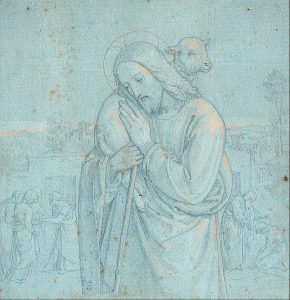
The LORD is my shepherd, I shall not want;
he makes me lie down in green pastures.
He leads me beside still waters;
he restores my soul.
Those are difficult words to pray when life has taken on the characteristics of a desert.
There are still moments when I miss the “green pastures” and “still waters” of religious life. There are still moments when I miss the hours set aside for prayer, simplicity of our cell, the laughter and smiles of the community, the folds of our habit, the quiet and simple work, the Stations of the Cross leading to the cemetery, the rattle of our side beads, the bells… Now there is even more that has been taken away due to the pandemic. So much more. I miss being able to pray with others. In person. In a Church. I miss being able to enter a Church. I miss going to Mass. I miss the Eucharist.
Yet I shall not want.
Jesus, the good shepherd, is the shepherd of my soul. He is mine, and I am His. That is what is important. That is all I need. Even when so much as been taken away, Jesus remains and He alone is enough. Although He has bound Himself to the Sacraments, He is not bound by them. He will continue to nourish my soul somehow and in some way. He will continue to lead me on the path of righteousness the Father has marked out for me from all eternity. He continues to come to me, and I can find rest and restoration in Him. Even here. In this desert. Even now. In the midst of the challenges and uncertainty.
Jesus is the green pasture. Jesus is the still water. Jesus is the restoration of my soul.
He always has been, and He always will be. And He cannot be taken away from me.
Even though I walk through the valley of the shadow of death,
I fear no evil; for you are with me;
your rod and your staff, they comfort me.
What has struck me most in the Gospel readings lately is how often Jesus seeks someone out and goes to them. “Jesus heard that they had cast him out, and having found him…” (John 9:35). “Jesus himself drew near and went with them.” (Luke 24:15) “she turned around and saw Jesus” (John 20:14).
How fitting it is that we should see Jesus seeking out His sheep in the days when He walked among us. “I am the good shepherd. The good shepherd lays down his life for the sheep.” (John 10:11). Jesus laying down His life is not confined to one moment 2,000 years ago. The burning love that made the sacrifice of Calvary possible is still alive here and now. Jesus lays down His life for His sheep in the little things and the big things. No act is too small for love. He who hung upon the cross for me will not abandon me in the bitter valley.
When St. Therese found herself in the midst of darkness, she found herself turning not to the cry, “My God, My God, why have you abandoned me?” but rather, “Even though I walk through the valley of the shadow of death, I fear no evil; for you are with me.” Jesus is the Good Shepherd. He will not abandon me.
You prepare a table before me in the presence of my enemies;
you anoint my head with oil, my cup overflows.
Surely goodness and mercy shall follow me all the days of my life;
and I shall dwell in the house of the LORD for ever.
At first the verse “You prepare a table before me in the presence of my enemies” seems nonsensical. Why would the good shepherd prepare a feast in the presence of enemies? Wouldn’t far away from the enemies be better? Yet in doing so, Jesus shows His true mastery over that which causes distress. So often I just want the difficult and unpleasant parts of life to just go away. Jesus shows His true power not through eliminating the difficulty, but rather through inviting me to feast in the midst of the difficulty and uncertainty. This harkens back to Isaiah 11:6 with “…the calf and the lion and the fatling together, and a little child shall lead them.” To be at peace in the midst of tranquility is expected. To be at peace in the midst of tribulation and distress is a gift. A gift that Jesus invites us to receive each day.
In the end, we are all on pilgrimage to our heavenly homeland. “I am the good shepherd,” Jesus says; “I know my own and my own know me, as the Father knows me and I know the Father” (John 10 14-15). Jesus knows us. We are not anonymous to Him, the creator and shaper of our hearts. He knows our rising and our resting. He knows the path that will lead us home to eternity with Him. Some of us will spend the pilgrimage in convents and monasteries which are like little vestibules of heaven. Others of us will spend this pilgrimage reflecting the love of the Trinity through the Sacrament of marriage. Others of us will spend this pilgrimage living the mystery of Nazareth through the seeming ordinariness of our life. Many and fleeting are the paths that we take. One and eternal is the destination. May our steps always remain homeward bound. May our gaze always remain fixed on Jesus.
Jesus is the Good Shepherd.
I am His sheep.
Jesus is the Good Shepherd.
I shall not want.
Jesus is the Good Shepherd.
I find rest in Him.
Jesus is the Good Shepherd.
I am never alone.
Jesus is the Good Shepherd.
I trust in Him.
Jesus is the Good Shepherd.
I shall not fear.
Jesus is the Good Shepherd.
I am homeward bound.


 8. Keep up some form of apostolate
 12. Your happiness isn’t in your temporal vocation anyway
 By LumenChristi
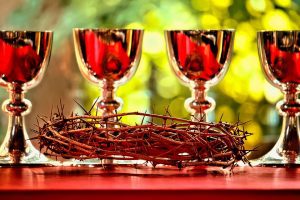 I learned to pray anyway, even if it was more often complaining than anything else. I learned to go to Mass anyway even though my heart felt dead rather than alive in the Lord. I learned to go through the motions of my life, seeking his will for me in practical ways (job searching, finding God in friends and family). I took comfort that St. Francis too, thought that God spoke to him (“rebuild my church”) and it meant something completely different than he thought – in fact greater than what he thought. But something was missing, completely gone, to the point where I didn’t think it would come back and barely remembered what it was in the first place.
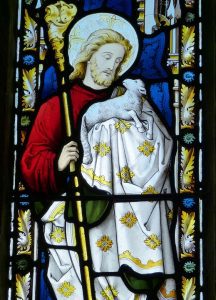 The Lord is my shepherd, I shall not want. . .
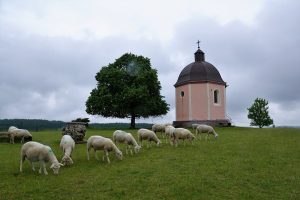 Previously I had misinterpreted this to mean “only blessings follow me” (in my relationships with other people) all the days of my life. But now I realized, these words were not the Lord’s promise to me. They were my promise to Him, in return for His goodness as my shepherd. I would choose to be kind, to bless others, that even the smallest encounter with me would grant them an encounter with Him. And “his house” – beyond being the Church I was privileged to belong to — was also His presence. In that, I could choose to dwell always, regardless of success or failure.
 An Advent reflection by Emma.
 Similarly, many of us who have been in religious life may feel like we have already had our adventure. We already made the sacrifice. We left home behind and followed Jesus out onto the water. We followed the calling with everything we had, and everything the Spirit was willing to give us. We grew in self-knowledge and matured in other ways through living religious life.
  Another theme that appears in Frozen II is grief. This is definitely an emotion that I felt after leaving the monastery, especially toward the sister I was. Each sister is so unique in the way she loves God and the way she loves the other sisters, and the way she is loved by God and is loved by the other sisters. The fact that I left means that there will never be a sister in that monastery who is like that. Indeed, when a sister leaves the monastery or convent, things will never be the same again, and I remember wondering what is on the other side of grieving that loss.
  I’ll refrain from commenting on the context of this song so as to avoid spoilers, yet I wanted to include it because of how it mirrors contemplative prayer so well (note: the full song does contain spoilers). More than anything else after having left religious life, I needed to re-encounter the God I fell in love with.
 This opening song of the film actually makes quite a beautiful Marian hymn. Mary, our mother, is full of memory. She watches over us and ponders moments of our lives in her heart. As St. Mary of Jesus Crucified says, “Mary counts your steps.” We have a mother who cares for us. Loves us. Nurtures us. Heals us. This Advent, I invite us to ask Mary to lend us her heart. I invite us to ask her to permit us to see as she sees. To feel as she feels. To know as she knows. To hear as she hears. To love as she loves. To ponder as she ponders. We have a Mother who is counting our steps to our eternal home, where truly all that we long for will be found.


 By Emma.
Recent Comments