May 27, 2016 |
By Lucia
“You will not be alone, because I am with you always and everywhere. Near to My Heart, fear nothing. I Myself am the cause of your departure. Know that My eyes follow every move of your heart with great attention. I am bringing you into seclusion so that I Myself may form your heart according to My future plans” (Jesus to St. Faustina, 797)
April 27, 2014- One of the most difficult days of my life, and yet, a very important day for the Church- Divine Mercy Sunday when St. John Paul II, the “Divine Mercy Pope”, was canonized. This was the day that I came home from the convent, and yet as I reflect on it more and more, I see it as a reflection of God’s Mercy and love to me.
Mercy, we hear it so often at Mass and in Scripture. It is one of the greatest attributes of God, and yet, how many of us plunge into the depths of what it means? The Latin, Misericordia, comes from “miserere”, which means “misery”, and “cor”, which means “heart”. So, this word literally means the act of a heart entering into another’s misery. So Divine Mercy is the message that not only does God enter into our misery with us, but that He comes and brings an even greater good out of every evil and suffering.
Coming up on the two year anniversary of my leaving, God blessed me with the beautiful grace to go on pilgrimage to the country that radiates God’s Mercy. He truly took me on a journey to experience the reality of this heart reaching out to me in my misery, especially in the experience my coming home from the convent. How? Redemptive Suffering. The people of Poland have experienced so much suffering, from the destruction of cities like Warsaw during World War II, to the incomprehensible terrors that resulted in concentration camps like Auschwitz. And yet, while these people have been through evils unimaginable, they have a heart for the Lord and hope unlike any other I have experienced.
This really blew me away… How can people who have experienced such immense suffering live like this? How can they have joy and hope, when everything they loved seemed to be taken away from them? How can they rejoice in Christ when they clearly came face to face with their own weaknesses and lived through so much fear?
In my own pain coming home from the convent, I have found that it has brought me face to face with fear and my own weakness. I have often given into discouragement, thinking that I can only love God once I move past the “ups and downs” of grieving the convent. But the people of Poland really helped me to see things in a new way through the lens of God’s Mercy.
As I progressed through my pilgrimage, the answer to my questions became clear to me. Teresa Benedicta of the Cross, Maximilian Kolbe, Faustina, John Paul II…These people were not immune to fear or death…Actually they were steeped in it. But what made these people saints they were meant to be?
They encountered the immense power of Divine Mercy. They experienced evil, came face to face with fear and suffering, and yes, knew ever deeper of their helplessness amidst such evil. But they made a choice- they chose to use it as an opportunity to cling to Christ and to take part in His suffering with Him. They saw their crosses in life through a twofold lens- that God was with them in their cross, and that they could unite their cross for another. They made the decision to allow the merciful Christ to be with them in their own pain, to receive His love gushing forth from his heart, and to be one with Him on the cross. And not only did they live out their suffering with Christ, but they had faith in God in whom they trusted would keep His promises. They had the hope in the reality that the resurrection comes after the cross, and that Christ not only brings good out of evil, but an even greater good!
 The image of Divine Mercy shows this reality well. In this image, Jesus is appearing after He rose from the dead, and yet, He bears his wounds…the wounds of His Love. His wounds are glorified, and radiate the depths of God’s Mercy to us. It is Jesus saying to me and to you, “I love you this much. I am here with you and will lead you through this.”
And perhaps what is most important is the words at the bottom. “Jesus, I trust in You.” Yes, these words seem to reflect the attitude and call that Christ presents to us in this Jubilee Year of Mercy. Jesus is asking us to trust Him, amidst worries, struggles, and even joys! When coming face to face with our weakness in our own specific journeys coming home from the convent, He wants us to trust in His goodness and in the reality that the resurrection comes after the cross. Just like Himself, He wants our wounds to be glorified- we need only to entrust them to Him!
Mar 15, 2016 |
By Guadalupana.
Picture this, I’m on a silent retreat (but not a religious vocation retreat; I’m no longer discerning religious life!) and at the end of the closing Mass for the retreat, the priest calls forward for a “special blessing” two religious sisters and four consecrated women as well as any women who may be feeling as if they are called to be the “spouse of Christ”. No one else probably noticed, but an invisible dagger went into my heart. I wonder what would have happened if I suddenly yelled, “Christ is my Spouse too! He’s the Spouse of all of us! (and maybe I want a special blessing too!).”
God had mercy on me. Once the women had returned to their pews and we were praying after Mass, a song was played with lyrics from the beginning of the Gospel of John 14. “Let not your hearts be troubled. You believe in God, believe also in me. In my Father’s house there are many mansions. Were it not so, I should have told you, because I go to prepare a place for you. And if I go and prepare a place for you, I am coming again, and I will take you to myself; that where I am, there you also may be.” I then started to cry. This was the Gospel passage at one of the final Masses before leaving religious life and these are consoling words. And so I ask myself this question. Was it really religious life that I longed for or Heaven? Union with God, to feel Jesus’ presence 24/7, the Beatific Vision, our Eternal Home: that is my true longing; my thirst. Deep down all of humanity has this same thirst; realized or not. When drawing closer to God in prayer, this desire would naturally increase. I had it before entering religious life and, if I’m honest, it was not quenched in religious life for religious life was still not Heaven. I don’t have Leonie’s Longing as much as I have God & Heaven Longing!
I’m going to end with a few resources and thoughts:
1. Danielle Rose is my favorite Catholic singer. She also used to be in a religious community. If you haven’t heard this song yet, I invite you to listen to it. It’s titled “The Saint That Is Just Me”. Here is a link to it, though with a YouTube video: https://www.youtube.com/watch?v=fh_fSNz6NvQ “Yes, if it weren’t for my sins or wounds or weakness, then You wouldn’t have married me upon the cross. Why do I fear being seen naked and broken? That’s why you came; cause I need You that much. When you hung upon the cross looking at me, You didn’t die so that I would try to be somebody else. You died so I could be the saint that is just me.”
2. Lighthouse Catholic Media puts out several inexpensive talks on CDs. “Jesus the Bridegroom. The Greatest Love Story Ever Told” by Dr. Brant Pitre may be one of my personal favorites for possibly obvious reasons. ;) He has also written a book with the same title.
3. Drink deeply of God’s mercy. A few days ago, I was in a Perpetual Adoration Chapel praying when everyone else that had been in there got up and left. I was left alone with Jesus. While before Him, I saw more deeply times I haven’t trusted Him yet also how He loves me. Oh, how He loves us. I am currently reading “7 Secrets of Divine Mercy” by Vinny Flynn and recently finished reading a book titled, “The Second Greatest Story Ever Told. Now Is the Time of Mercy” by Fr. Michael Gaitley. Both are SO good. Fr. Gaitley’s most recent release is “33 Days to Merciful Love” and can be used to make a consecration to Divine Mercy (St. Therese of Lisieux style).
So rest in God’s Merciful Heart & Love AND ponder this: God also longs for me (and you) to go to Heaven where we will be His brides forever! “Jesus, I trust in You!”
Dec 7, 2015 |
By Josepha.
The Immaculate Conception was a big feast day in the convent I had entered. We had our letter-writing day for all of our Christmas cards on that day and it was a mad race to try and write to every person that we did not often have the chance to write the rest of the year. There was Christmas music on and different Christmas treats around in the midst of all the Advent preparations. I always enjoyed this day in the convent, and I found it difficult the first year I was home again during Advent and had to write Christmas cards whenever I chose to make time for them. There is something to be said for the beautiful way feast days are often celebrated in the convent.
Mary was someone who was difficult for me to relate to and understand prior to entering Religious Life. I did not have much of a devotion to Mary, and I often prayed the rosary half-heartedly because I felt it was a “good” thing to do. During my time in the convent, my devotion and love for Mary grew and grew. I am grateful for that gift that Religious Life gave to me.
After returning home, I found I couldn’t even speak with Jesus in prayer most of the time because I felt so completely rejected by Him. I had laid down my life and made my vows only to discern Him asking me to leave a year later. Mary was the one solace I had in leaving because I felt like she could understand my pain of feeling so separated from Jesus while still knowing in my mind that He did love me and want what was eternally best for my soul. I’m grateful for her taking my hand and leading me through the darkness of leaving Religious Life. On days when I couldn’t bear to spend a minute in prayer, I was able to say a prayer to Our Lady and find some peace with her.
Nov 27, 2015 |
By Ignatia.
For three years before entering the convent, I had worn a chapel veil at Mass. As a child, I’d been attracted to the beauty of the veils themselves, and in college I became exposed to the theological reasoning behind the practice, which cinched the deal for me. I bought my first veil (a real mantilla!) in Madrid at World Youth Day and I’d worn one ever since. I loved veiling and adhered to it religiously (pun very much intended!), and I eagerly hoped and prayed that the day would come where I would wear a veil not just in the chapel, but “full time” as a religious sister.
When I finally heard and accepted God’s concrete invitation to join a religious order, I was ecstatic. Of course, there were difficulties with the decision to enter: Shortly after requesting entrance, I was offered several full scholarships for graduate study at prestigious universities, the Order asked me to do an additional “optional” year of formation as a prepostulant at a house in a foreign country, I needed to change my lifelong vegetarian diet in order to be able to eat “from the common table.” And I was asked not to wear a chapel veil as a prepostulant. While this last difficulty was not the hardest of those decisions (after all, I had the prospect of soon becoming a fully-habited religious sister in front of me!), I will admit that I struggled with it. It was one of the first tests of obedience that the Lord asked of me in religious life.
I grew a lot over the course of prepostulancy and during my two months as a postulant. And when I returned home from the convent, while it felt natural for me to continue veiling in the presence of the Blessed Sacrament, it was with a very different mindset than when I’d begun the practice.
Thus, a week after leaving the convent, I found myself at daily Mass trying to push aside my anger with myself, my anger with some of my former Sisters, my feelings of deep vulnerability, abandonment, and loss, and basically just an overwhelming amount of inner turmoil. While I was kneeling in thanksgiving after Mass was over, an older gentleman approached me. “It’s so nice to see a young woman with her head covered at Mass! The Lord is granting you many graces for wearing that,” he said to me. Whereas before, this comment would have spoken to my pride and made me feel flattered (“I know! I’m such a good Catholic!”), now I just felt irrationally angry. I wanted to yell at him that “With that mindset, the Lord would probably be granting me far more graces if I were still in the convent! You don’t know anything!” Noting my anger and resolving to take it to prayer to examine it later, I responded instead with a weary smile and as much restraint as I could muster: “I hope the Lord grants me graces regardless of what I’m wearing on my head.”
During a personal Holy Hour a little later, I returned to that interaction. “The Lord is granting you many graces [for wearing a veil]”, I quoted in my journal. “Well,” I continued writing, “I personally hope the Lord is granting me graces because He loves me and because I love Him and try to follow His will, not because of some piece of lace on my head. In fact, I have a feeling that I received more graces in not wearing a veil as a prepostulant than I do now in wearing a veil as a laywoman, since the former was done in obedience.”
“But God doesn’t love me because I veil or because I pray or because I entered the convent. He loves me because that is Who He is. And because Who He is doesn’t change, His love for me will never change. His love for me is not dependent upon what I do or don’t do, on what I wear or don’t wear. I am loved no matter what because He is love and He loves me.”
Until that moment, I’d never realized or admitted to myself that I’d been trying to earn God’s love, but that’s what I’d been trying to do. I didn’t feel worthy of the Lord’s love, so instead of accepting that I am unworthy and He loves me
anyways, I tried to make it “worth it” for Him to love me. But somehow, in that place of brokenness, of realizing just how weak and sinful I am and how insufficient all my “great big efforts” to make myself “worthy” of being loved by God actually are, the Lord spoke Love into my heart. “Oh, little one,” I heard Him say, “My dear, sweet little one, you don’t need to try to win My love, you don’t have to earn it. You can’t earn it. My Heart is already yours and nothing you do will ever alter that.”
I am eternally grateful to that older gentleman for helping open my eyes to the reality of the Lord’s love for me and for helping open my heart to His healing. His comment led to a moment of deep insight and consolation that has been helping me navigate the stormy waters of these first few months of post-convent life.
I still wear a veil at Mass. I continue to love the tradition, and it helps remind me that I am both beautiful and His bride, even if I’m not a religious sister. But I now veil with more humility and less rigidity because I realize that it won’t “earn” me anything. It’s one of the many precious insights that the Lord has so graciously granted me since leaving my former community.
“You have ravished my heart, my sister, my bride;
You have ravished my heart with one glance of your eyes.”
(Song of Songs 4:9)
Sep 30, 2015 |
Saint Therese, your love could not be contained within the boundaries of one vocation: you longed to give everything to God. Teach us, too, to extend our love beyond any limitations we have set, and to seek new paths in the service of Christ all our days.
O God, who didst inflame with Thy spirit of love the soul of Saint Therese of the Child Jesus, grant that we may also love Thee, and make Thee much loved. Amen.

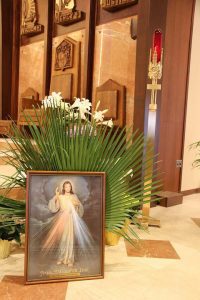 The image of Divine Mercy shows this reality well. In this image, Jesus is appearing after He rose from the dead, and yet, He bears his wounds…the wounds of His Love. His wounds are glorified, and radiate the depths of God’s Mercy to us. It is Jesus saying to me and to you, “I love you this much. I am here with you and will lead you through this.”
 By Guadalupana.
 By Josepha.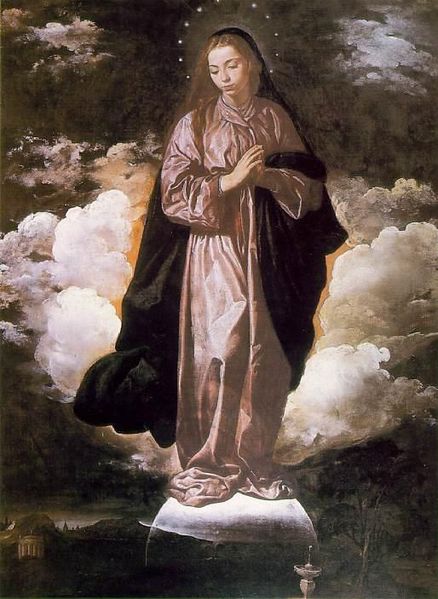

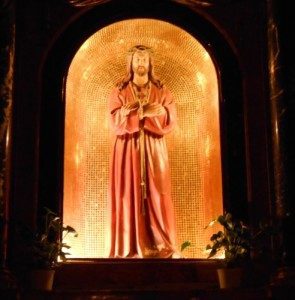 anger with some of my former Sisters, my feelings of deep vulnerability, abandonment, and loss, and basically just an overwhelming amount of inner turmoil. While I was kneeling in thanksgiving after Mass was over, an older gentleman approached me. “It’s so nice to see a young woman with her head covered at Mass! The Lord is granting you many graces for wearing that,” he said to me. Whereas before, this comment would have spoken to my pride and made me feel flattered (“I know! I’m such a good Catholic!”), now I just felt irrationally angry. I wanted to yell at him that “With that mindset, the Lord would probably be granting me far more graces if I were still in the convent! You don’t know anything!” Noting my anger and resolving to take it to prayer to examine it later, I responded instead with a weary smile and as much restraint as I could muster: “I hope the Lord grants me graces regardless of what I’m wearing on my head.”
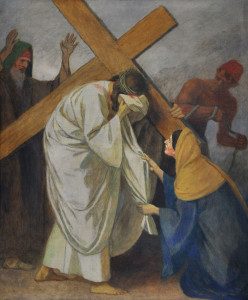 During a personal Holy Hour a little later, I returned to that interaction. “The Lord is granting you many graces [for wearing a veil]”, I quoted in my journal. “Well,” I continued writing, “I personally hope the Lord is granting me graces because He loves me and because I love Him and try to follow His will, not because of some piece of lace on my head. In fact, I have a feeling that I received more graces in not wearing a veil as a prepostulant than I do now in wearing a veil as a laywoman, since the former was done in obedience.”
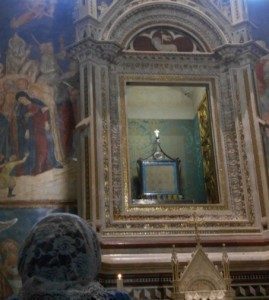 for helping open my heart to His healing. His comment led to a moment of deep insight and consolation that has been helping me navigate the stormy waters of these first few months of post-convent life.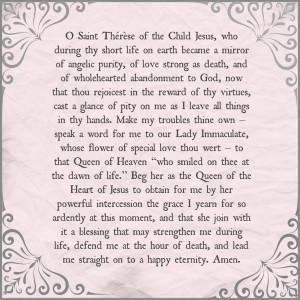
Recent Comments