Oct 16, 2014 |

By Misericordia
Today, the Church celebrates the Feast of a Saint very dear to my heart (no pun intended), Saint Margaret Mary Alacoque. She spearheaded the promulgation of the devotion to the Sacred Heart of Jesus (who was spear-hearted!), which was always present in the Church in one form or another but not formally recognized until then.
Before I started telling my own story about leaving the Convent and struggling with my eating disorder, I used to envy others who had seemingly more glorious stories. I thought my story was boring and embarrassing. Later on, however, I learned that my friends and acquaintances thought otherwise. And I soon realized that the Lord was a big fan of my story, not because it was particularly intriguing, but because it was the beginning of the story of my redemption. I started to see my wounded past as salvific, instead of shameful.
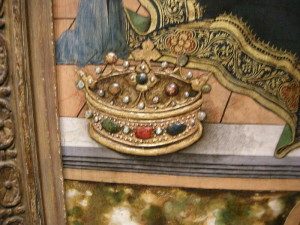
And if I can have this kind of experience – that my story is important and that my life has meaning and purpose – then certainly you can too! Each of our lives is so filled to the brim with extra-ordinariness in the midst of ordinariness, with grace in the midst of trial, with love in the midst of fear and pain, and mercy and forgiveness in the midst of apparent failure. So no matter who you are and what you struggle with, those sufferings are valuable gems. They are like the jewels on the Cross that represent the 5 Wounds of Christ. The points of access to redemption and salvation.
I love the images of Saint Thomas the Apostle when the Lord asked him to but his finger in his side, revealing to him and to us the gaping wound in His Side.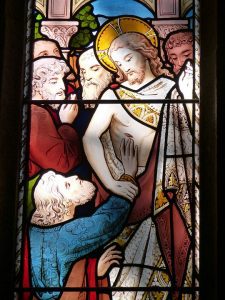
It is in His Wounds that we find refuge. There we realize that He knows our pain and our wounds. And as we put our finger into His Side we experience His vulnerability and humility. We realize the boldness of His trust in the Father’s Love that led Him to the Cross, to His seeming abandonment by the Father, and to His suffering and death.
But this wound is not a sign of failure and pain. It is the mark of His glorious Resurrection and Ascension into Heaven. In His Wounded Side we find, for us, the Love of His Sacred Heart, the Mercy He lavishes upon us, and the freedom He offers us in uniting our wounds to His. Yes, in Him we find freedom. Apart from Him there is nothing. When we try to rely on own accomplishments for affirmation and self-worth we end up being trapped under an avalanche of guilt, shame, unworthiness, loneliness, fear, and anxiety. But when we open our wounds to Christ and have the audacity to let Him see us as we really are, broken and in need of so many things, it is then that he pours Himself into us.
And despite the nothingness we may feel at times, the messiness of our life we finally admit to ourselves, and the rawness of the feeling of those wounds, we are finally filled. We no longer have this gaping empty bandaided wound because the Precious Blood of Jesus has finally gained access.
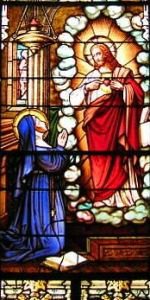
As we celebrate Saint Margaret Mary, who was given the vision of the Sacred Heart and who united her own heart to His, let us make a gift of our wounded hearts to the Lord and see Him graciously accept them, heal them, and care for them.
Aug 22, 2014 |
By Misericordia
To all of you who have twin siblings, you and I both understand deeply the concept of sibling rivalry. As an identical twin, my early life was a constant comparison. I loved (and still love!) my twin sister dearly, but I always felt self-conscious. I was never “as good” at things, even though I was the older twin, by eleven whole minutes!
When we were little, my “younger” sister loved pink and all the princesses in every story. However, I decided I was the queen. Why settle for princess when I could control everything (including the princess)? This seemed like a no-brainer to me!
The only problem was that the queen in almost every fairy tale is a villain…so my parents were slightly disturbed when I asked if I could be Maleficent for Halloween. But alas, I had to settle for being an octopus, which no where near resembled my second favorite queen, Ursula.
Eventually, I realized that the possibility of actually becoming a queen was unlikely! But more importantly, the Lord has personally shown me in adulthood that the less control I have over my life and that of others, the more room He has to work, and the more He can reign in my heart. So, as a former Queen-wannabe, I am preparing myself for the courts of the Kingdom of Heaven, where we are promised to be co-heirs with Christ.
Another lesson the Lord has taught me in my journey of Faith is that in addition to having a relationship with the King, I am also meant to have a relationship with the Queen of Heaven – Our Lady. She, however, is very unlike those I wished to emulate as a young child. First of all, she had no power over any earthly territory, not even her very womb, which she surrendered to the care of her Heavenly Father. Secondly, unlike fairy tale queens who succumb to jealousy and fear over losing their identity as the greatest or most fair, Mary at the Annunciation trusts the Lord when presented with the news that she could be both Virgin and Mother. And not only that but the Mother of God! And lastly, through her faith and hope, she was able to reveal to others how to live and love in total service of God and those around her.
Simply put, she knew who she was before God, and that was always enough, despite her material poverty, poverty of will, and the difficult circumstances she faced as a young mother who was not yet married. Her radical trust in God’s Providence and timing in all things was fuelled by the understanding of her identity and knowledge of her belonging to God. And consequently this fuelled her love of others, as she knew more than anyone the Love of God for their souls.
Even though we might know all of this intellectually, we can still feel ourselves distant from her because she is so holy, perfect, and immaculate, and we believe we do not possess any of the same graces. It is as though we see ourselves as a peasant in rags outside of the royal castle. However, her perfection opens the drawbridge for us. Her power was in her Assent to the Will of God, and the constant Fiat she lived in every action, word, and deed, was all for our salvation, that we may be one with her Son and the whole Community of Heaven. Thus, her seemingly untouchable holiness only brings us closer to her and the Blessed Trinity. She sees us approaching from afar and summons the guards to open the gates to us!
Similarly, her call to holiness was not only for her, the Queen of Heaven, the Queen of Angels and of Men, it is for all of us- all angels and men! We are asked to participate with her in the same spirit that she was given, the spirit that dwells in each of our hearts.
So I hate to break it to you, but no, we are not the fairest of them all. But are we searching for this perfection from mirrors, accolades, and the visible “successes” of our life conquests? Not to fear, because we can safely say that Our Lady truly is the fairest one of all! And praise God that we have so great a Mother to intercede for us at the Throne of the Most High God. The Queen of Heaven who watches over us, Sons and Daughters of the King.
Misericordia works for her home diocese, is a caffeine addict, and loves swimming.
Aug 19, 2014 |
By Nancy McCall, MS, LPC
In religious life, one is freed from having to make the mundane decisions about what to eat, what to wear, when and what to do for work, and when to pray. In this way of religious community, which involves self-effacement and obedience to others, one can focus on purifying the heart, growing in grace and on prayer for, and service to, others. It may take the religious person many years to progress far in purifying the heart. Meanwhile, she is growing in grace and does, at least formally, pray for others. When one exits religious life, one can come to believe that because she was free from those mundane decisions like what to wear and what to eat and when to talk, that she is somehow now rendered incapable of decision-making. No, not true at all. All the time while in religious life, the religious sister or brother was still making the most important decisions for himself or herself throughout every day.
You see, the important decisions involve the heart and eternal things. “Will I love today or only be placid?” “Shall I give fully or half-heartedly?” “Shall I bear difficulties patiently or become internally resentful?” “Shall I follow the way of Jesus or just go through the motions?” It is the same outside of religious life, only you must attend to the mundane things too.
Think for a moment and ask yourself, “Did I learn anything in religious life that will help me simplify my life now and be more attentive to God’s Holy Spirit?”
In religious life, there is a purpose for releasing you from the mundane decision-making you were likely used to prior to entering the convent. One purpose is that it is essential when living in community. If everyone decided what they wanted to eat, how would you have meals together? The other major purpose for this release from mundane decision-making is to free each person to focus on those things mentioned above: purifying the heart, growing in grace and on giving energy to prayer and service to the world. Now that you are not living in the same kind of community, naturally many mundane things of life will present themselves to you again and you must deal with them.
What is the best way to manage this new encounter with the diurnal? First, realize that while everything seems to have changed in your experience, nothing has actually changed in the larger picture. Your purpose in life is the same: to purify the heart, grow in grace and to pray for and serve others. Second, there is an art to living and one of your jobs right now is to study that art. For example, the best trick for deciding what to wear in the morning is to decide the night before. An easy way to decide what to do tomorrow is to decide this evening. And just as adhering to routine preserved simplicity for you in the convent, creating and adhering to routine will simplify and bless your life now.
What about that sense of community and common cause that you feel you are suddenly missing? How in the world can such a thing be replaced? You feel lonely, possibly rejected, and you are essentially on your own. Sometimes, the reason little daily decisions seem so difficult is because much bigger decisions are not yet made: in particular, the decision of overall vocation. What’s worse is that I thought I had that huge decision made. What a relief! Now it appears to be unmade. “Oh no!” So I think to myself, “what I was so certain of has unraveled before my eyes, how can I move on not even knowing which way to move?”
The best way to move on is to begin. It’s always easier for God to direct someone who is moving. Begin by choosing to look at your own situation in a fresh and beautiful way. Something beautiful has happened to you. It may look and feel ugly and awful, but it isn’t actually. And Jesus, who adores you, will show you its beauty in time – ask Him.
Second, remember, your decision-making abilities have not been surgically removed. Your emotions may have been badly wounded and your thought processes turned upside down because your circumstances were caught in a toad-strangling, unpredictable storm. You are going to recover, because God has not abandoned you, even if others have.
Third, routinizing all the important things and daily necessities can go far to normalize your life right now. Make a routine based on wisdom, your desires and practical needs. This may require prayer and could be aided by someone you trust who is especially good with routine.
Last, be attentive to self-care. Without good self-care, you will fail at everything. Here are some basics of good self-care:
Self-Care Advice
Remember, you are still in a discernment process. This is an important time in your life. Seek God. Ask for wisdom (James 1:5) and open yourself to all the beauty that is about to be revealed to you.
Jul 13, 2014 |
I have taken for myself the parents of the Martin Girls as my patrons for trying to live the ordinary demands of an ordinary life, as an authentic path for seeking God. Perhaps it sounds odd, but accepting the ordinary has been very difficult for me.
One of the hardest lessons I have had to learn in the spiritual life is the reverence that the ordinary, natural elements of life deserve. It is only in being grounded in the rich earth of ordinary life that the supernatural can be authentically received. In spite of my lifelong devotion to St. Thérèse, I spent many years quite frustrated by the routine and pressures of living the demands of daily life.
Mounds of laundry and dishes, hurrying to work, and hurrying home again to family expectations: all these felt like barriers to responding to God. The realities of my life did not seem to match any concept of holiness that might refer to me.
What did it take to open my eyes to the very real presence of God hidden beneath the surface of the demands of ordinary life? Years of simply doing what looked like the next right thing and a flood of graces. What did I ponder on in those days? Mostly survival from one necessity to the next. But once I began to believe that the call to holiness is universal and specific to each circumstance, then my soul was free to rejoice in all things.
What moved my soul beyond survival mode to the awareness of the presence of God? Fidelity to Mass, I think, even though I judged that I was not really praying. I carried a rosary in my pocket, even though as a young woman I rarely actually said it all, let alone meditate on a Mystery. The mystery to me was how profoundly I loved my family even though I was totally overwhelmed by them. By such tiny, desperate steps I began to believe that nothing can separate me from the love of Christ, because He chooses to be with me in all the chaos that I often considered my daily life to be.
If I’m not aware of God in the ordinary joys and sorrows of life, not in a state of deep gratitude for the natural elements of life, then I’m not yet truly in love with Our Father who created the natural, and said that it was good.
All things are created by God. Therefore, the most natural, common elements of life have the potential to be a revelation of God Himself. Growth in holiness cannot be His gift to me if I don’t learn to recognize the gifts that He has already given me and is giving me each day.
I’m just beginning to appreciate the importance of the teachings of St. Thomas Aquinas and St. Augustine on the relationship between grace and nature. The God-given nature of each individual is specifically given as the foundation for the relationship that He desires to offer to that soul. By means of the characteristics of my particular personality, profession, and limitations, God chooses to reveal Himself to me, and through me. There are no separate categories of life in respect to encountering the living God. God is all in all.
By Jacqueline-Thérèse
Living the Sacrament of Matrimony with a small flock of children and grandchildren. Greatly influenced by the Eucharist, the Oblation of St. Therese and the Rule of St. Benedict. In service through retreat work, fostering lay communities and vocation discernment.
 By Misericordia
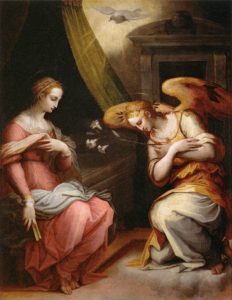 Another lesson the Lord has taught me in my journey of Faith is that in addition to having a relationship with the King, I am also meant to have a relationship with the Queen of Heaven – Our Lady. She, however, is very unlike those I wished to emulate as a young child. First of all, she had no power over any earthly territory, not even her very womb, which she surrendered to the care of her Heavenly Father. Secondly, unlike fairy tale queens who succumb to jealousy and fear over losing their identity as the greatest or most fair, Mary at the Annunciation trusts the Lord when presented with the news that she could be both Virgin and Mother. And not only that but the Mother of God! And lastly, through her faith and hope, she was able to reveal to others how to live and love in total service of God and those around her.
 By Nancy McCall, MS, LPC
 You feel lonely, possibly rejected, and you are essentially on your own. Sometimes, the reason little daily decisions seem so difficult is because much bigger decisions are not yet made: in particular, the decision of overall vocation. What’s worse is that I thought I had that huge decision made. What a relief! Now it appears to be unmade. “Oh no!” So I think to myself, “what I was so certain of has unraveled before my eyes, how can I move on not even knowing which way to move?”
 I have taken for myself the parents of the Martin Girls as my patrons for trying to live the ordinary demands of an ordinary life, as an authentic path for seeking God. Perhaps it sounds odd, but accepting the ordinary has been very difficult for me.
Recent Comments