Sep 28, 2016 |
 By AfterEpiphany.
For the longest time after I returned home from the convent, I was afraid to move in a fixed direction or put down any roots. I didn’t want to commit to anything unless I was sure. Once burned, twice shy… that’s how it felt. I had given everything I could of myself when I was “living the life” in my community. I had committed entirely on an interior level, so when the call back out to the world came it hit me like a ton of bricks. The sense of purpose that I had prior to discerning out of religious life was a hard act to follow. Unless I could find a similarly purposeful direction to move in, I didn’t want to be tied down.
3 years after returning home, I moved out of my parents’ home and took out a lease on an apartment. I decided to allow myself to ENJOY setting up my new home. I went for uncluttered without being minimalist, with a few soft furnishings and bits and pieces to create a pleasant place to relax or to entertain… even a few prints of paintings by local artists of places to which I have travelled in my past… each one, a memory. It sure won’t be gracing the pages of any interior design mags, but it’s home.
Why is investing time, effort and $ in homemaking, even important, you might ask?
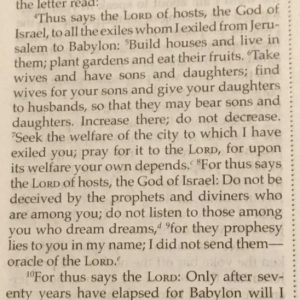
I’d invite you to pick up your Bible and flick to Jeremiah 29. No… not verse 11… that quote about a hope and a future that so many people explore on blogs like this one! Let’s have a look at something different! Go right back to the beginning of the chapter to where God addresses Himself to the exiles in Babylon.
 He tells them to build houses, plant gardens, settle down, get married, seek the good of the society within which they are living. He told them that this exile was PART of His plan for them, that it wasn’t a thwarting of His plan. He reassured them that they were exactly where He willed for them to be, and gave them the confidence they needed to get on with living their exile well.
I’m still in the process of trying to work out how to do this well in my own context, and I dare say that this is going to look different for every one who has returned to the world from the convent. I know this much – putting my life into a holding pattern in the hopes that some wonderful life mission or purpose will materialise out of nowhere is not what He is asking me to do. Gabriel didn’t appear to our Blessed Mother in a waiting room. He delivered God’s message to her when she was at work.
So again, I invite you – sit down with this passage – and if possible, do so before the Blessed Sacrament. How is He speaking to you through this passage?
I pray you’ll find reassurance and peace!
Pictured Rocks, MI – captured by a local artist. It hangs on my wall to remind me of a wonderful memory kayaking under that archway with a dear friend of mine!
Q: What is “From My Inner Cell” all about?
A: From My Inner Cell: Conversations with God for convent-leavers
Aug 11, 2016 |
By AfterEpiphany.
“Do not cling to me,” (c.f. Jn 20:17
The post-Resurrection encounter between Jesus and Mary of Magdala is one of my very favourite Scriptural accounts. Yet it poses a gentle challenge that I found very helpful upon returning to the world, if a little hard to hear, at first.
I’d invite you to step into Mary’s shoes for a moment. That moment of recognition at being called by name would obviously bring an unspeakable joy, an excitement, an awe. But I think there might also perhaps have been a sense that “now that He’s back, things will be just like they used to be…” Perhaps Mary was clinging to a set notion of the pre-Resurrection Jesus? She had to let go, to allow Him to return to His Father.
The words “do not cling to me” speak to me, also, as I ponder this account. I had certain ideas about my relationship with the Lord when I was in the convent. When I returned to the world, it was tempting to cling to these ideas. They were comforting, familiar. But they were my own ideas about Jesus – they weren’t actually Jesus.
How is Jesus revealing Himself to me in the present moment? Who am I before Jesus, now? How do we relate? Is my relationship with Him stagnating, because I am clinging to those old ideas? Perhaps it’s time for me to invite Him back in, to allow Him to love me, to grow in love for Him… a different kind of love…
Q: What is “From My Inner Cell” all about?
A:Â From My Inner Cell: Conversations with God for convent-leavers
Aug 5, 2016 |
By Amata
Some years ago, I was talking with a dear friend. She and her husband had been struggling to conceive, and she was sharing with me how painful this experience was. However, she said, if this was something that she needed to go through, to suffer, so that she could become holy, then so be it. She said she’d rather go to Heaven than have a baby, if that was what it took to get to heaven, if this experience of infertility was purifying her and sanctifying her through her pain.
Her words that day stuck with me. She’d rather go to heaven than have a baby, if that was what it took. I continued to ponder and to be amazed by those words. I grew up in a large family, where babies are seen as one of the greatest gifts God can give, and now I feel myself drawn to marriage. I love babies, and I could see the pain in my friend’s eyes as she spoke. And yet, she would rather go to Heaven than have a baby. Her desire for God, for sanctity, and for doing God’s will was greater than her desire to have a child of her own.
St. Ignatius talks about the indifference that is necessary for sanctity. He is not talking about a world in which we have absolutely no desires. Rather, he is talking about a world where our desires match God’s desires for us, where we make decisions based on God’s will, and where we subject our own desires to God’s desires for us. When I first heard of this idea, I struggled to understand what it really means. What does this holy indifference really look like in today’s world?
I think I saw it in my friend’s eyes that day. She’d rather go to Heaven. She was placing her own desires at the feet of God and accepting His will for her as necessary for her own salvation. And even as she spoke, there was a joy behind the pain. Nobody was twisting her arm making her accept the will of God. Rather, mingled with her tears there was a genuine desire for Heaven and an excitement at the thought of seeing God Himself face to face for all eternity. She’d rather go to Heaven.
I think that, in many ways, the greatest sufferings in our life come from a lack of this holy difference. If we are really
able to say “blessed be God” no matter what comes, if we can learn to let go of something because it does not correspond with God’s will for us at this moment, then I think our lives would be so much easier. Easier said than done, I know.
As I continue to ponder my own journey of discernment of religious life, through living active life and nearly joining a cloistered community, these words have stuck with me. Would I like to still be in my religious community, joking that I’ll be buried out back? Yes. But, I’d rather go to Heaven, and if living in the world as a layperson is my path to sanctity, then so be it. Would I rather have had that cloistered vocation that I explored? Somedays, yes. But, I’d rather go to Heaven.
And now, as I discern married life and am surrounded by friends and siblings with families of their own, it is easy to be frustrated. I never imagined that at this point in my life I would still be so… unsettled. Would I absolutely love to have a family of my own right now, or at least a serious boyfriend, so that I can be closer to the vocation God seems to have in mind for me? Oh, yes, by all means!
But, I’d rather go to Heaven.
Jun 28, 2016 |
By AfterEpiphany.
I think Joseph is quite a comfort to the average convent/seminary leaver. I’m not talking St. Joseph the Foster-Father of Jesus… he’s awesome, yes. But right now I’m talking about the owner of a certain Technicolour Dreamcoat.
We all recall that he was sold into slavery by his brothers who were offended that he seemed to think himself better than he really was. He was thrown into prison because he turned out to be better than the Pharoah’s wife thought he was. And if the irony of all of that wasn’t enough, throw in the fact that he was accompanied in his unjust fate by two others who deserved their punishment!
Unlike the Event for which this was a pre-figurement, where one of the thieves asked to be remembered by the Innocent One when He entered His Kingdom, in this case rather it was the innocent one who asked to be remembered:
“Only think of me when all is well with you, and please do me the great favor of mentioning me to Pharoah, to get me out of this place.” (Gen 40:14)
This request was made of the “chief cupbearer,” who promptly forgot all about Joseph when he left the prison. Joseph remained in prison for another two years.
What on earth went through Joseph’s mind and emotions over that two year period? What do you think he prayed about during that time? Did he give up hope that he would be remembered and freed? Was there some point at which he decided there was no way he was ever getting out of there, and was that belief something that sparked off the grief cycle for Joseph? Do you think He got angry at God? Perhaps he felt as though he had been forsaken? I wonder if that first little while after leaving the convent/seminary isn’t just a little bit like Joseph’s time in prison?
In the story of Joseph, we cannot help but notice that he did not return to Canaan. Yet as the adventure played out, albeit in a place other than that which Joseph had planned, it is worth remembering that God provided him with the means to put things right with his brothers, to be reunited with his father and to live a full and happy life.
Feb 24, 2016 |
By a Leonie’s Longing reader.
Photo credit: the fifth image in this sequence (the broken umbrella) is used under Creative Commons licence, CC By S-A 2.0. The owner is AshokaJegroo.

 He tells them to build houses, plant gardens, settle down, get married, seek the good of the society within which they are living. He told them that this exile was PART of His plan for them, that it wasn’t a thwarting of His plan. He reassured them that they were exactly where He willed for them to be, and gave them the confidence they needed to get on with living their exile well.

 By Amata
 I think that, in many ways, the greatest sufferings in our life come from a lack of this holy difference. If we are really





Recent Comments