Apr 11, 2015 |
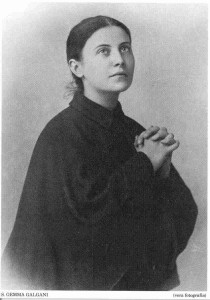 Burdened all her life by chronic illness, Gemma Galgani longed to become a Passionist nun, but was forced to surrender this desire to God when it became clear that her health would not allow it. She died on the 11th of April 1903, at the age of twenty-five. On this, her Feast day, let us ask for her intercession in discerning the will of God in the joys and disappointments of our lives.
The prayer of Saint Gemma Galgani:
O my crucified God, behold me at Your feet; do not cast me out, now that I appear before You as a sinner. I have offended You exceedingly in the past, my Jesus, but it shall be so no longer. Before You, O Lord, I place all my sins; I have now considered Your own sufferings and see how great is the worth of that Precious Blood that flows from Your veins. O my God, at this hour close Your eyes to my want of merit, and since You have been pleased to die for my sins, grant me forgiveness for them all, that I may no longer feel the burden of my sins, for this burden, dear Jesus, oppresses me beyond measure. Assist me, my Jesus, for I desire to become good whatsoever it may cost; take away, destroy, utterly root out all that You find in me contrary to Your holy will. At the same time, I pray to You Lord Jesus, to enlighten me that I may be able to walk in Your holy light. Amen.
Apr 11, 2015 |
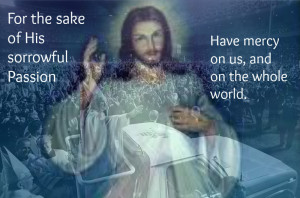
Eternal Father, I offer You the Body and Blood, Soul and Divinity of Your Dearly Beloved Son, Our Lord, Jesus Christ, in atonement for our sins and those of the whole world.

Apr 3, 2015 |
We adore You, O Christ, and we bless You. Because by Your Holy Cross You have redeemed the world.
Were Mary’s tears silent ones?
In the privacy of the space John made for her in his home, did the Blessed Mother ever get the opportunity to just let go and give voice to her grief? Perhaps, as she wept, she was struck by the fact that her sobs were the only sound she could hear… the surrounding silence that would have answered her own sounds of grief would surely have given rise to great sorrow.
Her Son lay dead in a tomb.
With the exception of those three days of anxiety searching for Him as a child in Jerusalem, she had never before experienced such a forced and terrifying separation from Him. That moment when they took His broken body from her loving arms and she watched them wrap Him in linen and place Him in the tomb, rolling a stone across the entrance way… it would have been a strange kind of closure which would have seemed to come too soon, too suddenly, even after the events that lead to His death. He really was dead. His burial, though rushed to accommodate the Jewish sabbath, was real… but what now?
The experience of that day Our Lord Jesus died would have been terrifying, dramatic, emotions would have been racing… but now that He lay dead in a tomb? Sudden silence. Eerie confusion, seasoned by the greatest depths of sorrow. Seeming nothingness.
The Sorrowful Mother knows silence and separation from her beloved Son only too well. During those times that I experience frustration in prayer due to a sense of separation from Him… when it seems He is absent, when the only language with which He communicates is silence, but it feels more like nothingness… I need not be alone. In turning to the Sorrowful Mother I have a companion who understands the distress of this experience, and yet she has hope in the belief that the Dawn of Compassion WILL break upon us.
And so she waits with me…
By AfterEpiphany.
Apr 2, 2015 |
We adore You, O Christ, and we bless You. Because by Your Holy Cross You have redeemed the world.
And bowing His head, He gave up His spirit.
I always breathe a sigh of relief when, during the Good Friday liturgy, we reach this line: the worst is over. Jesus has passed beyond the reach of His torturers, and nothing else can harm Him.
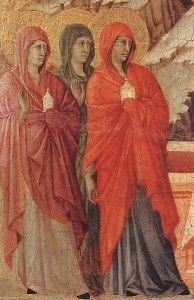
After a pause, the narrative is picked up again, but the focus has changed. Jesus is gone, the violent earthquake that ripped the Temple veil has passed, and we are left with the story of ordinary people doing small, practical things: finding a ladder to climb up and take out the nails, unfolding and laying out linen cloths, going into the city to collect fragrant oils and spices, and coming back up the hill to anoint the body. After the escalating violence of the Passion narrative, everything is suddenly still, quiet, and hollow.
We feel a pale reflection of the disciples’ loss every time we enter a church on Good Friday – the visceral wrongness of seeing the Tabernacle standing open and empty. You may have found that as Lent dragged to a close in the convent, the sense of hollowness was even worse, filling not only the chapel but also the cloisters and cells, everywhere that the Presence was supposed to be, but wasn’t. Every year, when Jesus in the Blessed Sacrament is gone, ordinary people must go on doing small, practical things in His absence: practising the chant, counting out candles for the service on Saturday evening, and replacing any wilting flowers on the Altar of Repose. And, above all, waiting. In the convent or out in the world, on Holy Thursday we watch and pray as the the Body of Christ is carried away from us, and we carry on quietly so that He will find us at work upon His return.
By Spiritu.
Apr 1, 2015 |
We adore You, O Christ, and we bless You. Because by Your Holy Cross You have redeemed the world.
The End
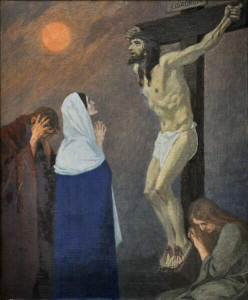
Can you imagine how the apostles and followers of Christ felt when He breathed His last breath? This was the end, the end of a journey, the end of a life, the end of Love. What were they going to do now?
We have experienced many endings in our lives, and most of us hold in common the ending of living the religious life. Yet here we are, still alive, in spite of all these “endings”; and, so also is Christ still alive after His “ending”! In truth, the end was the beginning; but, how do we survive these endings so we can make it to the beginning?
The answer to this one question is simple, in fact, it is only one word: trust. Jesus trusted the Father. He knew that His Father knew what He was doing, and that this ending, this death on the Cross was necessary. Jesus trusted in the Father’s Love for Him and for all humankind. Jesus knew that the Father would never leave Him alone. Jesus knew that the Father would not allow this ending to be an ending in the truest meaning of the word.
Do we trust the Father? Do we trust Him enough to realize that the endings we experience are not really endings, but beginnings? Do we trust that these beginnings will bring about the Father’s plan in a much better way? Do we trust Him enough to understand that He will never leave us alone and that He Loves us dearly?
Yes, endings hurt, endings bring pain, tears, and suffering. Look at the Cross: Jesus endured hurt that I cannot even imagine. He endured His death until the end, but thank God that that was not the end! And thank God that leaving the convent was not our ending either! He has great new beginnings for us in store, just as He had a wonderful beginning to the end of Jesus’ death, a beginning full of Easter-joy <3
Pax vobiscum
By Josephine.
Apr 1, 2015 |
Your human nature gripped by fear
Though union’d with Divinity
You grasp at root, at dust, at stone
Lor Jesus, on Your knees, alone.
The night so still, an eerie glow
interrupts shadows cast by the moon
No wind to sift through leaves below
Stark silence since the upper room.
As moments pass, chest heaves in pain
You see the wrong that I will do
Yet endure gladly for my stain
To draw my heart nearer to You.
Allow me, Lord, to come and help
You get up off Your knees
To wipe the blood-sweat off Your face
Your agony appease.
Not e’en one hour I wait with You
Now on Your knees again
I drift to sleep whilst You pour out
Your heartfelt plea for men.
Though spirit willing, flesh is weak
And my will, weaker still
You make me know it’s You I seek
that You alone fulfil
The night wears on and You, O Lord,
begin to tire from grief
Tormented by our hardened hearts
our sins, our unbelief.
I would not dare to interfere
with Your foretold redemptive act
But let me walk the way with You
At least in prayer if not in fact.
Now others to the garden come
Your victory will soon be won.
You freely choose the bitter cup
To torture and death You give Yourself up
Taken by thugs, betrayed by a friend
Your death: our bond with Father, mend.
By AfterEpiphany, written during her postulant year.

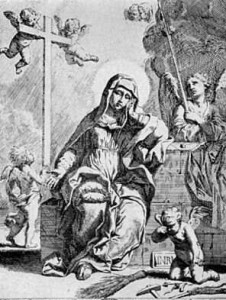 We adore You, O Christ, and we bless You. Because by Your Holy Cross You have redeemed the world.
 dramatic, emotions would have been racing… but now that He lay dead in a tomb? Sudden silence. Eerie confusion, seasoned by the greatest depths of sorrow. Seeming nothingness.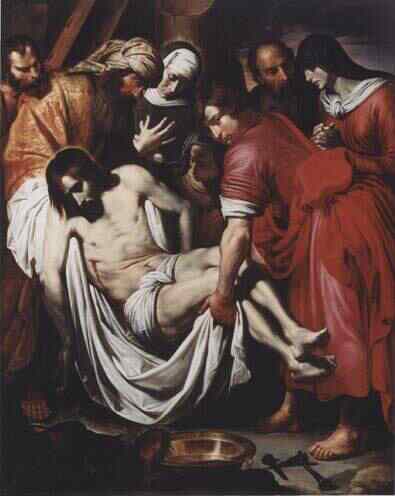
 the chapel but also the cloisters and cells, everywhere that the Presence was supposed to be, but wasn’t. Every year, when Jesus in the Blessed Sacrament is gone, ordinary people must go on doing small, practical things in His absence: practising the chant, counting out candles for the service on Saturday evening, and replacing any wilting flowers on the Altar of Repose. And, above all, waiting. In the convent or out in the world, on Holy Thursday we watch and pray as the the Body of Christ is carried away from us, and we carry on quietly so that He will find us at work upon His return.
 We adore You, O Christ, and we bless You. Because by Your Holy Cross You have redeemed the world.
 endured hurt that I cannot even imagine. He endured His death until the end, but thank God that that was not the end! And thank God that leaving the convent was not our ending either! He has great new beginnings for us in store, just as He had a wonderful beginning to the end of Jesus’ death, a beginning full of Easter-joy <3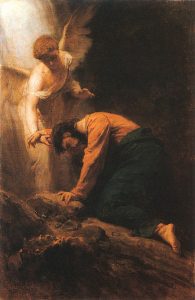
Recent Comments