Nov 26, 2014 |
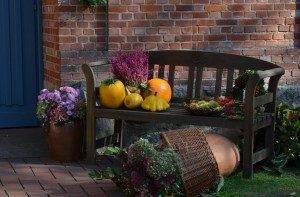
 O all you works of the Lord, O bless the Lord.
To him be highest glory and praise for ever.
And you, angels of the Lord, O bless the Lord.
To him be highest glory and praise for ever.
And you, mountains and hills, O bless the Lord.
And you, all plants of the earth, O bless the Lord.
And you, fountains and springs, O bless the Lord.
To him be highest glory and praise for ever.
And you, rivers and seas, O bless the Lord.
And you, creatures of the sea, O bless the Lord.
And you, every bird in the sky, O bless the Lord.
And you, wild beasts and tame, O bless the Lord.
To him be highest glory and praise forever.
And you, children of men, O bless the Lord.
To him be highest glory and praise for ever.
And you, spirits and souls of the just, O bless the Lord.
And you, holy and humble of heart, O bless the Lord.
Ananias, Azarias, Mizael, O bless the Lord.
To him be highest glory and praise for ever.
Let us praise the Father, the Son, and Holy Spirit:
To you be highest glory and praise for ever.
May you be blessed, O Lord, in the heavens.
To you be highest glory and praise for ever.
Wishing you all a happy and blessed Thanksgiving!
What are you most thankful for this year?
Oct 26, 2014 |
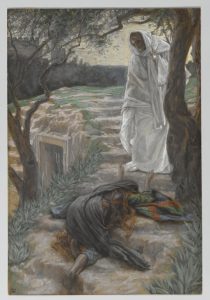
The Resurrection, by Misericordia
“Do not hold me, for I have not yet ascended to my Father; but go to my brothers and say to them, I am ascending to my Father and your Father, to my God and your God”
I’m sure many of us can relate to Mary Magdalene in this passage. We are close to Him, and finally find Him, and then He sends us off! It seems a bit harsh for Jesus to push her away and tell her to go to the Apostles. But He doesn’t really! He only wants to be closer to her. He wants to dwell in her very soul as He does in each of ours, and has an urgency to do so! (It can be frustrating in the Gospels how un-urgent Jesus can be- but here He makes clear that He desires to waste no time in order that He might be even closer to each of “His own” than He ever was and would be in His pre-Resurrected and pre-Ascended Bodies.) He gives to Mary- who represents those who are wounded and in need of healing (probably all of us), the mission to first trust in His being with us “always,” and then second to proclaim His Presence among us. We, like Mary, have seen the Lord and know of His Love and desire to redeem us and bring us to where He has prepared a place for us, and we are called to witness to this redeeming love. We may mourn the loss of the Call we “used to have,” that made us feel useful in the Kingdom of God. This transition is difficult: from an ordered life, with the Teacher right alongside you, to a new lifestyle of mission and motion, without constant assurance and instruction. However, neither is without the Lord, and both are filled with His Providence and Love.
In the last part of this passage, Jesus also says something else extremely important! He makes it very clear that has made His Father our Father, and His God our God. We are made sons and daughters of God, the Father, just as Jesus is! Can we even understand this? St. Paul says that we are sons (and daughters) and coheirs of God- and we are! Because of His Love for us, He suffered and died so that we could be brought into the family of the Trinity. He wants us to live out of that reality right away, and this is why He is so urgent! He wants His brothers and sisters to believe so that they can accept Him into their very souls at Pentecost when the Holy Spirit descends upon them. He wants each heart to be prepared to receive Him in Word and Sacrament.
Know that He dwells in you, that you are sacred because He has made you so. You do not need to “become” good enough for Him to dwell in you- surely He already has and does and will continue to dwell in you! Let yourself experience the Loving Gaze of Jesus, ask for the Confidence and Trust to let go of this world and your “securities” that you “hold onto” and live in the joy and freedom of Him dwelling in you and leading you into Hope, Healing, and one day our Heavenly Homeland!
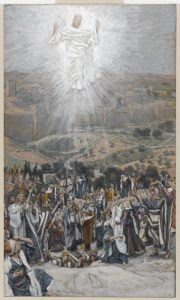
The Ascension, by Misericordia
I can’t imagine the emotional roller coaster of the disciples after Our Lord’s Ascension into Heaven.
-First they find Jesus and He calls them all from different walks of life, and they follow Him.
-They are probably looking at each other confused as to why the other is chosen, and/or why they themselves are chosen, but they still follow Him.
-As they journey with Him He challenges them to live a life of continual conversion, persecution, and difficulty, but they still follow Him.
-He sometimes goes off to pray without them, but they still follow Him.
-He sometimes preaches against the teachings of the religious and political leaders of the time, but they still follow Him.
-He foretells His Death and turns out not to be the conquering warrior Savior they thought, but they still follow Him.
-He is captured, tried, condemned, and crucified, but they still follow Him.
-Then He rises from the dead and comes back to them, and after proving it was really Him they follow Him.
Then He Ascends into Heaven… now what? They felt the same feeling we often feel… what now Lord? Where are You? If you don’t make Yourself Present to me, how am I supposed to know Your Will?
I won’t elaborate on the Holy Spirit, since that’s the next Mystery. But I think it is true that the Lord gives us this time of anticipation, to remember what the Lord has done for us so that we can reflect and then recognize the graces that are to come. We often get anxious, wondering how we can still follow Him. But if we look at what the disciples did, they gathered together with the Blessed Mother. I imagine they prayed, talked about what great things the Lord had done for them, and made proposals for what they would do when the Lord would send them out at Pentecost. So what can we do in times of transition? Three things come to my mind. In imitation of the disciples: pray, reach out to those who can support us- including the Blessed Mother, and give yourself time to process and reflect. From this time of prayerful reflection with the guidance of others we can gain insight as to what He might have planned for the future, and prepare for His coming. Anticipation is hard, but even in that time, we still follow Him.
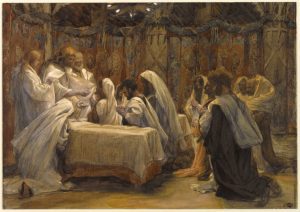
Pentecost, by Misericordia
When I was confirmed in eighth grade, I was not even slightly aware of the power of the Sacrament I had just received. Our class was more excited about the names we were taking, the dresses we were wearing to the Mass, and the party following! I did a small research paper on my saint, and memorized the beatitudes and gifts of the Holy Spirit for the test…quickly forgetting them after the exam that no one actually failed.
I think of this in comparison to what the Apostles experienced on Pentecost. Tongues of fire, rushing wind, Peter (not the brightest crayon in the box) speaking different languages…pretty amazing!
God chose to come to the Apostles in a rather dramatic scene, but we are no less anointed! Even if we were confirmed nonchalantly or don’t feel a sense of our own mission, we still possess the same spirit. Upon receiving the spirit, Peter proclaims,
“”It will come to pass in the last days,” God says,
“that I will pour out a portion of my spirit upon all flesh.
Your sons and your daughters shall prophesy,
your young men shall see visions,
your old men shall dream dreams.
Indeed, upon my servants and my handmaids
I will pour out a portion of my spirit in those days,
and they shall prophesy.””
We can feel removed from the Lord, Mary and the Saints, and those who are not (yet) saints but do “great” things – that we are not good enough for “great” things, since we don’t speak in tongues or see visions or have dreams…this makes me think back to the Magnificat. I know, wrong Mystery, but Our Lady makes an important point! “The Lord has looked with favor on His lowly servant, the Almighty has done great things for me, and Holy is His Name”… You see, Our Lady and the Apostles show us that our lowliness and our littleness allows more room for transformation in Christ. In the words of John the Baptist: “He must increase, I must decrease.”
Transition can make us belittle ourselves and we can become afraid to be “evangelically bold” as Pope Francis would say, because we see ourselves as failures. But lets turn again to the Apostles. Might they have felt something similar? And did the Lord withhold from them an outpouring of His Spirit? And did the uncertainty of the specifics of their mission and where it would lead them prevent them from doing God’s Will?
I hope that in meditating on this Third Mystery of the Glorious Mysteries that you all will become more aware of the glory God has revealed through you and that all fear will be banished from your hearts, so that you may say with Peter, who quotes Psalm 16:
“Therefore my heart has been glad and my tongue has exulted;
my flesh, too, will dwell in hope,
because you will not abandon my soul to the netherworld,
nor will you suffer your holy one to see corruption.
You have made known to me the paths of life;
you will fill me with joy in your presence.”
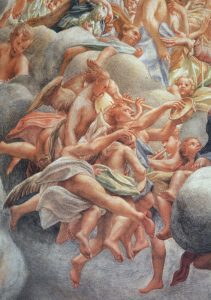
The Assumption, by Cinnamon
I entered the convent on a scorching hot Friday afternoon, which in some ways made what followed inevitable. After a glass of lemon squash and a quick catch-up, the Sisters and I headed over to the local church for the 3 pm Rosary. Hot day, stuffy church, tired traveler… suffice it to say that halfway through the Sorrowful Mysteries, I began my postulancy by falling dramatically at the Sisters’ feet.
Afterward, I wanted to stay and finish the Rosary (sitting, though, not kneeling), but was instead gently chivvied off to my cell for a lie-down. That was my first experience of religious obedience, and also of the comparative willingness of the flesh versus the spirit. Many more such lessons followed: a few months after I entered, I caught a flu that came back repeatedly and brought seven others worse than itself every time, eventually hampering my ability to keep up with community life. It’s easy to become a Gnostic when you want to be at Matins with the community, and instead you’re stuck in bed with only a packet of aspirin for company: to see the body as something useless that drags down the soul and hinders its service to God.
The Assumption of Mary is a direct challenge to that mindset. It reminds us that both the body and soul are important and valued by God, and created for His service. Instead of “liberating” Mary’s soul and letting her body corrode, God raised her whole being to Himself: the body that had borne Christ, and the soul that had suffered with Him on Calvary. Both body and soul were her, and neither could have been discarded.
Moreover, Mary’s Assumption is a sign of our own future resurrection – like her, we will one day worship God with souls and bodies rejoined forever. We are designed to long, not for liberation, but for completion. In the meantime, suffering of the body (weariness, illness or injury) and suffering of the soul (loneliness and loss after leaving the convent life) can be brought to God as an offering, and the Author of our bodies and souls will accept both with love.
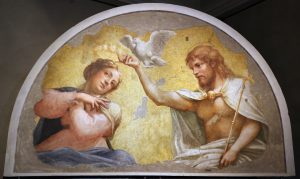
The Coronation of Mary, by Cinnamon.
Here’s a confession: I’ve always found it difficult to concentrate while praying the Rosary. “Hail Mary, full of grace… mustn’t forget to buy bread on the way home. The Lord is with thee. Wholemeal.” In the convent, saying five Mysteries daily, these distractions got worse instead of better.
Eventually, though, I developed a system that helped me to focus: I would link the different sets of Mysteries. For example, when meditating on the Finding of the Child Jesus in the Temple, I would let my mind drift back and forth between the image of Mary finding and embracing her twelve-year-old Son, and the fourth Sorrowful Mystery in which He embraces her on the road to Calvary. (I’ve also discovered that this works really well as an antidote to sickly sweet hymns and carols. For example, try singing Away in a Manger with your gaze fixed on a crucifix. I guarantee the words “No crying He makes” will suddenly send a chill down your spine.)
This final Glorious Mystery, the conclusion of the Rosary, is a beautiful one in which to search for parallels. At the beginning, I compared it with the Crowning of Christ with Thorns – seeing both the dignity with which Christ bent to accept His painful crown from mankind, and the quiet, grave expression of His mother as He placed the crown of stars upon her head in heaven. Later, I began to join it instead with the Mystery that began the whole story that unfolds throughout the Rosary: the Annunciation. Once, years before, the archangel Gabriel had called, “Hail, full of grace!” to a humble young woman from Nazareth – was this his greeting as he bowed before Mary, Queen of the Angels?
“The Holy Spirit will come on you, and the power of the Most High will overshadow you.” She kneels before her divine Son, who raises the crown high above her, then lays it upon her head forever. “I am the handmaiden of the Lord,” she says. “Be it done unto me according to Thy word.” The Rosary is complete.
Oct 21, 2014 |
By Misericordia
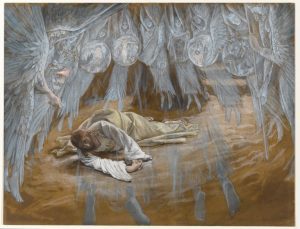
The Agony in the Garden
Most of us know the concept of solitude and the silence, and many of us have even lived extended periods during retreats or in our ways of live in Religious Life. Yet we know that connection with others is essential. Even Jesus, during the most excruciating days of His Life on earth desires to be with those closest to Him, including the one who would betray Him and those who would desert Him out of fear. In the Agony in the Garden we see Jesus suffer intense loneliness and desolation. He experiences the pain of our sins and the effects of those sins on our closeness to Him. And then, the disciples to whom He entrusts Himself the most, even they disappoint Him.
This intimacy with the Lord is something all of us have sought after, and yet even after being with the Lord in His suffering and our own, we now find ourselves outside of this life of tangible closeness. It is similar to my own familiar feelings of being chosen last for kickball, being left out of conversations and social events, or there being no room at any lunch table for me…those earthly heart-wrenching experiences of not belonging.
But it is in this context that we do in fact belong to Jesus. He felt intensely this rejection by the world, by His own friends who were with Him almost until the end, who saw Him cure leprosy and other ailments, raise people from the dead, forgive sins, claim authority over the Temple! No other prophet had done these things! Yet, Jesus was alone in the Garden without a hand on His shoulder or an encouraging word. He may have felt forgotten by His slumbering comrades, bringing back the painful memories of there being no room for Him in the inn, no room in His home town for His preaching, and no room in the hearts of His best friends.
Here, we can intimately unite ourselves with Jesus. Although He knew more than anyone the value of being alone with His Father in prayer, He too desired to be with others in His suffering. Whether we’ve left the convent or seminary, or experienced another life change or seeming failure (emphasis on seeming), it is in these very struggles that the Lord dwells. In these moments we are most configured to the suffering Christ as well as united to all of those suffering in the Mystical Body.
I hope that you all will be consoled by the truth that our sufferings and our loneliness is not for nothing. Each is an opportunity to choose Jesus as our most intimate friend and place ourselves in that Garden to console Him when no one else had the courage to do so.
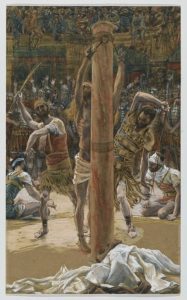
The Scourging at the Pillar.
When I was studying in Rome in college I had to opportunity to visit many Churches. The Basilica of Santa Prassede was one that I will never forget. It was easy to miss given that it was very close to the Major Basilica of Sancta Maria Maggiore, and many other tourist hot spots! But this Church in a busy corner of the Eternal City contains the Pillar where Jesus was scourged. It was amazing to stumble upon this sacred relic upon to which the Sacred Body of Jesus was chained, and upon which His Blood was spattered.
There is little expansion on the Scourging, but we can imagine the gruesome of this Sorrowful Mystery. In the Gospel of Matthew, the Jews have just chosen to release Barabbas (a murderer) instead of Jesus, Pilate washes his hands of the Blood of Jesus, and then Jesus was led “like a lamb to the slaughter.” The people cry out, “His blood be upon us and our children.” I don’t think the Jews realized that God would quite literally take them on their word! For, each time we celebrate the Sacrifice of the Mass we take His Body and Blood into us. And counter-intuitively it is this blood that makes us worthy, that sanctifies us and cleanses us of our sins.
Many of us have a reaction to the sight of blood, I know I do! But when it comes to the Blood of Jesus, I feel consoled. Why is this? Why don’t I get grossed out like I do in the opening scenes of every crime scene TV show? Well, all I can speak for is myself here, but I think the blood of Jesus strikes us with the reality by which we are saved. We see His Life poured out for us, only saving a few drops for when the lance would pierce His Heart on the Cross.
Let us receive the Blood of Christ and ask for it to “be upon us” since we know that this Blood is the means by which we are redeemed that paid the price for our salvation.
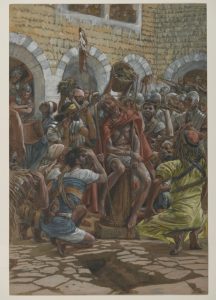
The Crowning with Thorns
It is interesting that in this Mystery of the Crowning with Thorns, that instead of being called the “mockery” it is called the “crowning.” This focus on the crowning is, to me, a consolation in the middle of the Sorrowful Mysteries, a reminder that it is not for nothing that Jesus is suffering, and that His Kingdom is in Heaven. This Mystery reminds me that the Sacred Head that deserved the finest crown decked with every kind of gem and jewel- though it first received a crown of painful thorns- would eventually receive that resplendent crown after the Ascension.
As many of us have endured the seeming failure of leaving religious life, we might put on a chapel veil, hat, baseball cap, etc. and mourn at the fact that there is no long beautiful veil there. These head coverings mock us. There is something special about the head and head coverings all throughout history and in most world religions. It signifies identity and belonging. As people of faith, we wish to bear an outward sign of what we belong to, of who we belong to. Jesus, though, reveals something powerful in this Mystery. He unites Himself to us in his suffering and mockery, in being crowned by something that does not correspond to His true dignity as the Son of God. But more importantly He shows us the foreshadowing of what would soon occur when the Son of God Ascends to His Father’s Right Hand, and is crowned in splendor and glory.
We too possess a share in His dignity, as sons and daughters of God, and even if we never get to wear that veil with which we so desired to be adorned in Religious Life, we already bear in our souls the sign of our identity in Christ. How we love also reveals the One to whom we belong. And one day, God-willing, we will all be crowned in Heaven as we are received as co-heirs with Christ in the Heavenly Kingdom.
Carrying the Cross
This might sound odd coming from a former religious sister, but my least favorite time of year is Lent. I know that there are some people who love Lent, but I am not quite there yet! I wish I could say that I love praying the Way of the Cross…but it’s always hard for me. Newsflash: suffering is hard!
Part of this difficulty is feeling incapable of doing anything to console Jesus in His Suffering. Am I just supposed to watch Him die because of my sins? I want to stop them from killing Him, but it has already happened. I think what Jesus wants in these periods of meditation and reflection on the journey to Calvary, is for us to insert ourselves in the story. We can participate actively in prayer, by helping to carry the Cross like Simon, by caring for Him like Veronica, by weeping like the Women of Jerusalem, by staying with Him like John, and (the prime example) by suffering with Him like Mary. When we enter this rather dismal scene we can experience make acts of faith and hope with those who followed Him. We can receive the love that would later be poured out for us on the Cross, cleansing us and making us worthy of Him.
May this Mystery of the Rosary be for us an encouragement for all of us who seek to follow the Lord, because we have many examples in this passage of Scripture where we see how others have ministered to the Lord in His Via Crucis. Here we gain insight on how we are to follow the Lord in our Cross in imitation of Him.
The Crucifixion
As a college student and even in the Convent there was a hype about a book called, The Five Love Languages. There is a lot of truth to this, but I couldn’t help but roll my eyes sometimes… really? In the Convent? What it taught me is how I desire love, how I can love, and how Jesus fulfills in a perfect way all of these modes of loving. He serves, affirms, gives gifts, touches us, and LOVES spending quality time with us.
But the one language that I am most struck by is Sign Language. My parish has a sign language interpreter, and although I know very few signs I do know one: Jesus. What is the “sign?” It is the touching on the palm of each hand with the opposite hand where the nail marks of the crucifixion are. This sums up who Jesus is to us- He is the one who suffered and died for love of us, who bore the marks of crucifixion and bears them even now in Heaven! This is the ultimate love language, as well as the 5th Sorrowful Mystery of the Rosary.
As we meditate on this mystery we ponder the Suffering of Our Lord, not with despair or guilt, but with gratitude for our Savior and faith that our wounds may also be glorified in Heaven. There will be no shame or sorrow or regret but the delicious aftertaste of suffering, the fruit of perseverance, the reward for our faith in the midst of trial.
May we love God in the unique and particular way in which we were created, and may we imitate Him, so that in Heaven the “sign” for each of us is our suffering and woundedness glorified by the One who has saved and redeemed us and given us the grace to endure all things.

 O all you works of the Lord, O bless the Lord.
 Grant, Lord, we pray
 The Resurrection, by Misericordia
 The Ascension, by Misericordia
 Pentecost, by Misericordia
 The Assumption, by Cinnamon
 The Coronation of Mary, by Cinnamon.
 By Misericordia
 The Scourging at the Pillar.
 The Crowning with Thorns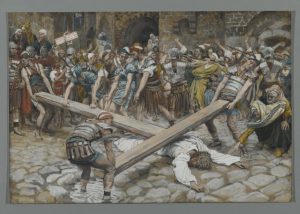
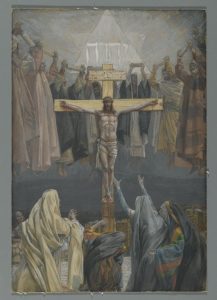 The Crucifixion
Recent Comments