Jan 4, 2015 |
 By Dee Bernhardt.
My beloved speaks and says to me: “Arise, my love, my beautiful one, and come away”…
Song of Songs 2:10
As a single lay woman working full-time in church ministry, I have often had my vocation questioned… “So, when are you going to commit?” or “You just haven’t found the right man to marry yet.” or “When are you going to get a real life?” Often, parish members assume that I have suffered some terrible trauma that caused me to remain single. Yet, I am single because my greatest joy is in serving many others, and I love best when I love broadly. And over the past thirty-plus years, I have experienced that my deep passion for loving and serving others meets a very deep need, especially in the young adults I encounter on college campuses through campus ministry and the ministry of spiritual direction.
In a sense, I belong to a sisterhood because I actually have seven sisters (and three brothers) in my family of origin. When thirteen of my friends all decided to join religious orders upon graduation from college, I wanted to fit in and do it too. I tried. I realized that I already had a community of sisters by birth, and that was enough sisterhood for me. By God’s grace, I became one of the first lay ministers in the United States as a campus minister, and I have been in that role ever since, growing in ministry over time.
John Cardinal Henry Newman once wrote a short poem encapsulating the call to holiness for the laity:
I sought to hear the voice of God;
I climbed the highest steeple;
But God declared: “Go down again.
I dwell among the people.”
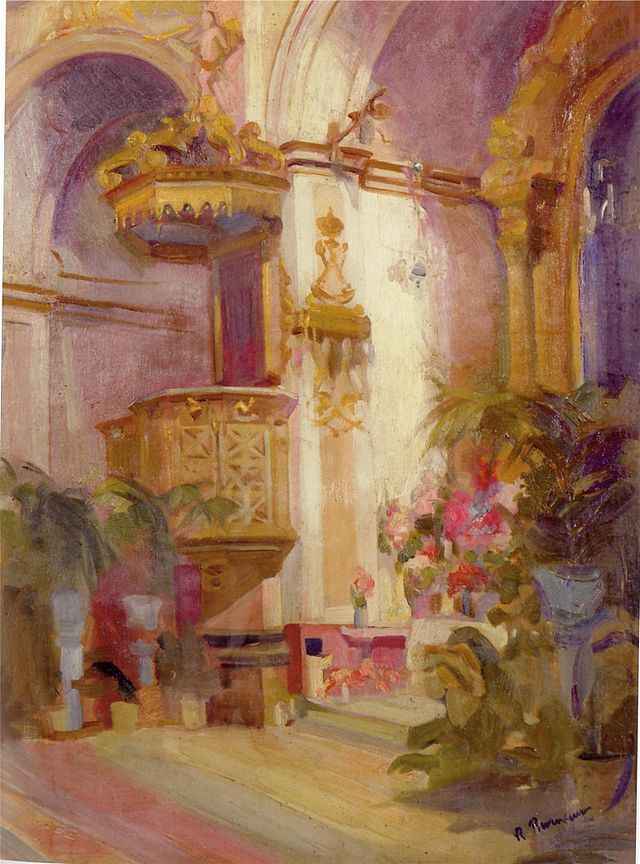
In our lives, we all seek the high steeple at times. Sometimes, we even make life commitments which encompass that idea of a “higher calling.” But when we consider the incarnation of Christ and the reality of our world, we realize that there are different callings, none of which is higher than any other. In fact, if you’ve ever read “Hope for the Flowers,” you know that the top is often the most disappointing position of all!
In our church, vocations to religious life and priesthood are often seen as the top. Bearing in mind that the humble parentage and birth of our Lord clearly exemplify simplicity and humility, we come to recognize that our inner dispositions determine how we hear the voice of God, which then influences our attitudes toward external life choices. Every lifestyle and vocation requires sacrifice; every one inspires joy. Each lay person (single or married), religious woman/man and/or priest believes strongly and doubts often; lives deeply and survives shallowly; loves fully and fails miserably. This is our human condition – which binds us all in the mystical body of Christ.
Dee Bernhardt is the Assistant Director of Campus Ministry at St. Thomas Aquinas Catholic Center, West Lafayette, Indiana.
Dee holds a Master of Science in Religious Education degree from Marywood College and a Master of Arts in Christian Spirituality degree from Creighton University. She holds professional certifications in Campus Ministry from the USCCB/CCMA and in Spiritual Direction/Directed Retreats from Creighton University.
She has served as national and regional advisor for a total of over 18 years on NCSC leadership teams, and believes in the empowerment of communities to bring the Church to life in higher education.
Dec 29, 2014 |
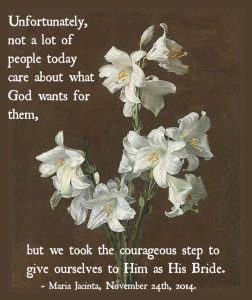
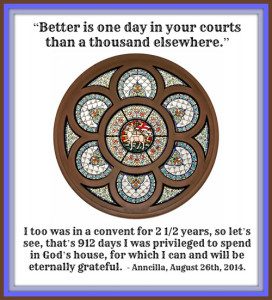
Throughout the year, readers have left many beautiful and insightful comments on the Leonie’s Longing blog. We thought that they deserved a post of their own!
Image credits:
St Veronica image used under Creative Commons licence. Owner: GuentherZ.
Traffic at night image used under Creative Commons licence. Owner: Sebastian Grunwald.
Agnus Dei Window released into public domain by Pastor David Castor.
Dec 12, 2014 |
By Maria Jacinta.
“Humility, humility and humility.” This was St. Bernard of Clairvaux’s response to the question of what the three most important virtues are. During Advent I only pray the Joyful Mysteries of the Rosary. I love meditating on Our Lady’s humility when she immediately gave her yes to God at the Annunciation and when she humbly responded with her Magnificat during the Visitation. It is beautiful, but it really baffles me as to how someone without sin could be so humble. My point in this post is not to preach about the importance of humility, but to address its vice: vanity.
In the initial days of being home from the convent, vanity was a real struggle for me, among other things. I believe it was triggered from my reaction to being back in the world. In the convent, I had one outfit to wear every day, and I did not need to spend time fixing my hair. Vanity was not too much of an issue. Now being back in the world, I cannot wear the same thing every day. I have to fix my hair. I have to look nice. All this became an obsession for me. Ah!!! What to do?!
Thanks be to God, I came up with two solutions. If any of you have any other ideas, please do not hesitate to post them.
1) In my last post “Guard Your Heart”, I talked about my struggles with dealing with young men. I noticed that when I would go to Mass I would be focused on if any young men were there and if they would see me and how nice I looked. Yeah, I know, pathetic, right? Well, to help deviate my attention from that I got back into the habit of wearing a veil at Mass. This actually helped to lessen my focus on my hair and my looks so that I could be more focused at Mass. It is amazing! It is a very humbling experience to cover your head.
2) This may sound contradictory, but I also find that dressing nice does help. To learn to overcome vanity, it is easy to play the false humility card and dress like you just rolled out of bed. It dawned on me that we were created with dignity as women of God. We should not be ashamed of our beauty. When I began to wear skirts more often and make myself decently presentable, I noticed my self esteem go up. Obviously, I need to be careful, as I do not want to get too inflated. I try to keep the focus that I am dressing for God and God alone. If you are having trouble finding nice modest clothes, I find that Ross and Good Will (or thrift stores) are good. The prices are not too bad either!
May Our Lady clothe us with her humility. Blessings to you all this Advent!
Oct 27, 2014 |
… There I met, of all people, a marketing hotshot who held up to me the image of my former faith-filled, fearless self, and said, in the voice of God: “I blinded you to your future a second time, after you were converted to Me, and you responded in exactly the same way as you did when you did not know Me at all. Trust Me!”
Now that I am (relatively!) firmly established in my degree program and my career track, I often think back to that moment in the meeting room. Not because that moment marked the abolition of all my fears. It certainly did not. But, from that moment on, I became intensely and deeply aware of my fear, of what precisely I am afraid of, and why. I still have fears today, but through that heightened awareness of them, I’ve come to realize that my fears have changed shape over the years.
For one, they no longer have anything to do with failure: I’ve been there and done that now. Strangely, incomprehensibly to most people but, I think, not to “Leonie’s Ladies” these days I’m afraid of succeeding.
As a now deeply religious person, I don’t really feel at home in academia. So I fear that academic success will turn me into…[dom Dom DOM]… a “real” (secular!) academic. At the moment, I am deeply convinced that what academics do is relatively unimportant and makes practically no meaningful contribution to society. However, I am academic-y (read: geeky) enough already to know that someone who becomes successful in something that they feel is pointless experiences “cognitive dissonance”; that it is practically a psychological law that we try very hard to avoid cognitive dissonance; and that the only way to resolve cognitive dissonance is to change either one’s behaviors or one’s beliefs. What that means for me is that, if I become an academic success, I will either have to renounce my success in order to experience peace within myself, or else I will have to change my beliefs about the value of my work. Having already experienced several major career implosions in my life, the first change is not really an option for me. And when I imagine the second, I see myself turning into one of those professors who basks in the meaningless, prideful prestige of their 25-page publication list.
In short, I fear that success in the world will turn me into something that I am not and that I do not ever want to be. I fear that it will make me value things that I do not value, that, in fact, I see as fundamentally unchristian. And I fear that, like most other things in the world, success will be impersonal and fleeting, and will ultimately chew me up and spit me out.
In the face of those prospects, how could I possibly want to succeed at what I’m doing? And yet, I cannot simply embrace failure: I have to survive somehow. But how a deeply faithful Catholic survives, much less succeeds, in the secular world without “selling out”, without compromising her soul or even just her human dignity, without putting God and Church and the pursuit of virtue second or even third, I have yet to figure out. And frankly, that scares the life out of me.
Ladies, are you afraid that succeeding in the world, that really giving yourself wholeheartedly to some non-religious endeavor, will turn you into a lesser Christian? Have you found ways to make a living (and maybe also a difference!) without sacrificing the depth of your faith, or the richness of your faith life? If so, please share below!
(Did you miss the previous posts? You can read Part 1 or Part 2 by clicking the links)
J. E. Sigler is the Vice President (+ Blog Mistress Emerita) of Leonie’s Longing and a doctoral student in the Brian Lamb School of Communication at Purdue University. She has never been in religious life, but she spends a whole lot of time with nuns. For a summary of her Master’s thesis research with 35 sisters, view her TEDx talk here: https://www.youtube.com/watch?v=9m5Ek34BROE&list=PLsRNoUx8w3rPODRo_T8DNdXCWrm7m9jSa&index=12.
Oct 5, 2014 |
By Spiritu
I remember reading once that, if someone in the Middle Ages recovered from a severe illness after having been given the Last Rites, popular superstition considered that his earthly life was actually over: among other restrictions, he was not permitted to marry, to make a will, or to eat meat. *
Without wishing to seem morbid, when I left the convent, I began to understand a little of what those people would have felt as they muddled around after their recovery, trying to make sense of a world with which they were supposed to have finished. While getting ready to enter the religious life months earlier, I had realised why a former colleague – now a nun – said that in a way it felt like preparing for death: once my date of entry was set, I stepped into some strange area outside the regular flow of life, knowing that I was on a limited time-frame. I’d look in shop windows at racks of clothing, and realise that even if I bought anything, I wouldn’t have a chance to wear it. At the supermarket, I’d buy the smallest possible jars of honey or peanut butter (even though it was more expensive) because that way, I’d be able to get them finished in time. Also, of course, I was hauling bag after bag of clothes and books to the op-shop, leaving my closet looking stripped and abandoned… and most of all, my friends and family were holding small parties to farewell me, knowing it might be a long time before they saw me again.
And then I left. And then I was back.
Good grief, the noise! I’d lost the ability to tune out background music, the chatter and footsteps of passers-by, the rumbling and honking of cars, the clattering signals at pedestrian crossings… I couldn’t believe I’d ever been able to ignore so much noise. Advertisements on TV and billboards seemed surreal: having barely handled money for over half a year, I couldn’t believe that I was once again being marketed to. Visiting the places where I used to live or work was more like walking into a memory than living in the present, and everything I read/watched/listened to was something I had consciously, willingly, given up for good. None of it made any sense.
Of course, true death to the world only occurs during the rite of final profession, as the religious lies beneath a funeral pall while the Litany of the Saints is sung. So, what about the rest of us, who didn’t make it that far but still feel as if we’re no longer really part of the outside world?
For one thing, the experience gave me a taste of what being “in the world, but not of the world” feels like. It’s probably a good thing to feel slightly distant from the things you’re shopping for, to be able to step back from the advertising and think, “Seriously? They’re trying to make me want this thing? Do I want it?” It’s definitely a good thing to be able to sit back while sending a text or surfing the net and say, “You know, I lived for half a year without this and didn’t miss anything important.” And it’s wonderful to put your arms around your grandparents in the knowledge that, in other circumstances, you might not have seen them again. Basically, the world becomes unexpected: having lived outside it, you can’t now take it for granted, and whether that’s ultimately good or bad is defined by your response to it.
*See The Catholic Encyclopaedia chapter entitled ‘Subject’, paragraph 3. http://www.newadvent.org/cathen/05716a.htm.
At the age of seventeen, Spiritu watched some elderly nuns laughing together after Mass and decided instantly that this was what she wanted to do with her life. After six years of intense study about the Catholic faith and the religious vocation, she entered a beautiful community in her own country, Australia. Seven months later, she returned to the world, saddened that her discernment hadn’t worked out as she’d hoped. She is now exploring other possible options for the future, and owes an enormous debt of gratitude to her family for their love and help.
Sep 21, 2014 |
By Anela, reproduced with kind permission from her blog http://anelafindshervoice.wordpress.com
Sometimes it’s funny, being known around the office as “the ex-nun.” My coworkers and I will be having a conversation, specifically about work or about life in general, and one of them will let fly something a little off-color. They’ll stumble to a halt in mid-sentence, or a sentence (or an hour) or two later, when they realize just what they’ve said in the presence of “the ex-nun.” Then they’ll apologize: sheepishly, sincerely or even offhandedly. I take no offense at their slips, although I have felt a bit uncomfortable on several occasions. When that happens, I usually end up offering up a silent prayer of apology to Our Lord on their behalf.
It’s a strange thing, but I’m grateful for the awkwardness these moments bring, because the culture we live in today has become so desensitized to issues of modesty and morality. We live in a culture whose mantra is “Sex, power and no responsibility.” We’re bombarded with images and messages that harm us physically, emotionally and spiritually every single day… and the majority of people buy into the message simply because society tells them they should.
Maybe when the people around me pause in that moment of awkwardness, they’ll take a moment to reevaluate the lies that society has told them are true. Maybe they’ll come to realize that they’re truly worth so much more than society leads them to think they are.
And maybe, just maybe, this “ex-nun” will be reminded that, just because I no longer wear the habit, live in community or keep the daily horarium (Latin for “the hours” – a schedule of work and prayer), doesn’t mean that I’m not still a beloved spouse of Christ or that I don’t need to remember that I am called to “live in the world” but not be “of the world.”
We all are.
But I still miss wearing the habit. Imagine the self-censoring that would go on in the office if I suddenly showed up in one?

 By Dee Bernhardt.


 By Maria Jacinta.
 with dignity as women of God. We should not be ashamed of our beauty. When I began to wear skirts more often and make myself decently presentable, I noticed my self esteem go up. Obviously, I need to be careful, as I do not want to get too inflated. I try to keep the focus that I am dressing for God and God alone. If you are having trouble finding nice modest clothes, I find that Ross and Good Will (or thrift stores) are good. The prices are not too bad either!
 into…[dom Dom DOM]… a “real” (secular!) academic. At the moment, I am deeply convinced that what academics do is relatively unimportant and makes practically no meaningful contribution to society. However, I am academic-y (read: geeky) enough already to know that someone who becomes successful in something that they feel is pointless experiences “cognitive dissonance”; that it is practically a psychological law that we try very hard to avoid cognitive dissonance; and that the only way to resolve cognitive dissonance is to change either one’s behaviors or one’s beliefs. What that means for me is that, if I become an academic success, I will either have to renounce my success in order to experience peace within myself, or else I will have to change my beliefs about the value of my work. Having already experienced several major career implosions in my life, the first change is not really an option for me. And when I imagine the second, I see myself turning into one of those professors who basks in the meaningless, prideful prestige of their 25-page publication list.
 Ladies, are you afraid that succeeding in the world, that really giving yourself wholeheartedly to some non-religious endeavor, will turn you into a lesser Christian? Have you found ways to make a living (and maybe also a difference!) without sacrificing the depth of your faith, or the richness of your faith life? If so, please share below!
 crossings… I couldn’t believe I’d ever been able to ignore so much noise. Advertisements on TV and billboards seemed surreal: having barely handled money for over half a year, I couldn’t believe that I was once again being marketed to. Visiting the places where I used to live or work was more like walking into a memory than living in the present, and everything I read/watched/listened to was something I had consciously, willingly, given up for good. None of it made any sense.
 For one thing, the experience gave me a taste of what being “in the world, but not of the world” feels like. It’s probably a good thing to feel slightly distant from the things you’re shopping for, to be able to step back from the advertising and think, “Seriously? They’re trying to make me want this thing? Do I want it?” It’s definitely a good thing to be able to sit back while sending a text or surfing the net and say, “You know, I lived for half a year without this and didn’t miss anything important.” And it’s wonderful to put your arms around your grandparents in the knowledge that, in other circumstances, you might not have seen them again. Basically, the world becomes unexpected: having lived outside it, you can’t now take it for granted, and whether that’s ultimately good or bad is defined by your response to it.
Recent Comments