Five Years of Leonie’s Longing!
Thank you to all our volunteers, supporters, and friends! We’ve made a video to celebrate, and hope that you enjoy sharing this milestone with us!

Thank you to all our volunteers, supporters, and friends! We’ve made a video to celebrate, and hope that you enjoy sharing this milestone with us!
By Mouse.
I’ve been following the work of Leonie’s Longing for a few years now, even though I’m having the opposite problem from many others who might read this: my circumstances mean that I am having a hard time *entering* a convent, rather than transitioning out of one. I’ve been discerning a call to consecrated life for 4 years and counting…what a wild, unexpected, eye-opening, hilarious, frustrating, love-filled adventure!
The soundtrack to much of it has come from one of my favourite artists: Audrey Assad. I donated to a crowdfunding campaign for her new album Evergreen a few months ago. Thanks to the behind-the-scenes glimpses she gave, I knew most of the words before it was released to donors at the end of January. (Now it’s available for the wider public – on iTunes, Spotify, and other major services.) I’ve had a lot of time to contemplate the lyrics, and have found them to be a blessing in this current “stagnant” season of my discernment. I’ve found myself asking “Is God working, when I haven’t seen any ‘progress’ towards His plan for me in months? Is He still there?”
I suppose it’s not that different “on the other side” of the convent…thinking that God’s plan was for you to live in a religious community, when, at least for a time, you’ve been called back out into the lay world with no idea of what’s next. As I wrestle with Him, I’m grateful to know that at least one other Catholic out there has admitted that faith doesn’t come easy for her. Kudos to Audrey for being been brave enough to share her story in a culture that expects faith to provide constant happiness and easy answers. I thought a song-by-song review of the album was the best way to pass on what her prayers have taught me.
#1 – Evergreen – The album opens with one of the most perplexing ideas of our faith: God on a cross – who would have thought it? This place looks nothing like Eden. And yet the Cross – and our God exhausted, suffering, totally spent as He’s on it – is what saves us and brings us to new life. We meet someone who has not completely worked through a trial in her faith yet, but is learning to find God in the strange, unknown, untamed places He has led her. Here in the wild, my hands are empty, and yet I’ve had all I needed. There is no drought out here in the desert; I’ve found a water that’s living. Out past the fear, doubt becomes wonder…rivers appear and I’m going under…” I get the sense that the struggle could have destroyed her, but didn’t. In having no other option but to trust God, she has learned that he can be trusted. Instead of asking whether God will provide for her, she is amazed to find out how. The tree of life is evergreen, indeed – remaining with us, showing us that divine life and love will have the final word, even when all seems lost.
At first, I thought these words were an odd choice to begin the album. Why start with a song about seeing the light at the end of the tunnel? But I’ve come to see it as encouragement from a friend, saying “I’ve made it through the worst part of this situation and grown in it. You can too.”
#2 – Deliverer – If you read the lyrics the way I did originally, you might be a bit shocked. You are not possessive; You respect all things. You are not invasive; You have no envy. You are not insistent…And then your mind, like mine, might ramble for a bit… “WHAT!? Aren’t You supposed to be…well…jealous? Aren’t You supposed to invade and ruin our ideas of what is good, right, true, and brings joy? One of the prayers at Mass says that we are ‘a people of His own possession!’ Didn’t my desire to orient every part of my life towards God bring me on this path in the first place? Didn’t I start traveling down this road because He asked me to consider it?”
Audrey wrote a blog post explaining her intentions here – God may rule over us, but as the song later says, He does not “force us” to love Him. Instead, His love “is freedom” and will always surpass our human impulse to make what we love into our own image. True callings from God – to religious life and elsewhere – are asked of us, not demanded. They include the possibility of saying no.
The best part, by far, is the bridge: In the ruins of my heart You preach to the poor, turning over stones to show me there is more – more than all I ask, more than I’m looking for in the ruins of my heart. Putting together all these realizations about who God is not, and what he does not expect of us, is painful. It’s so different from what we might be used to. Getting to the ruins of our hearts will have forced us to see our poverty and weakness…but all of it is met with such abundant love.
#3 – Little Things With Great Love – This song was first featured on the fantastic “Work Songs” album by the Porter’s Gate Worship Project (on Spotify here and iTunes here). Audrey was inspired by a phrase often attributed to Mother Teresa: This You have asked of us – do little things with great love.
My favourite saints tend to be those who see everything as an opportunity for love and holiness – St. Therese, St. Gianna, and yes, Mother Teresa, to name a few. Like them, Audrey reminds us that no flower grows unseen…No simple act of mercy escapes His watchful eye. For there is One who sees me; His hand is over mine.
The second verse is a bit more personal. When Work Songs was released, I had just found out that a childhood friend of mine was accepted as a postulant in a certain convent. Another of my best friends had already lived there for a year…and it was the same one that I’d been dreaming of since I was a teenager. It felt like the Lord was rubbing it in – “You can’t be there, so here’s your consolation prize!” Of course, God is not that cruel, and I needed Audrey’s words to remind me of the truth for the next few months. In the kingdom of the heavens, no suffering is unknown. Each tear that falls is holy, each breaking heart a throne. There is a song of beauty on every weeping eye. For there is One who loves me – His heart, it breaks with mine. He does not mock my pain and desperation…He shares it.

#4 – The Joy of the Lord – The first line sounds so much like the impasse I’ve reached. Mountains ahead of me and valleys behind – the road may be narrow, but your mercy is wide. Having to climb those mountains doesn’t necessarily mean I’ve gotten God’s will “wrong.” God’s love is with us no matter how lost or “off-track” we feel. And then the deepest truth: Sorrow may linger and last for the night but I am never alone. The joy of the Lord is my strength… I am on this path because of the Lord – because I have known His love and want to return it wholeheartedly, because that kind of answer will bring joy to my Love’s heart and my own. And as I gather courage to take the next step, I may be weak, but I’ll cling to the vine. I’m pressed but not crushed, for You are making new wine. Wounds may be opened and weakness revealed, but I will be healed in the fire. I am reminded of my weakness, and my need to trust that these obstacles have a purpose. (St. Therese’s attitude to her own delay in living her vocation comes to mind. She treated her period of waiting to enter Carmel like a “training ground” to grow in virtue. That image gives me such hope! I hope it does the same for you, no matter what your future holds.)
#5 – River (feat. Propaganda) – “River” isn’t as obviously connected to discernment…but the frustration and hope of people seeking justice, and God’s “reaction” to the movements of their hearts, will stand out. She could not even follow the Lord and live. ‘God will be with you just as you say he is.’
#6 – Unfolding – This is a cry of desperation. How do I grieve what I can’t let go? It’s got a hold on me. How do I mourn what I cannot know? It’s got a hold, it’s got a hold on me… None of us know what life with the communities we love and cannot remain with would have been. Having to grieve what might have been doesn’t always make sense, and can feel like a waste of time. At its deepest, it can lead us to question Who God is, how He sees us, and even make our own identity a mystery. Oh my God, I don’t know what this was, am I a child of your love or just chaos unfolding? How do I keep what I cannot find – I’m letting go, I’m letting go of You. (Well, not entirely, but getting rid of old, ill-fitting ideas of who God is and what He wants from us can be frightening at times.) I don’t have the answer to any of these questions, and neither does Audrey…but at least we aren’t alone?
#7 – Teresa – Mother Teresa is known around the world as an example of faith. It was only after her death that the decades of desolation she experienced came to light. Again, while I’ve only known small bits of this darkness, it’s not hard to see myself in the pleading questions she must have had for her Divine “Lover”: did you call my name just to plunge me deep into the darkness? I, too, find it hard not to listen to the accusers around me…whispering to me that I’m wilfully blind and clinging to nothing. If God has really called me to be His, wouldn’t He make it easier and more obvious? If you’ve just left community life, it must seem like even more of a betrayal. Does Jesus still love you if you were not meant to live for Him in this particular way?
Mother Teresa’s attitude towards His absence is an extraordinary. She wanted to admit her pain privately, but to hide it from everyone else she came into contact with. She wanted to smile even at Jesus – after all, I trusted your promise, I gave you my life. We should strive to imitate that perseverance and loyalty. At the same time, I find it comforting to know that one of the greatest saints also questioned His love for her.
#8 – Irrational Season – More than anything else on the record, this one comes the closest to capturing the current state of my heart. I’m at a standstill, and it doesn’t make sense Nothing sensible has yet appeared in this irrational season…but the light is wilder here, out on the edge of reason. I may have a lot of desires, but I’m trying to have very few expectations. That way, God is almost “more free” to act. My plans won’t prevent me from seeing the radical love in His vision for my life, which expands far beyond my own. At the same time, I can see that Love burns bright and clear out where I cannot seize Him.
Again, we find that real Love does not want to possess or be possessed. I personally know what I am meant to do (Be His. Make self-giving service and prayer the point of my life. Tell other people how much they are loved.) The how is still a mystery. (Religious life? Consecrated virginity? Who knows!) To see God revealing a “destination” in the lives of people I love, while I am still traveling towards mine, is extremely frustrating…but it’s yet another call to cultivate trust.
#9 – Wounded Healer – I love the Celtic sound Audrey explores here! God may be mysterious, and His work might even leave us hurt and confused, but He is not distant. Pain is not foreign to Him. As Isaiah says, by your wounds we shall be healed. God’s power is not the brute force of a dictator, bending us to His unpredictable whim. Instead, its aim is to heal and unite us to Him in love. His arms stretched out not to part the seas, but to open up the grave. Blood poured out not for war, but peace and to show us God’s own face. His way contains no fire, no fury, just death into life. over and over, till all things are right. Knowing that he suffers with us makes it so much easier to say Wounded Healer, we give our hearts to you.
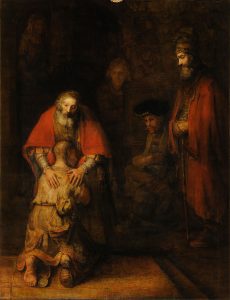 #10 – When I See You – Audrey has said that this song is inspired by the Prodigal Son. I can see two stages of his (and our) approach to the Father: You have loved me well, in a million ways, but my wounds are all I know. So I turn my head and I hide my face, too afraid to come back home. From where some of us stand, it might sound like “Why should I come to You with this wounded heart when my response to Your love seems to be the cause of it?” We might even wonder whether He’ll look down on us for thinking that way. The second verse shows the adventure we’re being called to: When my fear comes close, and it robs me blind, oh, how Your love provides for me. What a winding road, what a river wild, being Yours, becoming free! We will not feel abandoned, miserable, or captive forever. That’s not the state God intended for us. The once-paralyzing fear grows cold in the light of Your love once we see Him as He really is.
#11 – Immanuel’s Land – Depending on where you are in your healing, this will either be the easiest or hardest song to hear. Christ, He is the fountain, the deep, sweet well of love…fuller than the ocean, His mercy does expand…no problem there. I am my Beloved’s and my Beloved’s mine!? For most of my post-conversion life, I have believed that such intimate expressions of love belong only to…well, nuns! Not so. C.S. Lewis even embraced the term; the line “And this is the marvel of marvels, that he called me Beloved.” is hidden towards the end of the Narnia series. We are the ones God loves, whether we’re in the convent or out, whether we’ve discovered our vocation and made a permanent commitment to love or not. Jesus, of course, does not give Himself to us halfway.
For me, the most important wisdom is found in the “bride’s” priorities. Love has revealed Himself to her, and so she eyes not her garment, but her dear Bridegroom’s face. She will not gaze at glory, but on my King of grace – not at the crown He giveth, but on His pierced hand. None of the beauty around her is as captivating as its Source.
I am trying not to worry about my own “garment.” Will I swap shopping sprees for habits one day? Is a wedding dress completely off the table? I have no idea. At times I’ve found myself so distracted by thoughts on what might be that I miss what is. I’m not going to be an expert on love just because I’ve made some kind of commitment. The ways I am asked to love today will shape the ways I love in my permanent vocation. I should realize that now, and keep fighting the temptation to look in at myself all the time.
12 – Drawn to You – Plenty of Christian songs are inspired by the enthusiastic, all-consuming commitment of a new convert. Evergreen finishes with a similar profession of sorts, reflecting Audrey’s faith in its current stripped-down form. All my devotion is like sinking sand. I’ve nothing to cling to but Your sweet hand. No clear emotions keeping me safe at night; only Your presence, like a candle light. The “fragility” she faces is not so different from the setbacks we face in discovering our vocations. We can’t rely on our hearts alone to tell us what is true. Even the circumstances in front of us do not always tell us of God’s goodness as clearly as we’d like. As painful as the “refining” process has been, she has discovered how much she needs to rely on Jesus. After everything I’ve had, after everything I’ve lost, Lord, I know this much is true. I’m still drawn to you. Sorrow has become precious. Even her tears have been transformed into an offering of the highest praise. Most importantly, none of this is “accepted” in a grumbling, obligatory way. Audrey and her “offering” are welcomed by the Lord as-is. There is no need for perfection or masks with this God who sees and loves all the imperfections. Can we remain faithful to Him after everything’s been said and especially after everything love cost? (Think of two friends who don’t need to be caught up in conversation to enjoy spending time with each other.) Audrey’s experience proves that love transcending feelings may not always be pleasant, but it is possible.
 By Amanda, re-published with permission from her blog http://www.mariasmountain.net
The conversation shouldn’t have been an awkward one. That is, if I were normal, if I were like any 32 year old.
But I’m not, so instead, it turned awkward and I wanted to crawl under a rock.
I’m new to my work and we were all sharing details of our lives in the office, so an intern innocently asked: “So, Amanda, do you have any kids?”
“Nope.”
“You married?”
“Nope.”
“But you’re 32…do you just not want to get married?”
Oh, God.
I will admit that I brushed this off as the intern being a young college student and not having learned the prudence I learned was taught in religious life.
“It’s not that.” Pause. All right, I need to give more details here or they’re just going to fill in the blanks. “Okay, so I was a nun and left just a year ago.”
After the initial “WHAT?!?!” and “WHOA!“, she paused and said “But it’s been a year already. You’re not married or anything. What have you been doing with your life?”
I know she asked this innocently (once again, young college student), but I was taken back. I mumbled something about things don’t happen that fast and I changed the subject. But I couldn’t get the question out of mind:
“But it’s been a year already. What have you been doing with your life?”
What have I been doing with my life? Have I been doing anything with my life?
I feared the answer was “nothing”.
I am no closer to finding out my vocation in life, no closer to marrying anyone (or even going out with anyone), certainly no closer to having kids.
I am closer to starting graduate school for my MSW…and by closer, I mean I’ve filled out most of the application. So really, not that close.
I am no closer to any kind of promotion or salary increase. I switched jobs twice this year and I’m now in a job I like, but one that won’t be my permanent career.
Everything has remained the same since the day I left – same apartment, same car, even the same friends.
Maybe it’s true, maybe I haven’t done anything in a year.
I won’t deny it; I sulked around with those truths for a few weeks, even through Christmas. I had a year and I did nothing. I felt as if I had failed myself, failed God who had this great plan for me, and, in a way, even failed those who supported me leaving the community. I wallowed in shame.
Life with the Daughters was so packed with ministry, prayer, meetings, conferences, etc. Every moment was filled with purpose. Now that I was by myself… was I just wasting my life because I didn’t have a “purpose” of being a wife or mother?
But, as I let myself reflect on it, I realized that while I may not have done the logical “next steps” or what the world would expect of me, there were some accomplishments this past year:
I am no closer to finding out my vocation in life, but I started writing again and am deeply in love with its pains and joys.
I am no closer to finding out my vocation in life, but I’ve gained some self-confidence, which can only aid in the search.
I am no closer to my MSW as of right now, but I have learned many lessons in ethics, motivational interviewing, etc by experience.
I am no closer to any kind of promotion or salary increase, but I’m happy in my job and isn’t that what counts?
Everything has remained the same since the day I left, but I have gained some great friends from church that I didn’t have a year ago that I wouldn’t trade for anything.
Everything has remained the same since the day I left, but I’ve grieved my past and kept walking ahead.
I pray that, if that question comes up again, I can say with confidence: “Actually, I did a lot.“
By Rosemary Kate.
Dear Leonie’s Longing Readers, I feel like I have been keeping a secret from you, and that secret is this book. I first heard about Hurting in the Church through a book review, and my reaction was, “I have to read this book!” Father Thomas Berg is a priest of the Archdiocese of New York with a history not unlike our own. He spent 34 years in religious life as a member of the Legionaries of Christ. This priest, I thought, will have something to say to me. He did.
Hurting in the Church is divided into three sections. The first section shares personal stories of the ways we, the lay faithful, hurt in the Church today. The second is a grouping of several chapters on personal healing, and the third speaks of the hope for healing the Church at large. The book masterfully draws you in with stories that anyone can identify with in some aspect, thus providing the authority for what Fr. Berg says in the following sections.
The first part is where Father Berg shares his story. If you are familiar with the recent past of the Legionaries of Christ, you will know that Father Berg left the community during a time of deep turmoil. In the end, though, his reasons and the circumstances for leaving were deeply personal and unique, just as they are for each of us. Father Berg courageously allows his wounds, like the wounds of Christ, to be a source of healing for others. He also assists in sharing the stories of others, including those wounded by the scandal of priestly sexual abuse. Later in the book Father Berg does not shy away from this topic, and contributes to the ongoing discussion of how the Church can move forward. But this review is not meant to focus on that piece. Ultimately, the connection between Father Berg’s personal journey and the journey of anyone who has left religious life gives this book a voice that particularly spoke to me, and I think could speak to you.
The second part of the book is where I found much food for thought. Father Berg continues to share anecdotes from his personal healing, and his words said to me, “what you are experiencing is to be expected.” I found in these pages a mirror of my own journey, a source of reflection where I could name my experiences and grow from them. One example is on page 110:
“One of the effects of suffering a severe emotional trauma such as betrayal is the sense that our life has been upended. Our compass seems to fail, and we lose our north. Long-held convictions about life, love, and purpose—once foundational for our own self-understanding—can be abruptly shattered. It can give us the terrifying sensation of being held to the precipice of an existential void. Anxiety attacks and depression are not uncommon responses to such interior turmoil.”
Yet all of this is written with the underpinnings of hope. A few pages later, Fr. Berg writes, “I rediscovered that, at my core, my life was anchored in that experience of the love of Jesus” (p. 113).
The third section looks at the universal Church. After providing guidance on how one can personally heal, Father Berg expands his vision and speaks of what the Church is, can, and will be if and when her members heal individually and help each other heal. I found the first section a draw into the book, the middle a “deep dive,” and the third a gentle exit to the reality of the world we live in as well as a roadmap of where it could go.
Hurting in the Church is a much-needed book for our time, and a great tool for anyone, as Father Berg masterfully explains in his note at the beginning. With its rich content, it took me a few months to read it; therefore, dear readers, I hope you will forgive me for not sharing it sooner. It was only published in 2017, so I have not kept silent for very long after all. Father Thomas Berg’s writing has been a much-needed companion, teaching me, as he writes, “the wound and how I chose to deal with it would have a lasting influence on who I would become from that point on in my life” (p. 109, emphasis in the original). I have left religious life, which, no matter how peaceful or not, created a wound in my life, and both that wound and my time in religious life will have a lasting influence on me. With Father Berg’s inspiration, that lasting influence will be a positive one. I hope he can assist you in coming to the same conclusion.
Hurting in the Church: A Way Forward for Wounded Catholics, by Father Thomas Berg, published by Our Sunday Visitor – Website: http://fatherberg.com/
 By MJ
By MJ
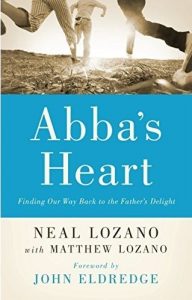
Abba’s Heart, Finding Our Way Back to the Father’s Delight by Neal Lozano and Matthew Lozano.
Abba’s Heart was the book that most fed my heart during a difficult time of solitude.
This book unveils for the reader the person of the Father, and His love for us through the person of Jesus, whose sole mission is to lead us to the Father and the Father’s love.
Initially I was a little hesitant, I felt my relationship with with Jesus and the Church was a bit fragile – but the title intrigued me. Who doesn’t want to find their way back to the Father’s delight? So, I kept reading. This book helped open my own heart to that delight of his love, feeling and knowing that I was loved was what I most needed. It started my inner healing and it gave me hope. Suddenly my hurt was overcome by this amazing love and faithfulness!
The book has four main sections. The first is: The Way Home, which looks at our own heart, its brokenness and tragedy. The second part: The Father’s Heart, looks at God’s heart and His desire to console us, to love us, to give Himself to us in a tender way. The third section is titled: Coming Home. This section takes a closer look at the weaknesses and obstacles that prevent us from being aware of this amazing love the Father has for us. Lastly, Life in the Father’s House calls us to act, to forgive, to trust in His love in order to worship and to move on, at our own pace; rooted in His love.
Throughout the book Lozano uses some personal anecdotes and the parable of the Prodigal Son to reinforce the message of God’s love for each of us. And, each chapter ends with a beautiful prayer that always seemed to capture exactly what my own heart most needed.
I was so grateful that I found this book. I hope you get a chance to read it and that it brings you healing, hope and the delight of knowing you are loved by God.
Recent Comments