Introducing Career Coaching!

By Ryan Haber.

“What do I do next?”

You might not know. To make things worse, you might not very good at much that the world is willing to pay for.

I felt that way when I left the seminary. I landed a decent job almost by dumb luck but didn’t really know what I was going to do next or even what I was doing in general. I was bored with work which seemed trivial compared to the grand vision that had been laid out before me during years of priestly formation. During one job hunting phase, I couldn’t get anyone to look at my resume. I sent out 200 resumes and got back not one response. How worthless can you feel?

I’m happy to report that more recently, Google and Facebook have approached me about jobs and I like my current situation well enough that I turned them both down.

How did that happen?

I do not have any magic. I have learned a few things over the twelve years since leaving seminary, and I’d really like to share them with you.

You can have a stable job that adds value to the world and that you enjoy. You can change jobs when you want, rather than getting chased out of them. You can have your own home and be confident in job interviews. You have something to offer. The “world” works by a different set of rules than the monastic community. The good news is that you can learn these rules and, without compromising your faith or morals, navigate the game of life.

I am not a career coach. I’m not an expert. But if you’re feeling lost and confused, I am probably just a step or two ahead of you and can relate. I’ve love to share what people have taught me.  Here are some of the things we can work on together:

  • Thinking and envisioning careers which may interest you
  • Figuring out potential next steps
  • Getting your resume and online profiles ship-shape
  • Learning how to network in powerfully effective ways
  • Getting job interviews
  • Being more comfortable with job interviews
  • Figuring out how to get along with secular managers and coworkers
  • Negotiating for salary
  • Strategies for decision making

There are no guarantees, and you’ll only get out what you put in. But if you’d like to chat with me about yourself, your career and what may come next, I’m very happy to share what I have learned so far.

To get started, go to https://leonieslonging.org/careercontact/ and complete the contact form.

Soon afterwards, we will be in touch to make appointment for an initial chat.

Here’s what you’ll do in your initial 60-minute initial chat:

  • Get to know each other a little bit
  • Tell me where you are, what you’re doing, what you want
  • I’ll probably give you a homework assignment
  • Set up a time to talk more in-depth about one topic or another

After the initial chat, you and I will go on to the steps that make most sense for you. Each time we meet – whether in person at a coffee shop or across the country via video chat – just buy me a cup of coffee and we’ll call it even. That’s not much of a risk.

Ryan Haber is a Maryland native. Since leaving Mt. St. Mary’s Seminary in 2006, he has mostly worked in software development even though his B.A. is in history and he has no other degree. He has worked in companies big and small to help document and explain technical software development tools to software engineers. Periodically they let him out of his cubicle to speak at conferences and workshops about similar nerdy things. Right now he works for Blackboard, Inc. In his free time, he hikes and camps and takes pictures and kicks his nieces around. Like you, Ryan has no idea what God has in store for him next.

Book Review: One Beautiful Dream

I entered into reading Jennifer Fulwiler’s book One Beautiful Dream with a bit of apprehension. From my perspective as a single woman, most Catholic media are focused on spouse and family and have little that relate to my life experiences. However, I was pleasantly surprised to find this story of self-discovery challenging and inspiring for my state of life as well.

The book is an easy and fun read filled with amusing stories and anecdotes. But behind the silliness are some very important messages. One of the main concepts explored in the book is the idea of the “blue flame.” This is the thing that you are passionate about. It gives you energy to participate in it. It’s what you’re “made for.” She posits that married women with kids often leave these things behind in order to be a perfect parent, Catholic woman, etc. In my opinion, it seems as though this is an easy thing for any woman to slip into as she gets older and has increased responsibilities. Furthermore, entering religious life made me let go of my dreams and aspirations, and it’s been incredibly difficult to reconnect with them after returning to lay life. One must ask, “What am I passionate about? What do I need to make time to do?”

She also talks about guilt and comparison. How often do we make choices because we feel guilty? We think, “I shouldn’t do this because…” (it’s not holy, it’s not Catholic enough, what would people think?? etc). On the flip side is, “[insert name of model holy woman at Church] would never consider doing such a thing. What is wrong with me?” and other statements of comparison. Yuck. There’s no peace there.

In confession, she talks to a priest about her struggles with balancing her life, and he shares some beautiful thoughts, including: “‘We always think like individuals, like the work that we do has nothing to do with anyone else. God wants us to see what we do as just one small part of something greater…’” (pg 129). He then goes on to encourage her to really make her family a part of what she is doing. As someone without a family of my own, it’s easy to dismiss this concept as irrelevant. However, it is true that I approach things as an individual but it should not be that way. Who should I take into account as I consider my “blue flame?” Who can I ask to support me in these endeavors?

Next, I was buoyed by the idea that having constraints on my time is a good thing. I often lament the fact that I have to work full time, do my own laundry, cooking, and all the rest, and therefore have little time for hobbies or personal advancement. In her busy life, Jen Fulwiler feels similarly. However, she comes to realize this lack of time and forced pauses required her to be very focused while working and also gave her mental breaks in between which allowed her to “come back with a fresh, new perspective” (page 174).

Finally, she discusses the idea of “Resistance” from the book The War of Art by Steven Pressfield. The concept is that there is a force in the world trying to keep you from creating. Once you recognize that, you can combat it. I know I certainly have felt this way and I dealt with it rather badly – vacillating between anger and self pity. But once you know that this is a universal problem, you can take bold steps against it. How exciting!

Hurricane

By Windy Day.

In 2016, I went for a walk with a colleague when Hurricane Matthew was striking the United States. We couldn’t help but talk about the weather because it was such big news. He shared that he was in Virginia for Hurricane Bertha and said it was “only a Category 2.” He then described his experience:

“The sky was pitch black; the wind howled nonstop for hours. The eye of the storm passed by at around noon, which I recall vividly because it provided just enough time for us on staff to go out for lunch — we sat outside at a local sandwich place under beautiful, peaceful blue skies and sunshine! Then, no sooner had we returned to the office when the deafening, dark tempest began roaring again. The contrast in so short a time was surreal and impressive.”

We were discussing this on a beautiful Autumn day, knowing full well that in other parts of the world people were recovering from devastation, experiencing devastation, or awaiting devastation. It was a strange feeling. Enjoying the beautiful weather and yet knowing not everyone in the world was experiencing the same thing.

If that can happen with weather I would suspect that it can happen in the spiritual life.

Does it sometimes seem that your experiences and feelings are casting a cloud over everything? It’s easy to deduce that everything is awful when we feel awful ourselves. But our current feelings and experiences aren’t an all-encompassing reality (or they don’t need to be). Have you heard St. Therese’s analogy of the little bird looking at the sun when the cloud passes in front?

“With bold abandonment, he remains gazing at his Divine Sun. Nothing can frighten him, neither wind nor rain; and if dark clouds come to hide the Star of love, the weak little bird will not move away, for he knows that on the other side of the clouds his Sun continues always to shine.”

To me that analogy made sense. But the way I had been reading it made it seem fairly tame. However, if we think about a hurricane completely blocking out the Sun so that midday looks like midnight, that is something very different.

Have you felt this way? I know I have.

Since returning to lay life I have felt to varying levels of desolation and spiritual torment. These are hard to reflect upon, let alone describe, especially when you’re afraid to scandalize others. It feels as though everyone expects you to have your life together because you were a religious. And to make it worse, we often expect that of ourselves.

Instead, I think it’s more realistic to anticipate and expect at least some darkness, if not extreme darkness, at this time. We are vulnerable and the evil one always looks for weakness in our defense (see 14th rule in St. Ignatius’ Rules for Discernment of Spirits*). It is quite likely your relationship with the Lord has been strained or challenged and this gives Satan an “in.”

How can we combat this darkness? Here are a few thoughts:

First, recognize this possibility and, “Be not afraid!” Fear can easily dominate us and cause us to feel powerless. Try to manage your response and any other things that you can control. Remind yourself of the truths of the spiritual life. Once again, Ignatius’ rules may help.

Next, don’t be surprised, offended, disappointed or take it personally. It magnifies things and only makes everything feel worse. This is a great opportunity to find hidden pride. If you are shocked and upset, you most likely had an unrealistic image of yourself (mea culpa!).

Finally, consider praising God in all things and thanking Him for this opportunity. View this truly as an opportunity and not a barrier. How can this be true? A few ideas:

You can learn more about yourself.

You can depend on God more.

You can turn to Him.

You can grow.


These are all good things that God wants for you! And you can always ask Mary to help you. Keep reminding yourself that, as St. Therese affirms, on the other side of the clouds his Sun continues always to shine.


What suggestions do you have? Please share in the comments below!

___________________________________________________________________


*http://www.discerninghearts.com/catholic-podcasts/14-rules-discerning-spirits-different-movements-caused-soul/

Plain Without, Shining Within

By Gertrude Heartwood.

In Fr. (now Bishop) Robert Barron’s video series Catholicism, he points out that Our Lord Jesus did not have any religious status in his society.  He was not a member of the priestly class and was neither a scribe nor a Pharisee. He was a manual laborer, a member of the laity.  So now are we, who once had “religious status” as members of a religious community, counted among the laity.

All states of life were elevated by him, for although he was a regular working man, he also was the model for all in religious life, living poverty, chastity and obedience; and he is the Eternal High Priest.  We know that all priests derive their priesthood from His; that all religious follow him more closely in the evangelical counsels; yet he is simultaneously a lay person.

Reflections like these can comfort those of us who pursued religious life and left, but we can never get away from the fact that we no longer remain in what is considered by the Church to be the objectively more perfect way of life which persons in religious vows have been called to live.

Lay people are not called like priests and religious to a supernatural vocation.  We may be chosen for the married state of life, or for some ministry in the Church, but this is not the same sort of call that a priest or religious receives…a summons to a way of life that can only be lived because of the grace that is available from the Redeeming Act of Christ.  Prior to Christ, the celibate priesthood and the consecrated life did not exist. These are possible only because of the new economy of grace brought about by the Blood of His Cross.

So here we are, just regular folk, living a regular type of life.  Some of us are single, some of us are married. But our states in life are nothing new, nothing particularly Christian.  All cultures and religious traditions have married people and single people. We are just plain Janes.

And yet, are we really?  

In the purely lay state, having no Church status to rely upon, we can show forth the essentials of the Christian gifts, the changes that Christianity brings to human beings.  We look, dress, talk, live like secular folk. But we have the Holy Trinity within us. We have a mother in heaven who watches over us. We have a guardian angel. We have grace upon grace upon grace.  We are new creations. Furthermore, if we are married, we can live that state in life at a higher level, at the level of grace, because it has been elevated to a sacrament.

These hidden treasures of grace we possess within are like jewels sparkling out quietly from within us, upon a world that is inhabited by darkness.  People will catch the sparkles if we remain in His Love, and be drawn to Him too. And that is all we have. Those sparkles of grace. We don’t have a habit, or religious vows, we don’t have a collar, we aren’t set apart.  When people look at us and interact with us, it is as persons just-like-them. The only things we have to rely upon to draw people to Christ is His grace inside of us and our cooperation therewith. No one will look at us in a habit and be moved to think of God.  But if we wear a smile for them, they may see that they have dignity and that they are loved. If all our interactions with them bear the Light of Christ, the heaviness of their darkness can be lifted from them, if even for a moment.

At the same time, we see the goodness in them, these regular folk like us…though not Christian, they can make us marvel at how they too reflect God’s goodness.  His goodness in us, His goodness in them…we and they, regular folk, yet carrying too, the wonder of God’s generous presence.

Experiencing Holy Envy

By Christina M. Sorrentino (re-printed with permission from her blog Called to Love OSB).
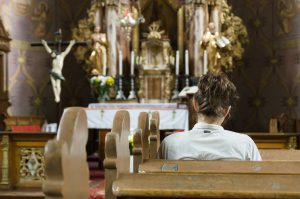
One of the greatest blessings of living in a monastery or convent is being able to live with the Blessed Sacrament. When young women would come on a discernment retreat and ask me what my favorite part was of being in religious life, I would always tell them, “Being in the constant presence of the most holy dwelling place”. There were some nights I would go down to the Eucharistic chapel and simply sit quietly alone with Jesus in the darkness with only the sanctuary lamp as my light. I cannot explain the feeling that would come over me as it is indescribable, and it is a feeling that I miss the most after leaving the monastery. I can no longer at night right before bed go downstairs and sit in the stillness before the Blessed Sacrament, and I can say that is my greatest sadness and loss of no longer being in religious life.

As in the words of Fr. Michael E. Gaitley, MIC, I find myself with a sort of “holy envy” in that I wish that I lived in the same house in such closeness to the Eucharist. Religious sisters and nuns are truly blessed in that they actually live in the same house as the Blessed Sacrament, and can visit with Jesus as often as they wish to visit him. I remember after Compline visiting the Eucharistic Chapel on my way back to the Sisters’ residence, and whispering to Jesus, “Good night”.

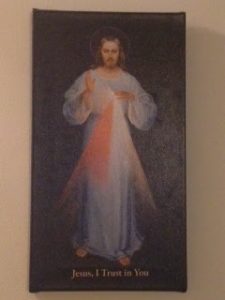
My heart yearns for the day when I will once again be living in the same house as the Blessed Sacrament. I do not find it a coincidence that not too long after my departure I was given an image of the Divine Mercy, which is such a beautiful image of his grace. I told my father I wanted to hang the image on the wall in my parents’ living room, and I was surprised when he told me that I could do so, and already I knew that Jesus was pouring out his merciful love.

Although the image is not the Blessed Sacrament, it will be a reminder of the merciful love of Jesus for me and for my family. The Divine Mercy Image Enthronement is an invitation to allow Jesus to reign not only in our home, but also in our hearts, and I will remember to trust Jesus and his divine will. This image of great grace brings Christ into our home, and until the day that I can once again live in closeness to the Eucharist I will consider myself blessed that the Image of Divine Mercy will remind me that Jesus is always with me, and to trust him.