Jun 29, 2014 |
 After I returned from the convent I was filled with worries, fears, and questions about my future. I asked God over and over: What do You want me to do now? Where do You want me to go with this life You have given me? Why am I back here?
I like to have a plan, directions, and a goal. When I left the convent I felt like I was plan-less, direction-less, goal-less. I didn’t know where to go, what to do, or how to do it.
So, two weeks after I got back I got my first job, working at a deli. I knew if I didn’t start doing something I would go crazy. St. Joseph, the patron saint of workers, isn’t my namesake for no reason! I recently quit the deli in favor of a bakery job and am now saving up for college in the Fall. I don’t know what I’m going to study, what career I want to pursue, or even if God is calling me to religious or married life in the future. These are all future vocations, vocations of later; I needed to have a vocation of now.
I believed that I didn’t have a vocation of now. But I do. What is my vocation of now? I am a single working lay Catholic woman, soon to be a student, too. I try to attend daily Mass and to “pray unceasingly” throughout my day. I try to serve everyone at work with the dignity they deserve as my brothers and sisters in Christ, even if I am only serving them donuts and coffee. I try to be a joy-filled witness of Christ’s love to all. And soon I will also be called to be a living example of my Catholic faith in a college setting, too. This is a pretty busy vocation: spiritual priorities, being in the workforce, and being a student.
Sometimes I get so caught up in wondering what my vocation of later is that I miss what is right before me. I need to live in the moment and use each second to glorify God. This is my plan now: to trust God, show Christ’s love to all, and be joyful no matter what my directions are. My goal is to use where I am now to bring me closer to Heaven, and to bring as many of my brothers and sisters with me, too. These directions, plans, and goal fit with every vocation: vocations of now and later.
Let’s realize that God is calling us now and that we do have vocations of now, and God will guide us to our vocations of later in His own time.
“Entrust your works to the Lord, and your plans will succeed.” ~ Proverbs 16:3
Josephine was a postulant for six months before discerning that God was calling her back to the world to attend college. She has been back for four months and is enjoying her job at a local bakery. She is still discerning religious life but is open to married life, too, if that is what God is calling her to. She loves to read, write poetry, sing, cook, go thrift store shopping, and she likes to laugh a lot! She is grateful for the opportunity to reach out to others who are going through the same situations as her.
Jun 22, 2014 |
After leaving the convent in July 2013, one of the most valuable things I did was get myself some new music. Almost every song on my MP3 player from before I entered had a different meaning after I left: this was the song I had been listening to seven months earlier as my train pulled out of the station, heading for the convent; this was the tune I had taught myself to strum on the community’s old guitar, sitting down the bottom of the garden on Sunday afternoons; this was what I hummed to cheer myself up when I realised that cracks were starting to appear in my vocation; I still enjoy those songs, but there’s a certain bittersweetness about them that wasn’t there before.
So, while I was visiting op-shops to re-stock my wardrobe with clothing, I started picking up CDs for a dollar each as well, by bands I knew nothing about, except that their cover art was nice. I discovered some wonderful music that way, but one song has stood out for me so strongly that I wanted to share it with others who are grieving the loss of the religious life as I was (and in some ways still am).
The song is “In Repair” by John Mayer. I admit, I find Mayer confusing: his hedonistic public persona is completely at odds with the soft, deeply expressive songs about loss and yearning on his albums. Well before I knew anything about the artist, though, I knew that this secular song expressed precisely what I felt, and didn’t yet have the language to describe:
Too many shadows in my room
Too many hours in this midnight
Too many corners in my mind
So much to do to set my heart right
Oh, it’s taking so long
I could be wrong, I could be ready
Oh, but if I take my heart’s advice
I should assume it’s still unsteady
I am in repair
I am in repair
Although I don’t regret actually leaving the convent (it was clearly what had to be done) what I do regret, sincerely, is having let things escalate to the point where leaving became the only option. What went wrong? With 20/20 hindsight, I’ve realised that over the course of a couple of months after I entered, I gradually stopped being a postulant and became instead an actress playing the part of a postulant. (I was good at it, too: I managed to fool even myself for months.) The trouble was that I then unconsciously began to see the Sisters not as my community, but as the audience I needed to impress if I wanted to stay.
Finally, half-way into my postulancy, the inevitable happened: while standing outside the back door of the convent receiving a correction in private for something I’d done wrong earlier in the day, I suddenly realised that, however hard I tried, I wasn’t going to be capable of staying. You will know for yourself what that moment feels like: it’s as if life quietly fades from full-colour to black and white. I stayed on for another month after that in the hope that the Lord would intervene and help me. And He did: when I finally admitted to the prioress that I couldn’t cope, she came in to bat for me magnificently. But in the end, I had to recognise that I’d simply run out of internal resources.
You may know, too, what I mean when I say that much of what’s happened since I left feels as if it’s happened in black and white after the vividness of life in the convent: whatever my vocation is, I’ve clearly not found it yet. I can only understand and trust that eventually, I will start to uncover the real calling that God has prepared for me, and the colour will come back.
And now I’m walking in the park
And all of the birds, they dance below me
Maybe when things turn green again
It will be good to say you know me
I’m in repair
I’m not together but I’m getting there.
I’m in repair
I’m not together but I’m getting there.
By Spiritu
At the age of seventeen, Spiritu watched some elderly nuns laughing together after Mass and decided instantly that this was what she wanted to do with her life. After six years of intense study about the Catholic faith and the religious vocation, she entered a beautiful community in her own country, Australia. Seven months later, she returned to the world, saddened that her discernment hadn’t worked out as she’d hoped. She is now exploring other possible options for the future, and owes an enormous debt of gratitude to her family for their love and help.
Jun 15, 2014 |
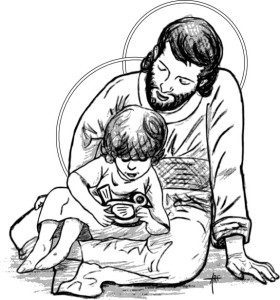
 Well, in a manner of speaking. God alone saves, but in my case, He decided to use art for that purpose. Leaving that community of prayer and mutual spiritual support left my soul feeling lost and starved, my heart with feelings of bitterness and despair. I did not immediately realize after I left that I needed to have a healthy outlet for these feelings or they would destroy me. And for several months they did indeed tear me down.
I’d always been a bit of an art nerd. I took lots of art history classes in college, without much idea of how to use them other than to soak up my elective credits, despite the continued objections of my academic advisor who thought I was crazy and needed something more practical. I took all my class notes as a series of random doodles, partly from love of doodling, and partly because I have ADD so bad I couldn’t actually take proper notes. The pictures formed for me a kind of pictorial mnemonic device for remembering what I’d learned that particular day.
By the end of my 4 years in college there were guys who would come to me at the end of the semester just to see my notebooks. I really didn’t understand why they were fascinated. The staff there thought it was inexcusable, that I was treating my academics like a joke by spending all my time doodling, so naturally I felt that way too. For me, those scratches represented what I perceived as my own personal weakness and laziness, my inability to be a “good seminarian.”
I eventually would go on to show those scribbles to family and friends outside of seminary, and almost overwhelmingly I would be asked, “Is there any more? Will you please make more?” I had no inkling that this art thing was anything important, but my spiritual director had just reminded me that when you have a gift from God, the Holy Spirit will draw people to it, and they will come to you and ask for it. So I went back to drawing.
I didn’t think I was very good. Actually, I was objectively bad! But I drew because I needed it, as a way to heal. And because other people needed it, and I needed to feel that people needed me, too. In prayer, God made it clear that I needed to do this for Him, because He had people who needed what I could make.
So I learned how to draw in new ways, using new tools. I learned how to use paint. I learned how to engrave. Some people meditate over Scripture by reading it over and over again, but I would imagine it over and over again, and then draw it. Other times, when my imagination would run wild in the Adoration chapel and I couldn’t get an image out of my head, I’d draw it, and then listen to see what He thought.
There were also times that I would draw with the intention of making something for selling, without listening to God or presenting my work to Him – worshiping mammon with the work of my hands, as it were. In these cases I almost always failed. It was humbling to see how my work is empowered by Him, how even when I will not obey His commands, the work of my hands is still the work of His hands.
Through all of this, I was constantly reminded that drawing was something that was for my healing. Not because it stroked my ego (though it sometimes did) but because God made my hands and I was using them to do something for Him, even though I didn’t understand exactly how. I don’t always pray before I pick up my pencil or brush, but in those early days I learned a sense of working with God on this hobby of mine. Or more precisely, this hobby of ours.
I discovered that I didn’t have to change the whole world to be holy or happy outside of a religious community. My vocation to personal holiness and communion with God can sometimes just be about making scribbles and giving them to Him.
By Anthony
Anthony is a thoroughly lovable former seminarian, artist, and Catholic blogger. He is not only the author of this week’s post, but also the creator of its featured image. If you’ve never seen his artwork, check out his blog at http://weaselsgonarf.blogspot.com/.
And please PRAY FOR ANTHONY, because he’ll be marrying the lovely Katie on the Solemnity of the Assumption (this coming August 15th)!
Leonie’s Ladies: What have you found works as an “outlet” for you since returning to the world? Has something in particular helped you to heal, to process feelings, to readjust? Please share in the commboxes below so others can get ideas that may help them!
Jun 9, 2014 |
This past week we explored the process of grief in the context of leaving the religious life. The final stage of grief, Acceptance, can seem a far way off when one is in the deep valley of anger, depression, or denial. Yet it does, and will come to all of us.
Today is Ascension Sunday, the day when Christ, in all His glory, is taken up to heaven to be with His Father. What a contrast to his prior exit from this earth – one of bloody defeat to one of triumphant victory.
Despite the contrast of Christ’s two exits from earth, one aspect remained – His wounds. Why did He keep them? Perhaps it is more than a symbol of what He did for us. Perhaps it is a lesson in suffering – that it has a purpose, that it shapes our identity and our mission in life. Our past wounds, Christ shows, are not to be hidden, but to be a sign of triumph and transformation.
The final stage of Acceptance is not forgetting about our loss, but embracing it as a part of who we are and who we are to become. It was said once that where our wounds are, there is our mission. How paradoxical that sounds. Yet, if you look around, you will find this truth.
By Wendy Macagno
Wendy has received her MA degree in Counseling Psychology from Regis University and her BA in Religious Studies from Benedictine College. She has served her community as a career coach in both the non profit and government sectors.
Jun 8, 2014 |
The Holy Spirit moves in mysterious ways. Whenever we are faced with a move, a change, it brings conflicting feelings.
This Pentecost I am in the middle of preparing for a move from my first assignment as a priest to a new assignment later this month. One of my brother priests called it “from one extreme to another” – from two slow-paced, rural parishes to a big suburban parish with a school in a major college town. I have lived here four years, five if you count the times I visited on the weekend as a transitional deacon. The people and the place have left a mark on my heart. Everywhere I look I find more things that belong to me and that I will need to pack and move. I also find things I’ve bought for the rectory with Church money and wonder if I’ll have these same amenities at the new place.
Moving is difficult, not just for me but for the staff and the parish. Each person has to deal with it in their own way. I am filled with conflicting emotions: excitement for the new and unknown and sadness for the places where I experienced God’s love. A part of me is happy to leave behind certain people and memories. In the mess of the move, the preparation, the packing, the schedule hassles, the new pastor moving in early, the waiting for the date of the move, it is easy to feel lost and forgotten. Sometimes it feels like the whole world is advancing while I stand still. Temptations multiply to fill oneself with snacks, TV, iced cappuccinos… and indeed some of those things do seem to take the edge off temporarily. It is hard to pray, to sit and be still in the heart even during prayer. Moving brings up emotions and memories from the past, insecurities and fears.
There is something else too, though, or rather someone. There is a presence, a deep peace, a person who is accompanying me, who gives thoughts such as “Be at peace, it will be all right,” “Be patient, it will work out,” “Keep praying your regular prayers,” “Stay quiet,” “Watch me work this out.” This is the Third Person of the Holy Trinity, the one we call the Holy Spirit. He is God just like the Father and the Son. He is a person just like the Father and the Son. And His presence is palpable in all those who have been baptized and believe.
The Holy Spirit is all-pervading, the Advocate, the Consoler, the one whom I can trust when all else seems to fail. The Holy Spirit has been there for me in the past and I am even more aware of Him now. The Holy Spirit wants me to be strong and calm:
By waiting and by calm you shall be saved. In quiet and in trust your strength lies.
Isaiah 30:15
The Holy Spirit wants me to be holy, to not freak out, not send a quick reply over email, not make a hasty comment, not indulge. The Holy Spirit wants me to enjoy this experience even amid the pain. The Holy Spirit wants me to have a holy transition and His way is indeed the better, wiser way.
Why be up in arms? Why fear, be anxious? Nothing has importance except my relationship with the Son and the Father in the Holy Spirit. Everything else is fluff. May God bless all our moves and transitions!
By Fr. Tom Wasilewski
Fr. Tom was born in Poland, raised in East Lansing, Michigan, and graduated from Central Michigan University. Since his ordination in 2010 he has been a priest in the Diocese of Lansing. In his spare time he likes to mountain bike and work on basic wood projects.

 Well, in a manner of speaking. God alone saves, but in my case, He decided to use art for that purpose. Leaving that community of prayer and mutual spiritual support left my soul feeling lost and starved, my heart with feelings of bitterness and despair. I did not immediately realize after I left that I needed to have a healthy outlet for these feelings or they would destroy me. And for several months they did indeed tear me down.
 The Holy Spirit moves in mysterious ways. Whenever we are faced with a move, a change, it brings conflicting feelings.
Recent Comments