Divine Mercy Sunday
Eternal Father, I offer You the Body and Blood, Soul and Divinity of Your Dearly Beloved Son, Our Lord, Jesus Christ, in atonement for our sins and those of the whole world.
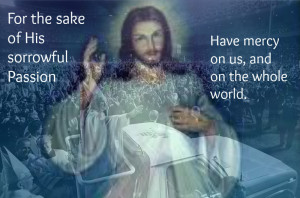

Eternal Father, I offer You the Body and Blood, Soul and Divinity of Your Dearly Beloved Son, Our Lord, Jesus Christ, in atonement for our sins and those of the whole world.
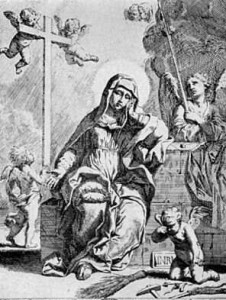 We adore You, O Christ, and we bless You. Because by Your Holy Cross You have redeemed the world.
Were Mary’s tears silent ones?
In the privacy of the space John made for her in his home, did the Blessed Mother ever get the opportunity to just let go and give voice to her grief? Perhaps, as she wept, she was struck by the fact that her sobs were the only sound she could hear… the surrounding silence that would have answered her own sounds of grief would surely have given rise to great sorrow.
Her Son lay dead in a tomb.
With the exception of those three days of anxiety searching for Him as a child in Jerusalem, she had never before experienced such a forced and terrifying separation from Him. That moment when they took His broken body from her loving arms and she watched them wrap Him in linen and place Him in the tomb, rolling a stone across the entrance way… it would have been a strange kind of closure which would have seemed to come too soon, too suddenly, even after the events that lead to His death. He really was dead. His burial, though rushed to accommodate the Jewish sabbath, was real… but what now?
The experience of that day Our Lord Jesus died would have been terrifying, 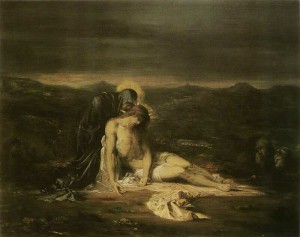 dramatic, emotions would have been racing… but now that He lay dead in a tomb? Sudden silence. Eerie confusion, seasoned by the greatest depths of sorrow. Seeming nothingness.
The Sorrowful Mother knows silence and separation from her beloved Son only too well. During those times that I experience frustration in prayer due to a sense of separation from Him… when it seems He is absent, when the only language with which He communicates is silence, but it feels more like nothingness… I need not be alone. In turning to the Sorrowful Mother I have a companion who understands the distress of this experience, and yet she has hope in the belief that the Dawn of Compassion WILL break upon us.
And so she waits with me…
By AfterEpiphany.
 We adore You, O Christ, and we bless You. Because by Your Holy Cross You have redeemed the world.
The End
Can you imagine how the apostles and followers of Christ felt when He breathed His last breath? This was the end, the end of a journey, the end of a life, the end of Love. What were they going to do now?
We have experienced many endings in our lives, and most of us hold in common the ending of living the religious life. Yet here we are, still alive, in spite of all these “endings”; and, so also is Christ still alive after His “ending”! In truth, the end was the beginning; but, how do we survive these endings so we can make it to the beginning?
The answer to this one question is simple, in fact, it is only one word: trust. Jesus trusted the Father. He knew that His Father knew what He was doing, and that this ending, this death on the Cross was necessary. Jesus trusted in the Father’s Love for Him and for all humankind. Jesus knew that the Father would never leave Him alone. Jesus knew that the Father would not allow this ending to be an ending in the truest meaning of the word.
Do we trust the Father? Do we trust Him enough to realize that the endings we experience are not really endings, but beginnings? Do we trust that these beginnings will bring about the Father’s plan in a much better way? Do we trust Him enough to understand that He will never leave us alone and that He Loves us dearly?
Yes, endings hurt, endings bring pain, tears, and suffering. Look at the Cross: Jesus 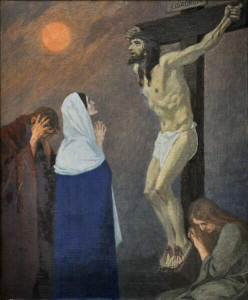 endured hurt that I cannot even imagine. He endured His death until the end, but thank God that that was not the end! And thank God that leaving the convent was not our ending either! He has great new beginnings for us in store, just as He had a wonderful beginning to the end of Jesus’ death, a beginning full of Easter-joy <3
Pax vobiscum
By Josephine.
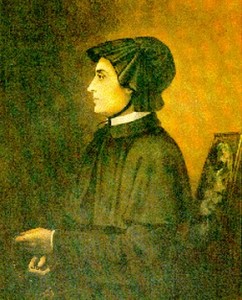 Saint Elizabeth Ann Seton: August 28th, 1774- January 4th, 1821. The first native-born citizen of the United States to be canonized by the Catholic Church.
Prayer by Saint Elizabeth Ann Seton
Lord Jesus, Who was born for us in a stable, lived for us a life of pain and sorrow, and died for us upon a cross; say for us in the hour of death, Father, forgive, and to Your Mother, Behold your child. Say to us, This day you shall be with Me in paradise. Dear Savior, leave us not, forsake us not. We thirst for You, Fountain of Living Water. Our days pass quickly along, soon all will be consummated for us. To Your hands we commend our spirits, now and forever. Amen.
Saint 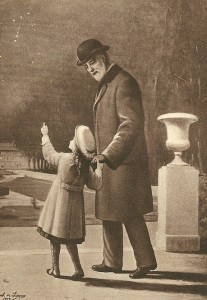 Thérèse of the Child Jesus and the Holy Face, January 2nd 1873 – September 30th 1897.
From the preface to the 1912 edition of The Story of a Soul by H.E. Cardinal Bourne, Archbishop of Westminster:
From the cradle all the Martin children were dedicated to Mary Immaculate, and all received her name: Marie Louise, Marie Pauline, Marie Léonie, Marie Hélène, who died at the age of four and a half, Marie Joseph Louis, Marie Joseph Jean Baptiste, Marie Céline, Marie Mélanie Thérèse, who died when three months old, and lastly, Marie Françoise Thérèse.
Zélie Martin’s whole ambition as a mother was directed to Heaven. “Four of my children are already well settled in life,” she once wrote; “and the others will go likewise to that Heavenly Kingdom enriched with greater merit because the combat will have been more prolonged.”
Never did her husband allow the meannesses of human respect to degrade his Christian dignity. In whatever company he might be, he always saluted the Blessed Sacrament when passing a church; and he never met a priest without paying him a mark of respect. A word from his lips silenced whoever dared blaspheme in his presence.
In that house the “Little Flower of Jesus” first saw the sunshine. Again and again, in the pages of her Autobiography, she calls herself by this modest name of the Little Flower, emblematic of her humility, her purity, her simplicity, and it may be added, the poetry of her soul. On the manuscript of her Autobiography she set the title: “The Story of the Springtime of a Little White Flower,” and in truth such it was, for long ere the rigours of life’s winter came round, the Flower was blossoming in Paradise.
Saint Thérèse, pray for us!
Recent Comments