Sep 14, 2026 |
 By Jennifer, CA.
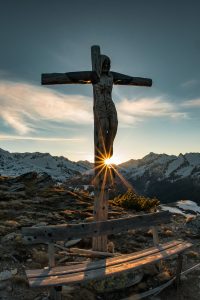
Sometimes I can feel contradicted like Jesus, as He went through His Passion. Why is the Son of God being questioned, beaten, and condemned to die?! It takes faith and surrender to have the mindset to acknowledge that the unsuspected is happening to me, and it’s not up to me to fix it beyond my daily fiats. Because God is going to do the rest.
A definite example would be when I recall leaving religious life. Why is this happening? I am supposed to be a nun! It is when I can only raise my eyes up to the crucifix like Our Lady, and maybe like her, silently look on. Though, unlike her, it may be difficult for me to know what to think or do from there. But I am trying to remember that the key is, to still be confident in the God Who Loves me. And as I have heard so many times, He is God, and I am not.
I can give myself permission to not only be strangely beyond controlling of a situation, I can also carry on in that certainty that He has got this. That is definitely how Jesus hung on the cross, raising His eyes to the Father, did He not? (See complete Psalm 22, especially the ending.)
I share this after going through my own dark nights of depression, anxiety, and dread, and slowly learning the way to be “pulled back up” again. Sometimes I’ve got to recommit to letting go, even now. It takes grace, it takes confidence, and it takes recalling the goodness of God. Because guess what? He’s got this!
Even in the face of contradiction, I am called upon to keep going, and as I have learned time and time again from three simple words a beloved Sister once told me: Let Him Lead!
Mar 19, 2025 |
By S.E. Greydanus, reprinted with permission from Homiletic and Pastoral Review.
Nearly everyone reading this has probably heard something on the subject of vocational discernment. For those accustomed to Catholic terminology, these words may evoke images of a retreat for young people praying to find their path in life, or a novena asking for divine guidance about a major decision, or “come-and-see” visits to a religious order. As the term is generally used, it refers to making one’s life choices based on the will of God, as perceived through prayer and careful consideration.
While at first glance this method appears constricting—to shape one’s life entirely based on the wishes of another—we Catholics, if taught properly, learn early on that conforming to God’s will is not like conforming to the wishes of another human being, whose whims might have nothing to do with our good. God’s will for us is identical with our own fulfillment and happiness—the kind of long-term fulfillment and happiness that is reached by a difficult path, but ultimately brings deeper satisfaction than short-term rewards. Images used to explain this concept include success in art or athletics, where the many pains and efforts involved are crowned with a beauty approaching perfection. (1)
Yet, even if we did learn this lesson, perhaps we could use to be reminded from time to time. For many, vocational discernment is a subject fraught with anxiety, even anguish. Countless souls, especially young people, who are honestly seeking to “follow God’s will” find themselves tortured with questions about whether they are doing something wrong, failing to follow His plan, and possibly ruining the rest of their lives by making some mistake in this area.
The Lord who made peace His bequest to us (John 12:27) and bids us through St. Paul, “Have no anxiety about anything” (Philippians 4:6), assuredly does not wish that seeking to follow His plan should be a cause of so much inner disturbance. Stepping back to examine the problem, and to consider how the Church’s teaching on vocation applies, may be helpful in finding peace amid this tangle of questions.
The Problem
How did discernment become such a stressful subject? Others have written better than I could (2) about the anxiety-inducing type of advice, which I have also encountered firsthand, that warns young people of the dire consequences if they fail to correctly figure out God’s will for them, as though God were making a guessing game out of our lives. This way of thinking runs counter to an attitude of trust, which assures us that our Shepherd, our Father, is directing the course of our lives, and that we need not fear choosing wrongly when we choose for love of Him.
Over time, I have become increasingly convinced that the problem has another component. So often, the question of discernment focuses solely on finding one’s way to a single life-changing moment, generally a wedding, ordination, or profession of religious vows. In discussions of potential life paths, one hears language like, “our vocation, whether to marriage, the priesthood, or religious life”—again and again. The rest of life, it is implied, either prepares for or flows from this all-important day.
No doubt, considering these paths is important for “seekers,” many of whom do find their place in one of the above vocations, responding to a tug on the heart. The danger here is that a too-narrow focus on one day, one goal, sometimes even to the point that only that day matters—or progress made toward it—has a way of devaluing all the rest of life.
The consequences do more harm than one might think. If everything depends on the day a ring is put on my finger, and I am not currently moving toward that goal, I am simply wasting time in the present, however good, virtuous, or even necessary my current activities may be. A person may have no way of further hastening the desired goal; for instance, if the goal is marriage, one can socialize and pray in search of a potential spouse, but cannot produce a spouse by sheer efforts. One can still live wholeheartedly for God, working for Him, taking time for Him, giving to Him all the little things that make up one’s life. Yet how likely are we to take this approach if we think that His will for us consists solely in arriving at a single turning point? Ironically, we may become so absorbed in frustration over not being able to do what God may will for us someday that we overlook what He calls us to do now!
The pain is especially great for the increasing number who remain among the single laity. If following God’s will is all about reaching a great life-changing day, and no such day ever arrives, all sorts of bleak conclusions quickly follow: I was not chosen; I have been left behind; I have no place; God has forgotten me. Often, if they come from a Catholic background, these single men and women have grown up hearing a great deal about “finding one’s vocation” in the same sense in which one might speak of finding one’s place in the world. To be told, in effect, that they have no vocation can be devastating.
In fact, the pastoral needs of the single laity are, as can happen when the world changes quickly, a growing vacuum in today’s Church. Luanne Zurlo calls attention to the scale of this need:
Pastorally, singles have fallen through the cracks. At the same time, the number of singles in society and in the Church has exploded. The U.S. Census Bureau reported in 2015 that 109 million (45 percent of American adults) are unmarried, of whom 69 million (63 percent) have never been married). To compare, in 1950, some 33 percent of American adults were unmarried, 20 million or so having never been married. (3)
On occasion, this dramatic spike in singles is attributed to the younger generation’s inability to make serious commitments. Whatever degree of truth that explanation may have, to explain the issue entirely thus is to dismiss the many fervent, generous young adults, some of whom I have been privileged to know, who have sincerely wished to enter one of what might be called the main vocational paths. Some find that, despite their best efforts, the door never opens; they never find a suitable spouse, or a religious community to which they are called. What can we tell them regarding their vocation? Has God forgotten them?
On this the Lord has spoken clearly. He who attends to each of the sparrows and has numbered all the hairs on our heads (cf. Mt 10:29–30) does not leave out of His providential design any person He created in His image. For each one He has a plan and a purpose. To better understand the relationship between His purpose and our vocational discernment, we may do well to reflect on the concepts of “discernment” and “vocation” in the teaching of the Church and in the lives of the saints.
The Teaching
A search for these two terms in Scripture yields some thought-provoking results. “Discernment” is used to mean something like understanding, the ability to perceive truth; someone who is wise or understands what should be done can be described as having discernment. (4) This could be applied by extension to determining the choice of one’s particular life path, but in itself is a broader concept. “Vocation,” also rendered “calling” (“vocation” comes from the Latin vocare, “to call”), recurs several times in the letters of St. Paul, referring not to a specific type of life but to the calling given to all Christians to live the life of Christ, e.g. “I therefore, a prisoner for the Lord, beg you to lead a life worthy of the calling to which you have been called, with all lowliness and meekness, with patience, forbearing one another in love” (Ephesians 4:1–2; emphasis added). In both cases, what has become narrowly defined in regular usage is used in Scripture in a way that applies to every Christian.
Results in the Catechism are similar. The Index does not even have an entry for “discernment,” and searching for “vocation” yields the following string of sub-entries: “to follow Christ,” “to sanctity,” “to the catholic unity of the People of God,” “call of all by Jesus,” “call of all by the Creator.” Here, again, the term directs the searcher not to specific life paths, but to a universal calling addressed to all who belong to Christ.
At the very end of this list comes “see also: Evangelical Counsels.” The evangelical counsels, namely poverty, chastity, and obedience, are formally vowed by those in religious orders and other forms of consecrated life. At first it might look as though the Catechism is saying, “Is this what you meant by a vocation—this specially set-apart way?” Yet, if it is, even here is a suggestion that the concept of vocation is something greater. The section on these three counsels begins by noting, “Christ proposes the evangelical counsels, in their great variety, to every disciple” (CCC §915; emphasis added).
Naturally, a layperson in the world cannot embrace these counsels in the same way as a religious sister or brother; yet neither are they irrelevant to those outside the convents and monasteries. A layperson is not under an abbot or prior, but still owes obedience to lawful authorities; those in the world must have material things, but are still obliged to share with those in need rather than simply accumulating for themselves; most are not vowed celibates, but chastity is required of everyone. Those who enter religious communities adopt the counsels on a deeper level, yet to one degree or another the calling, or vocation, to these is extended to all.
The upshot is that God calls each person, perhaps through a specific vowed way of life and perhaps not, but always to Himself. The universal call to holiness, promoted more vigorously after Vatican II but always present in Scripture and Tradition, is not only a true calling but our most central, from which all the others flow. St. Thérèse of Lisieux, after wrestling with all the seemingly impossible desires that divine love inspired in her, cried out, “My vocation, at last I have found it . . . MY VOCATION IS LOVE!” (5) Hearing these words in the film The Miracle of St. Thérèse, my father commented wryly that if that truth was such a revelation for her, the world was badly in need of her teaching; after all, everyone’s vocation is love.
The Great Vocation: Universal and Personal
To those searching for their place in the Church and the world, a “vocation to love” might sound unsatisfyingly vague. But love, of course, cannot remain a mere abstraction; love worthy of the name takes shape in concrete expressions. Ordinarily, living this vocation of love involves carrying out the many small details of our lives with a generous heart, as best we can and with
God’s help. Whatever ways God invites us to deepen our relationship with Him—carrying out tasks at work with a generous heart, a visit with a lonely relative or neighbor, attending daily Mass and regular adoration—are means of living out our own particular calling to the sanctity He desires for us. Each person has been given a combination of strengths and opportunities not given to anyone else, making that person uniquely suited for a particular contribution to God’s Kingdom. If one uses these fully and lovingly in His service, trusting and submitting to such direction as one has been given, one is indeed fulfilling one’s vocation, whatever the particulars of one’s life. This is a true vocation in the sense given by Scripture and the Catechism, our surest authorities.
If further assurance is needed, the saints attest to the universal nature of this calling with the vibrant variety of their lives. Among them we find priests and religious, husbands and wives, and many more who were none of the above: St. Catherine of Siena, St. Rose of Lima, (6) St. Giuseppe Moscati, St. Gemma Galgani, St. Angela Merici, (7) St. Kateri Tekakwitha, St. Marguerite Bays, Bl. Francisca de Paula de Jesus, Bl. Pier Giorgio Frassati, Bl. Carlos Manuel Rodríguez Santiago, Bl. Natalia Tulasiewicz, Bl. José Gregorio Hernández, Ven. Matt Talbot, Ven. Edel Quinn, Ven. Jan Tyranowski (life-changing mentor to the young Karol Wojtyla), and more. These holy men and women demonstrate that holiness is possible in any kind of life for a heart that responds to God’s grace.
All this is not to dismiss the dreams of those who yearn to do and become something more, who feel their lives have still not yet arrived at the fullness of what they are meant to be. After all, this feeling is true for most of us! Paradoxically, however, we only achieve our fullest potential by faithfulness to grace, which manifests itself in small ways in the here and now. Fr. Wilfrid Stinissen expresses this movingly:
Every person comes into this world with a dream of doing something great with his life, something that will make an imprint and bear fruit. God himself inspires this dream. He is, of course, the one who makes the human person great. “You have made him little less than the angels, and you have crowned him with glory and honor” (Ps 8:6). If only we could understand that we can only realize our dream by being totally present to the little and insignificant things we have to do at each moment. We encounter the infinity of God only in the present moment. The more we are recollected in the moment, the more clearly does the eternal now of God reveal itself. (8)
This, too, is demonstrated in the lives of the saints. Bl. Carlo Acutis created a gallery of Eucharistic miracles which has since been displayed all around the world. Yet his influence is not primarily due to his skillful use of technology; people seldom encounter him first through his website. Instead, the simple marvels of holiness that grace worked in him, from persistently getting to Mass every day to befriending beggars and lonely classmates, have drawn hearts everywhere. Because Carlo responded to the divine invitations extended every day of his short life, he has changed the world—and has surely fulfilled his vocation.
Taking prudent thought for the long-term future, and bringing these thoughts to prayer, is necessary and valuable. The most important point, though, in considering possibilities for our future is the same as when considering any other choice: One is walking hand in hand with a loving Father who will always lead the way and needs nothing from us but our trusting consent. The choice is not a matter of finding a hidden path, nor of fitting into one category or another, but of loving God, trusting Him, and acting on that love and trust. That principle can take as many concrete forms as there are people in the world.
In the end, all discernment comes to the question, “Lord, what would you have me do?” The answer may be surprising, but an answer will always be provided, and it will always be an answer of the deepest, most personal love.
1. Cf. Thomas Howard, Chance or the Dance? (San Francisco: Ignatius Press, 1969), 107.
2. Christopher J. Lane, “Trusting in God with St. Francis de Sales,” Crisis, December 30, 2013.
www.crisismagazine.com/opinion/trusting-in-god-with-st-francis-de-sales.
3. Luanne D. Zurlo, Single for a Greater Purpose: A Hidden Joy in the Catholic Church (Manchester, NH: Sophia
Institute Press, 2019), 3.
4. See, for instance: “No one considers, nor is there knowledge or discernment to say . . .” (Isaiah 44:19–20); “The
wise of heart is called a man of discernment, and pleasant speech increases persuasiveness” (Proverbs 16:21); “And
it is my prayer that your love may abound more and more, with knowledge and all discernment, so that you may
approve what is excellent” (Philippians 1:9–10). A list can be found on biblegateway.com by selecting the desired
Bible translation—the above were taken from the RSV-CE—and searching for “discernment.”
5. St. Thérèse of Lisieux, Story of a Soul, third edition, ed. John Clarke, O.C.D. (Washington, D.C.: ICS Publications,
1996), 194.
6. Although St. Catherine and St. Rose, in their black and white habits, are often mistaken for nuns, they were in fact
Third Order Dominicans who pledged themselves to Christ by private vows of virginity.
7. The group that St. Angela organized eventually developed into the Ursuline Order, but this stage came only after
the saint’s death; Angela herself died as a single laywoman. See “Saint Angela Merici,” Franciscan Media,
www.franciscanmedia.org/saint-of-the-day/saint-angela-merici/.
8 .Fr. Wilfrid Stinissen, Into Your Hands, Father: Abandoning Ourselves to the God Who Loves Us (San Francisco:
Ignatius Press, CA), 61.
Dec 13, 2024 |
 By Mikayla.
“I am the Lord’s poor servant; to him alone, the living God, I have offered all in sacrifice; I have nothing else to give; I offer him myself.”
Antiphon for the Canticle of Zechariah, Memorial of St. Lucy
On this feast of St. Lucy I would like to take a moment to reflect on the virgin martyrs. The martyrs are the foundation.
In my own discernment after leaving religious life, I have lately been thinking of how the original form of the consecrated vocation began with the virgin martyrs. I think sometimes we talk about them in a way as if to say, “Well, their society didn’t allow religious so they had to wait until it was allowed, and they are so valiant for standing firm even when they knew it would not be accepted.” There are some precursors in the Old Testament, but as a whole virginity for the sake of the kingdom especially in large groups with a formal community was a very new concept once it started forming after the end of the persecutions in the tradition of the desert fathers. At least we can say for certain there were no vocation fairs (1) proposing the idea once Christianity was legalized. Religious life was not this preconceived notion, it was something that gradually took shape through the lives of the saints. When we look back it’s the virgin martyrs who are the foundation of religious life just as the martyrs in general were the foundation for the Church–“the seed of Christians.” (2)
Sometimes for those of us in transition, or those who perhaps feel called to a consecration to Christ but are not able to live as a religious for some reason, when the vocation fair comes around or the prayer for vocations in the petitions at Mass, we do feel forgotten. (3) For me even when a “singleness” vocation is mentioned it strikes the wrong chord because of how the secular world typically sees what it means to be single. To the secular mind it’s all about not letting yourself be burdened by other people, which is the very antithesis of a vocation. But here I am, single, desiring to be completely given to God but in a spousal way with no formal outlet that makes sense to anybody else. Or perhaps you are in a different situation and feel called to marriage, but you spent those years of your life when people normally meet their spouse in a habit, and socially you have to completely start over. This can be very daunting as well. Whatever your situation is, I think many of us can relate to feeling like we don’t have a place until we find that vocation that we were supposed to be in and it can be recognized by everybody.
To those around her in her own culture, St. Lucy’s call to remain unmarried must have seemed very strange and not a type of life that was recognizable. But she knew herself to be recognized by the Lord where she was. It was not about fitting into some sort of category, but about living to the full the radical vocation to holiness. All vocations are at the service of our primary vocation to holiness. And each person’s vocation is entirely unique. It’s not as if we could say, “Oh everyone’s called to holiness so that means it’s not that special of a vocation. It’s like the participation award for vocations. You didn’t make it in one of the other ones that gets mentioned in the petitions at Mass but you still slid into heaven!” Your call to holiness is completely radical. It is completely unique to you. And it doesn’t start tomorrow when you figure things out. It starts now. Saint Lucy became a cornerstone of consecrated life in the Church not because she knew what was going to happen, but because when God called she said yes in the here and now–even if she didn’t understand what it meant. This radical living of the Gospel by the saints was the seed.
Be those saints for this generation. The saints that are fully given to God in the here and now. It’s not as if St. Lucy and the other virgin martyrs were planning how their choice to follow Christ in this particular way would shape the world. Or even how they had to find the perfect situation in which to do God’s will. Could you imagine St. Lucy? “I can only do God’s will once this suitor lets me live my life of virginity in peace, once Christianity is legalized.” But no. God’s very will was for her to be misunderstood, for everything to seem to fight against her call, and it was in this very struggle that He made His power manifest.
As we celebrate this feast, let’s pray through St. Lucy’s intercession that those of us who are shrouded in the darkness of uncertainty may cling to the light of Christ which shows us the way to heaven. Lucy’s name – meaning light – comes to us in the liturgy at one of the darkest moments of the year physically. She also lived at a rather dark time for Christians as well – it being in the midst of persecution. However, in both cases she brings the light of Christ which she herself has experienced to those around her and to us today. I can’t help but think of the parable of the wise and foolish virgins which also very fittingly ties into this blessed Advent season. (And this parable is not just for the consecrated persons or religious, it’s for everybody.) Let us not be afraid this Advent and in our transitions from religious life to practice the “art of waiting.” Let us follow in St. Lucy’s footsteps, with our lanterns burning bright–no matter our situation, so that when Christ comes we will be ready to give Him everything. Because that is the radical call of every Christian.
- To this day I still love a good vocations fair.
- Yes, the Apostles are the foundation, but they were all martyrs by blood except St. John who received his white martyrdom, living through its attempt. Also. Yes, that’s a Tertullian reference.
- This of course is not through anyone’s fault, I think it just comes from a diversity of calls with so many different people. Only God knows every call that He’s going to make, so it can be hard for us as humans to include everyone. But that shouldn’t stop us from praying for vocations.
- A reference to Mother Mary Francis’ book Come Lord Jesus: Meditations on the Art of Waiting.
A good article on the life of Saint Lucy: https://www.newadvent.org/cathen/09414a.htm
Dec 19, 2021 |
by Emma
“Do you not know that in a race the runners all compete, but only one receives the prize? Run in such a way that you may win it.”(1 Corinthians 9:24)
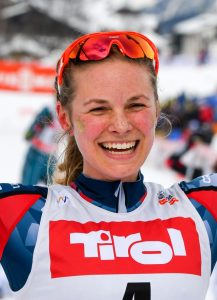
Reading these words made me wonder, what does it take to win a race? What does it take to not only cross the finish line, but to cross the finish line first? And how can I relate that to the spiritual life? So I read the autobiography of an athlete. My athlete of choice was Jessie Diggins, a cross-country skier who won the first gold medal for the United States in any Olympic cross-country skiing event. Although her autobiography “Brave Enough” is secular in nature, there are many parts that are relatable to running this great race and participating in this pilgrimage to Heaven. Running a race takes an individual. Winning a race takes making good decisions each day, words of encouragement and truth, and the support of a great team.
It’s all in the moderation and balance, and before I do anything, my first thought is, how will this impact my racing? (p. 185)
There are a lot of decisions to make after leaving religious life – decisions that perhaps earlier were made for us. What will I wear? What will I eat? What time will I get up? How should I spend my free time? When will I pray? Athletes too face many daily decisions during their months – or even years – of preparation for a race. Jessie approaches these decisions with the end goal in sight: she asks herself, “How will this impact my racing?” I have found it helpful to ask myself the same question as I make decisions in the world. Of course, by “racing” I don’t mean an Olympic cross country ski event, but rather that pilgrimage to Heaven. Through that lens, the decisions usually become clearer and perhaps even easier.
Sometimes the right decision means striving to grow just a little bit more. One exercise that some competitive skiers do is roller ski 100km (that’s 62.1 miles!). Jessie completed this one year, or so she thought. When she got to the end of the route she plotted out the tracking device only read 96 kilometers… so she immediately roller skied four more kilometers. I was struck by how she gave that workout her all, even if there weren’t crowds cheering her on and she could have easily called 96 kilometers good enough. For us, sometimes the right decision will be just managing to sit through Mass. Or perhaps it is filling out one more job application, or even an act of generosity or patience when we feel like we have nothing left. Whatever it is, sometimes the right decision is to stretch ourselves and ski those last four kilometers.
And sometimes the right decision is rest. I was struck by the importance that athletes give to rest – and not just physical, but also mental. Athletes need physical rest, a whole day of it per week (doesn’t that sound familiar?), so that their muscles can be allowed to recover and build after all of the exercise. It means no going hiking or anything that could be physically demanding, even if that is something she wanted to do that day. In preparing for a race, mental rest was also needed. For Jessie, sometimes the right decision was to watch a movie with a teammate to relax and calm down when things were getting stressful. Reading about the intentionality and importance of rest inspired me to try to find ways to be more intentional about how I treat Sunday. This day of rest is more than just a day off or a day to go to church. If I treat it more intentionally, perhaps it will become a day of restoration and growth for my soul, much like it is for athletes.
Lastly, and perhaps the favorite thing I noticed, is that sometimes making the right decision is in the little things. For Jessie, an important part of preparing for a race is glitter. Putting glitter on her face before a race reminds her that racing is fun. Glitter is a little decision that positively impacts her race. Perhaps there are little, seemingly insignificant, decisions that we can make that will positively impact our relationship with Jesus. One little decision I have recently made is to smile at Jesus, to let my delight in Him be shown as I would a friend. That little decision of allowing a visible sign of my love for Him appear on my face has brough much joy to my prayer life.
Words are a powerful thing. (p. 175)
One of the pivotal moments in Jessie’s story is when her coach, Matt, said to her “Who you are is good enough,” and she believed him (p. 123). After having had many difficult experiences with a previous team, those words gave her the freedom to be herself and to trust that she would be loved and supported as she was. Of course, “Who you are is good enough” doesn’t mean that she was ready to win a gold medal right then and there. Of course there was still work to be done, but that doesn’t take away from the fact that she is good enough. She is someone her team is ready and willing to support. She is someone who has what it takes to race well. She is good enough.
Sadly, words can also have a negative impact. In a 10K Olympic race, Jessie missed the podium by 3.3 seconds. The media implied that she should be very disappointed that she failed to achieve the first Olympic medal of the US women’s team by a hair. But she wasn’t disappointed. She gave that race everything she had. She made the right choices leading up to the race. She had a good race. That was the true victory. And the media took that away from her. They were telling her she wasn’t good enough.
I think many of us who have left religious life face a similar temptation. We each have our own story of why we left, and we need to remain faithful to the truth. Sometimes we know the truth about leaving immediately, and sometimes it is a truth that unfolds after we have left. But we cannot let others take that truth from us. One of the lies that perhaps many of us face after leaving religious life is that we’re not enough. Those are not the words of the Father. In those moments, we need to turn to Jesus who is the Truth and allow Him to speak His words into our hearts. We need to allow Him to tell us that we are good enough. That we are still called to live lives of great holiness, lives of what Caryll Houselander calls “undiluted, heroic, crucified love.” That we are loved. Fully. Here and now. That He will never abandon us, and never has. Jesus wants to say those words to us. He wants to say, “Who you are is good enough.” Who you are is someone He can contine to lead along the path to holiness. Who you are is fully loved by Him here and now. Who you are is good enough.
It was the start of what we called the “fifth leg of the relay” because it was our way of saying that the alternate was our most important leg. (p. 126)
Selection for a 4 X 5K relay is hard when there are more than four skiers on the team. Someone is going to get left out of the race. The first year that this happened with the US National team the skier who was left out, Ida Sargent, turned it into the most important leg of the race. She showed up to the course on race day – even though she didn’t have to – and cheered her teammates on for over an hour. Her enthusiasm was so exuberant that some skiers wondered who that crazy person was yelling herself hoarse!
In a way, those of us who have left religious life are now a part of “the fifth leg.” Others were chosen and we are left out. But the reality is, whether or not we or our communities act like it, we are on the same team. We may no longer be a part of the particular community, but we are still a part of the Body of Christ. Ida set a precedent for the US National team. Perhaps some of us could help set a precedent for those of use who have left religious life. What if we could act like we still have an important role to play? What if we acted like our prayers and sacrifices do matter? Maybe the team that we left doesn’t have the camaraderie that would make imitating Ida easy. A rough transition can really make being a part of the fifth leg difficult. But we can still try. I can still try. You can still try.
“Here comes Diggins! Here comes Diggins!”
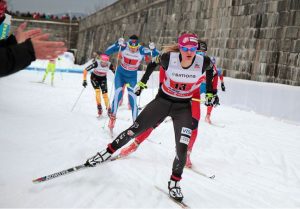
When you watch her gold medal finish at the Pyongyang Olympics, it may seem like she is on her own to strive for that finish line. But she’s not alone. Her team not only supported her though all the training, but was also there for the race. Her family was there. The announcer shouting “Here comes Diggins! Here comes Diggins!” as she edges past the other skiers knew her. She had family and friends watching the race on television. She was not alone in her race. And we are not alone in ours either. Some of us, I’d hope many of us, have the strong support of family and friends as we run this race to Heaven. Regardless of whether we do or don’t, sometimes it can be too easy to focus on the shortcomings of the earthly teams we are a part of, and forget that we are a part of an incredibly beautiful team. A beautiful team that is on our side. We have the Communion of Saints supporting us. We have the angels, and Mary, and Joseph. We have the Father, Son, and Holy Spirit. We are not alone. And perhaps, when we do cross that finish line, we will hear the enthusiastic roar of all those who have been cheering for us along the way.
Images of Jessie Diggins from Wikimedia Commons, used under Creative Commons Licence.
Attribution: Granada • CC BY-SA 4.0
Attribution: Cephas • CC BY-SA 3.0
Sep 15, 2021 |
By Mary Rose Kreger, republished from her shared blog Monastery in My Heart.
Eight years ago, I was a young novice, Sr. Mary Inez. I spent 19 months in the convent before realizing I was called to a married vocation. Today I am a happy wife and mom, but re-entering the world was a great struggle for me. Here is a poem about my experience:
Once outside the convent
You still long to be inside it
The white curtained walls
The ancient creaking floors
The silence and the song.
He drew me in and I followed,
Hungry for the final Word in treasures—
His secret gaze pierced me, pleaded silently:
Come.
I left everything to find Him,
My home, my job, my family—
Stepping out of the boat into the deep waters.
In return, He gave me the Cross,
That bitter cure-all for a thousand ills,
But also a taste of Heaven.
19 months in His garden, and then He says,
“Go home and tell your family all that I have done for you.”
And so I do. I go home and tell of
The white curtained walls
The ancient creaking floors
The silence and the song.
Six weeks later, I meet James,
The man whom I will marry
Whose birthday is Christmas like
The First Beloved of my heart.
We work and we play, we talk and we pray.
We are married, find a home,
Have a son, then a daughter—
Make friends, lose friends.
Die a hundred tiny deaths, and
Rise a hundred times again.
We share our lives together.
The Lord makes us new—He kisses me
With James’ touch, and embraces me with
Lukie’s arms, and gazes at me
With my daughter’s eyes.
He still wants me, even if His rose was
Never meant to stay in His convent garden.
No, rather to struggle and labor
In this world, pretending to fit in
When my heart has been spoiled for anything
Save Him.
On the outside, endless motions,
Movements of faith, hope, love—
And grit and survival, too, for this
Long journey is hard.
On the inside, a tiny-heart-home,
Always longing for the white curtained walls,
The ancient floors, where I first saw Him.
There, I tasted heaven once—
A darkness that was Light—
And I can no more return to my
Heathen ways than a child to her
Mother’s womb. I tasted heaven once, and my
Heart is ruined for anything else.

 By Mikayla.
 As we celebrate this feast, let’s pray through St. Lucy’s intercession that those of us who are shrouded in the darkness of uncertainty may cling to the light of Christ which shows us the way to heaven. Lucy’s name – meaning light – comes to us in the liturgy at one of the darkest moments of the year physically. She also lived at a rather dark time for Christians as well – it being in the midst of persecution. However, in both cases she brings the light of Christ which she herself has experienced to those around her and to us today. I can’t help but think of the parable of the wise and foolish virgins which also very fittingly ties into this blessed Advent season. (And this parable is not just for the consecrated persons or religious, it’s for everybody.) Let us not be afraid this Advent and in our transitions from religious life to practice the “art of waiting.”
 by Emma
 Sadly, words can also have a negative impact. In a 10K Olympic race, Jessie missed the podium by 3.3 seconds. The media implied that she should be very disappointed that she failed to achieve the first Olympic medal of the US women’s team by a hair. But she wasn’t disappointed. She gave that race everything she had. She made the right choices leading up to the race. She had a good race. That was the true victory. And the media took that away from her. They were telling her she wasn’t good enough.
 When you watch her gold medal finish at the Pyongyang Olympics, it may seem like she is on her own to strive for that finish line. But she’s not alone. Her team not only supported her though all the training, but was also there for the race. Her family was there. The announcer shouting “Here comes Diggins! Here comes Diggins!” as she edges past the other skiers knew her. She had family and friends watching the race on television. She was not alone in her race. And we are not alone in ours either. Some of us, I’d hope many of us, have the strong support of family and friends as we run this race to Heaven. Regardless of whether we do or don’t, sometimes it can be too easy to focus on the shortcomings of the earthly teams we are a part of, and forget that we are a part of an incredibly beautiful team. A beautiful team that is on our side. We have the Communion of Saints supporting us. We have the angels, and Mary, and Joseph. We have the Father, Son, and Holy Spirit. We are not alone. And perhaps, when we do cross that finish line, we will hear the enthusiastic roar of all those who have been cheering for us along the way.
 By Mary Rose Kreger, republished from her shared blog

Recent Comments