Apr 17, 2021 |
 By Cate.
Do you find yourself ready to start dating and yet limited by the lack of social activities these days? (Thank you, Lord, for paradoxically opening my heart to marriage in the midst of a global pandemic!) Or maybe you’ve found the local Catholic dating scene leaving something to be desired. (Too many awkward conversations on tap.) Maybe you’ve thought of trying an online dating site but have hesitations for multiple reasons including horror stories, safety concerns, or the belief that if God wants you to date, He’ll bring someone into your life.
I always desired to meet someone organically. And I did. Multiple times. I probably started dating before I was ready, considering I had been in consecrated life for a decade. But several years and a few breakups later, the Lord did something in my heart. And He called me to create a profile on a Catholic dating site. I believe that I reached a point where clicking “not discerning a religious vocation” gave me a sense of finality and intentionality in my discernment of marriage.
I am grateful for the person I met online! I also know people who tried it for years and finally met their spouse in real life. It’s different for everyone, but I’d like to encourage people to prayerfully consider it. And because it can be so brutal, I’d like to offer some thoughts based on my own experience.
- Craft a stellar profile. Make it honest and detailed. Be specific—it helps you to stand out and not just be “one more profile” that someone reads. What makes you unique? Choose good photos that represent you well. If you don’t have many, ask a friend to help you take some. Be you. Don’t be afraid to talk about yourself. That’s easier for some of us than others.
- Find a tribe to support you. Or at least a friend. I was blessed enough to be living among holy friends when I entered the online dating scene. Because it can feel demoralizing at times, it helps to have a sister to remind you of your worth. It’s also great to have someone to bounce messages off of and to seek advice about a particular person or conversation.
- Be intentional and disciplined. Set aside certain times to scroll, like profiles, and send messages – both so that you don’t become obsessed with it and so that you don’t do nothing at all.
- Don’t be afraid to make the first move. We all want to be pursued, am I right? And much of our formation has told us that this is the “right” way. I always assumed that if God wanted me to get married, He would bring that person to me. But that mentality kept me from taking ownership of my desire for marriage.
I’m here to tell you that sending a first message to let a guy know that you’re interested IS OKAY. It is NOT contrary to letting yourself be pursued. Men want to pursue, but they also want to know that they won’t be rejected. And many men appreciate women who are confident.
If he doesn’t eventually begin to pursue you, then you can move on. But sometimes we need to be the ones to drop that first hint. If he’s right for you, he’ll take it from there.
- Be open minded. Know your non negotiables, but don’t unnecessarily lock yourself into a certain type when it comes to things like interests, career, or location. You could be surprised by someone who didn’t seem to be your “ideal match” at first.
At first I was looking for someone within driving distance. Or someone who lived anywhere but worked in ministry. The man I fell in love with fell into neither of those categories. I sure am glad I expanded my search and kept an open heart.
- Send messages. Don’t be afraid. The more you send, the more of a chance you have at finding someone you really click with. And it’s good practice. Read their profile and acknowledge something from that. Ask leading questions, not ones that can be answered with “yes” or “no.” Be genuine. Allow some back and forth, but don’t continue relentlessly if he doesn’t seem interested.
- Say “no” if it’s not going anywhere. Don’t be afraid to kindly express that you’re not interested in taking the conversation any further.

This is hard. It was especially hard for me. I can make good conversation with just about anyone, and I have a sensitive heart. But I had to be honest I wasn’t interested in going further. If I knew this person in real life, I’m sure that we could continue being friends. But the reality of online dating is that you will have to reject good people, and you will never see them again. A relief for some, a cross for others.
But don’t ghost. It’s not kind. I appreciated polite rejections from others, so I wanted to do the same. Sometimes a conversation will fizzle out without either person having to say anything, and that’s ok. But if you’ve corresponded a lot or have talked on the phone, sending a polite rejection couched in appreciation and compliments, is the right thing to do. Even though it can be super hard.
- Maintain hope. Don’t let the bad apples discourage you from finding a potential match. You’ve heard all about it—the number of guys who don’t believe in all the church’s teachings, the ones who don’t go to Mass, the guy whose mom set up his profile so that he could find a “nice Catholic girl,” the ones who lie about their age or don’t update their photos in years. Click “not interested” and move on. Don’t hate the tool because not everyone uses it perfectly.
- Remain rooted in your identity in Christ. It can be pretty discouraging when none of the cute guys are responding to your messages, when a promising conversation fizzles out, when a first phone call doesn’t lead to a second. We can be harsh on ourselves and wonder if there’s something wrong with us.
This is where our relationship with the Lord has to be our source of truth. Who we are in Him is much more important than how we are perceived by anyone else. That must be our foundation and where we return day after day.
- Keep it light! You can be both casual and intentional. Just because the ultimate goal is marriage doesn’t mean you have to have it all figured out from the beginning of each encounter. That’s unrealistic. Not every conversation will turn into a date. Not every date will lead to marriage. Relax. Enjoy getting to know people. Laugh at the awkwardness. Rejoice in the variety of humanity. Be grateful for pleasant conversations and new things learned.
—
Dating is a great act of faith and trust. If we believe that God works all things for our good, we are called to trust that each dating success or failure is part of His greater plan. In the midst of a heartbreak it’s tempting to wonder endlessly why things didn’t go our way. Sometimes it is only chapters down the road that we get a glimpse of understanding—and are even filled with gratitude that the Lord had His perfect way in the matter.
So if you’re feeling the itch to try online dating, approach it prayerfully, with a system of support, keeping an open mind and a trusting heart. It’s one more way of putting ourselves at the Lord’s disposal, allowing Him to lead us as He wills.
If you’re interested to try online dating and would like help creating a profile, or if you’d like to give your current profile a makeover, contact me to sign up for a free 45-minute profile session. I’m happy to share tips based on my own dating experiences and my background in marketing. Please send a message addressed to Cate via the Leonie’s Longing contact form , and it will be forwarded in confidence.
Mar 17, 2021 |
By Windy Day.
A few years ago I went for a surprising bike ride. It was a sunny and beautiful day and I set off recognizing that it was a bit breezy. My hat was slightly blowing around but I didn’t think about the direction of the wind. I thought I’d go for a 20 minute bike ride; 10 minutes one way and 10 minutes back.
When I turned around to return, I had a rude awakening. Unbeknownst to me, I had been riding with the wind all along. Now I was going straight into it.
And it was strong. Very strong.
Because I was in the country, the wind cut across the fields and hit me with great force. I felt as though I could hardly move forward. I had gone up and down a few hills on my way there and now I realized that I would have to tackle those hills against this wind. This daunting prospect discouraged me. But I realized that I needed to go. I had no other way of getting home.
So I pedaled and I pedaled and I crept back. The wind was so strong that even when I was trying to coast downhill I was losing speed. It was stunning.
Eventually I made it home and I was rather proud of myself. And exhausted.
I found it to be a great analogy for the spiritual life. The entire time I felt like I wasn’t making progress because I was going about half the speed that I was when I left. It was frustrating to suddenly slow down that much. I wasn’t accomplishing what I thought I would. The expectations I had for the bike ride flew out the window. My hands were cold, my ears were ringing and I was exasperated.
I felt similarly when I returned to lay life. I had grown accustomed to the graces and beautiful gifts the Lord had been giving me during my time of discernment. It was a bright period filled with consolation.
But my time in religious life and the period afterwards were in stark contrast to this peace. I felt as though I was not making any progress at all as I plunged into spiritual darkness. As a matter of fact, it felt like I was going backwards.
As we all know, our feelings about our prayer life and the spiritual life are often inaccurate. We don’t have a precise way to gauge our progress. Saints like Alphonsus, Aquinas and Francis de Sales say that a prayer time which feels distracted and pathetic is the best for you. This is because you persevered and exercised your will! In contrast, when I was riding my bike, even though it did not feel like I was going forward, I could assess my progress by seeing the landscape pass by … just verrrrry slowly.
Often we simply have to trust that we are moving in the direction that God wants, even if it doesn’t feel that way. I encourage you to keep fighting and moving forward even if you want to quit. As the saying goes, “God can’t steer a parked car.” If I have momentum while biking, it’s easier to change direction as opposed to starting from being “parked.” Even if you’re slightly off-course, God will have an easier time reorienting you if you are moving.
But how can you fight discouragement, frustration and powerlessness?
First, remind yourself that you can choose. On my bike ride, a part of me felt I had no choice – I had to get home! But I did have a choice. I could have stopped and collapsed on the road. I could have walked my bike all the way back. I could have waited for a car to come by and tried to hitchhike. And I could have kept riding. We always have a choice. If nothing else, we can choose how to respond internally.
Second, you can do a self-assessment and/or ask for feedback from others. A daily Examen helps but often we don’t have the best perspective on our own spiritual life. Try to check in with family, friends, a spiritual director, etc. to help you get a more accurate perception of your spiritual condition. Just because it doesn’t “feel” that you are changing or growing doesn’t mean that is actually the case.
Next, the sacraments are powerful and provide us with grace beyond measure. Reconciliation and Eucharist both provide much-needed healing and they can be regularly accessed by the faithful. During confession the priest might even offer advice and words of encouragement.
Finally, remember that strength comes from pushing yourself reasonably. If you exercise and only do things you find easy, you won’t get stronger. But, if you do too much, you will hurt yourself. Finding that balance is the key, but it is SO DIFFICULT. If you’re recovering from a physical injury, it’s understandable that you may be afraid to be hurt again. It’s possible that you have experienced hurts, wounds and injury during and/or after your time in religious life. As a result, it can be scary to keep up with prayer, consider discerning with another community or be open to marriage, for example. Be honest with yourself and with God about these fears and allow yourself to be “coached” when you are discerning your next steps. Ask Mary to help you discern when to push forward and when to change course.
Times of desolation and spiritual combat are incredibly challenging. But they can be less difficult if we anticipate them and have tools ready to address them.
If you’re not currently struggling in this way, think about what you will do when you are in this situation. Also, please pray for others who are having a hard time.
If you have experienced this before, please share your tips and strategies in the comments below.
If you are grappling with discouragement, please try the suggestions listed here and keep pedaling! Most of all, be assured of our prayers.
Nov 29, 2020 |
An Advent reflection by Emma.
As I watched Disney’s Frozen II I felt, at some level, understood. Some friends who saw the movie also noticed themes that resonate very much with what it is like to discern religious life, or to have a friend who is discerning religious life. The below is less of a review and more of a spiritual exploration of a few of those themes through soundtrack lyrics paired with scripture. To those who may feel a little frozen in their discernment journey after having left the monastery, I hope these reflections help you to see that you are not alone – that others are frozen too – and that there is hope, for indeed “We know that in everything God works for good with those who love him” (Romans 8:28)
I’ve had my adventure, I don’t need something new
I’m afraid of what I’m risking if I follow you
Into the unknown
“Lord, if it is you, command me to come to you on the water.” Matthew 14:28
Elsa rules peacefully rules over Arendelle in the company of her dear sister Anna and friends. She already had an adventure of self-knowledge, self-acceptance, and sisterly love, yet there is still more to be learned and growth to be had. She still doesn’t understand why she has cryokinetic powers and is simultaneously longing for a life where having such a gift makes sense, but that might mean leaving behind her tranquil, easy-going life… again.
Similarly, many of us who have been in religious life may feel like we have already had our adventure. We already made the sacrifice. We left home behind and followed Jesus out onto the water. We followed the calling with everything we had, and everything the Spirit was willing to give us. We grew in self-knowledge and matured in other ways through living religious life.
And now we’re back.
It’s too easy to think that I have already had the adventure of religious life and I don’t need anything new. It is hard to listen and discern when I’m not sure if I trust those movements in my heart anymore. It is be hard to consider risking everything… again. Yet I do have the qualities of a contemplative soul and desire to find a place where those gifts fit in. I am different. Not many people would be willing to leave family, friends, career, and everything else to wake up before 5 am every day and never again be able to choose what’s for breakfast. Of course, the secret is that underneath the sacrifice is a deep love and longing for God – a spousal love.
And so the call remains… to something. I remain confident that Jesus is calling me to consecrated life, yet the context remains unclear. So I try to trust. And ask Jesus to bid me come to Him on the water if indeed He is the one who is calling.
And with the dawn, what comes then?
When it’s clear that everything will never be the same again.
Then I’ll make the choice to hear that voice
And do the next right thing.
“But on the first day of the week, at early dawn, they went to the tomb, taking the spices which they had prepared.” Luke 24:1
Another theme that appears in Frozen II is grief. This is definitely an emotion that I felt after leaving the monastery, especially toward the sister I was. Each sister is so unique in the way she loves God and the way she loves the other sisters, and the way she is loved by God and is loved by the other sisters. The fact that I left means that there will never be a sister in that monastery who is like that. Indeed, when a sister leaves the monastery or convent, things will never be the same again, and I remember wondering what is on the other side of grieving that loss.
I encourage you, wherever you find yourself, to do the next right thing. Perhaps the next right thing is spending a few minutes in prayer. Perhaps it is reaching out to a friend or priest for guidance. Perhaps it is going to Mass or Adoration. Perhaps it is simply finding enough motivation to go for a walk. The next right thing may not seem particularly remarkable, but each step taken out of love for Jesus is heroic. I encourage you, like Mary Magdalene and the other Mary, to go to the tomb. Because if you do, you will find the Resurrection – it just might not be right away though. Things will never be the same again, and that’s okay.
Show yourself
I’m dying to meet you
Show yourself
It’s your turn
Are you the one I’ve been looking for
All of my life?
Show yourself
I’m ready to learn
“Jesus said to her, ‘Woman, why are you weeping? Whom are you looking for?'” John 20:15
I’ll refrain from commenting on the context of this song so as to avoid spoilers, yet I wanted to include it because of how it mirrors contemplative prayer so well (note: the full song does contain spoilers). More than anything else after having left religious life, I needed to re-encounter the God I fell in love with. I needed to know that I was still loved by Jesus, when my emotions after leaving the monastery had me feeling rejected and abandoned. I found much healing here through praying in a way described by a bishop. His prayer in difficult moments was, “Lord show me how you are good here. Lord I want to see you in this situation” and he assures that when we pray in this way “God always comes through. And I mean always.” Through this prayer I was asking Jesus to show Himself, which is at the heart of the cry of a contemplative soul. I wanted to learn how he loved me through the difficult moments. I wanted to see how He was living His mysteries within my own life. I wanted to see God. As I began to pray in this way, moments of great suffering turned into moments of great intimacy with Jesus, and I’ve grown much in understading who I am to Him and who He is to me.
Where the north wind meets the sea
There’s a mother full of memory
Come, my darling, homeward bound.
When all is lost, then all is found.
“And Mary kept all these thing, pondering them in her heart.” Luke 2:19
This opening song of the film actually makes quite a beautiful Marian hymn. Mary, our mother, is full of memory. She watches over us and ponders moments of our lives in her heart. As St. Mary of Jesus Crucified says, “Mary counts your steps.” We have a mother who cares for us. Loves us. Nurtures us. Heals us. This Advent, I invite us to ask Mary to lend us her heart. I invite us to ask her to permit us to see as she sees. To feel as she feels. To know as she knows. To hear as she hears. To love as she loves. To ponder as she ponders. We have a Mother who is counting our steps to our eternal home, where truly all that we long for will be found.
Nov 9, 2020 |
By Emma.
“You don’t need to fold it.” Mother said.
“Too late.” I replied from the inside the infirmary bathroom as I fiddled with the bandana, trying to cover my shorn hair as best I could. I was glad I already folded the habit, before a sense of obedience would have bidden me leave those holy garments in a deflated heap of brown and white. Street cloths felt so unusual now. Especially a short sleeve shirt. ‘Good enough,’ I thought as I stopped adjusting the bandana. I gently picked up the clothing I wished I was wearing off the counter, opened the door, and placed it on the large windowsill of the cloister corridor. I felt stripped. We walked past the cloister door where I entered the monastery, and came to a stop at the turn door, where I would leave.
“I am the door; if any one enters by me, he will be saved, and will go in and out and find pasture.”
– John 10:9
Doors mark a entering, or a leaving. They provide access to shelter and security. They can provide a hiddenness. An open door is an invitation. A closed door can feel like an inpenetrable barrier. Doors can mark a change, a transition, or a new space. Those Holy Doors of Mercy were the floodgates of grace thrown wide and a passage to a new beginning. Entering the door of the monastery seemingly marked the end of one life and the beginning of another. Three knocks, the click of a bolt, and a few steps brought many of us within a world we could only enter through our imagination. Doors carry importance in our hearts and our minds. In fact, research conducted by Gabriel Radvansky at the University of Notre Dame indicates that we do have a memory lapse when we walk through a doorway. Doors do mark a change, a transition into something or someplace new. In identifying Himself as the door, Jesus is itentifying Himself as that new beginning, as that source of shelter and security, as that invitation newness of life.
Jesus also says that if we enter by Him, we will “go in and out and find pasture.” I find this to be a very heartening phrase for those of us who have left religious life. In these words, Jesus promises us nourishment on either side of the sheepfold. When I went in to religious life, found pastures for my soul. When I went out of religious life, I also found pastures for my soul. Speaking on a more practical level, although walking out of the monastary door meant leaving the sisters with whom I had lived and loved like family, no longer living under the same roof as the Eucharist, and no longer having the silence, the stillness, and the simplicity of monastic life, walking out of the monastery also meant re-entering the world. It meant an open door to the friends and family members with whom communication was limited. It meant entering being a daughter, a sister, a friend, and a coworker. And in re-entering these familiar places, and exploring some new ones, I continue to find interior pastures for my soul.
“I am the door of the sheep”
– John 10:7
More than any door made of wood or steel or stone, each of us has entered that door which is Jesus Himself. Jesus is the reason why we entered the monastery in the first place. As Sr. Karla Goncalves, OSCO, describes, “I ask myself Why did you come? It’s Him. Who do you seek? It’s Him. Why do you stay? Can’t live without Him.” (Hidden: A Life all for God) As I reflect on those words, I am drawn to add “Why did you leave? For Him.” As paradoxical as those words can seem, they are true. Leaving the monastery was still wrapped in the prayer “All for you, dear Jesus, through your mother, Mary, as an act of the most pure love.”
In the first reading for today, the Dedication of the Lateran Basilica, we hear “The angel brought me back to the entrance of the temple, and I saw water flowing out.” Perhaps each of us needs to go back to the entrance, the real entrance. Not to any doorway made of stone and wood, but to the very heart of Jesus Christ. That is where we entered the monastery. That is where we re-entered the world. That is there where we will find those flowing waters for which we continuously long for.
“He who enters by the door is the shepherd of the sheep”
– John 10:2
In the Gospel of John, Jesus identifies Himself as both door and shepherd. Yet how can this be so? Perhaps this is so because our wounds are united to His. And if this is true, then perhaps, on a deeper level, leaving the monastery is not a closed door at all. Perhaps it is a very open door.
Leaving the monastery has left me with a wound; it has left me with a place where God can enter. Having a wound allows me to unite myself to Jesus in the most intimate way – in His suffering. It is only with our closest friends that we share our wounds. Those friends who we know will have the courage to enter within those wounds with us. Those friends who we know will be compassionate. Those who enter by other doors in our life are not as close to us. Perhaps this is precisely how we can know that it is Jesus who is entering – because He enters by the gate – He enters by our wounds. He accepted the Cross, He received wounds, so He could meet me here. He received wounds so that He could suffer with me. He received wounds so that He could enter within my wounds, and He invites me to enter within His wounds.
Not only does Jesus enter our wounds, but our wounds are the very place where God desires to manifest His glory. In Salvifici Doloris, Pope St. John Paul II writes that “…the weaknesses of all human sufferings are capable of being infused with the same power of God manifested in Christ’s Cross. In such a concept, to suffer means to become particularly susceptible, particularly open to the working of the salvific powers of God, offered to humanity in Christ.” May our wounds be like the wounds of Jesus. May our wounds be the door for the saving power of God.
“Knock and the door will be opened to you.”
– Matthew 7:7
I approach the door
candle in hand
light of Christ to guide me
I knock
and knock
and knock
The click of a bolt,
the creak of hinges,
crucifix cradled
by gentle wrinkled hands.
Even now
I can still enter
those sacred wounds.
Nov 2, 2020 |
By Sally Hoban.
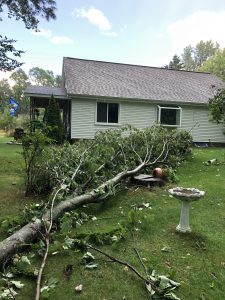
On September 3rd (2019), the canopy of one the trees in my yard snapped and crashed down in our yard; it missed the house by a few feet. In many ways, the breaking of the top of this tree and the fact that it did not damage our house reminds me of my own path through this dark period of my life. The tree is no longer whole and the top that kissed the sky is now in a woodchip pile somewhere, but thankfully, the tree is still standing, and the damage done to the area where it landed was minimal. In so many ways, this parallels with me, however, I pray that the damage I have done in the depths of my despair and rage has not damaged beyond repair my relationships with those who love me.
As I start to feel the storm of despair and anger recede, I’m beginning to not feel blinded by the light around me. No longer do I recoil when I find myself looking out and wondering what next. No longer do I weep over the yearning to fulfill the call I heard to live out my life as with the congregation I love so much. Yet, I am now able to also acknowledge how painful and agonizing it was to constantly be in the throes of trying to prove my vocation to the decisionmakers within the congregation. So, how do I learn to live with this conundrum…
For so many months, I banged my head against a wall trying to make sense of all of this. I went round-and-round trying to make sense of hearing a call from God to pursue my vocation with this congregation and being rejected; blaming myself for being me, wishing I could have been someone the Provincial Team and the Vocation Director would accept; to replaying my mistakes and wondering how they could have been so great as to be summarily dismissed. I was so in love with God, my vocation and the journey of discernment that I believed nothing could stand in the way of fulfilling this yearning, but something did stand in the way…I was told by the Provincial, “The decision has been made to not continue the discernment with me.”
After the dust settled and I awoke to this reality, I found myself broken and shattered beyond repair. For the first year, I could barely get through a day without weeping and wishing to die. (Yes, I said it, I wanted to die!) I had spent over 40 years searching for meaning in my life. When the spark of living my life as a Catholic sister took hold, my whole being lit up. I found myself living from my heart from the early days of my discernment through the early days of February 2018, when I still believed that Jesus would sweep in rescue me and restore me back to my vocation with the congregation that rejected me. When I became aware that this was not going to happen, my life became a living nightmare and I rejected God and myself, the self that still believed and hoped for meaning in my life.
A few months ago, I was encouraged to embrace the phrase “fake it until you make it”. Since I was told this by one of the sisters from the congregation, it stung all the more. Yet, as the second year of this reality comes to a close, I am aware that in many ways, I have successfully utilized this task. I am back on my feet, albeit different feet than before, but nonetheless, I am gainfully employed, no longer weeping or lost in turmoil when I reflect on the current status of my life, and beginning to take in my life and contemplate a new path.
Like something that was broken and glued back together is never the same, I too am learning that I am broken and slowly being glued back together. I believe that Jesus not only has stood by me during this darkest time in my life, but saved me from the darkness that threatened my very existence. I’m still figuring out how to deal with this, because I am still angry with God over my rejection; however, I no longer have the energy to lash out at God when it arises, instead I find myself desiring to simply be honest by acknowledging this anger, sadness and hurt without losing myself in the depths of this despair.
Somehow though, I don’t want to go back to life before I was broken. I want to learn how to live from my brokenness. Can Jesus use my brokenness in God’s great mission? How can I live with my brokenness without letting it destroy me? How will Jesus to carry me in a new way? How might I use this longing to return to my religious vocation with the awareness that it is unlikely that I will return to my religious vocation with that congregation? Perhaps this leads to the question, do I really want to return to that?
I’ve often reflected upon my friend’s encouragement to write a book about my experience; however, I fear that my recounting of my experience would turn into a negative rant tied with fantastical dreams. Yet, I would like to utilize my keyboard to gain insight into how I might learn to live from this brokenness.
I’m not sure where this journey is leading me. So, I am utilizing my need to express myself, my hope to be heard (read) and the prayer that perhaps this might open a new path on this life’s journey…. Living from a place of brokenness…
Addendum
Nearly a year after writing this with COVID-19, these words describe where I was. Where I am today is somewhere further down the road of discovering who I am and how I might learn from my experiences. While I don’t pine for what was and what isn’t, I wonder where might God be calling me. The other day my spiritual director reminded me that God isn’t finished with me yet, so I know I am living my next adventure right now.
During prayer, I have been hearing, “Tell me, what is it you plan to do with your one wild and precious life?”, the line from Mary Oliver’s poem “The Summer Day”. Some days, I am troubled by the question, as I wonder, what to do? Other days, I am on a mission to determine what I am called to do. Today, I realized I am simply living into this moment, and this is my “one wild and precious life”[1].
[1] Oliver, Mary, “The Summer Day” from Dog Songs: Poems , (Penguin Books, 2015).


 Dating is a great act of faith and trust. If we believe that God works all things for our good, we are called to trust that each dating success or failure is part of His greater plan. In the midst of a heartbreak it’s tempting to wonder endlessly why things didn’t go our way. Sometimes it is only chapters down the road that we get a glimpse of understanding—and are even filled with gratitude that the Lord had His perfect way in the matter.
 By Windy Day.
 But how can you fight discouragement, frustration and powerlessness?
 Times of desolation and spiritual combat are incredibly challenging. But they can be less difficult if we anticipate them and have tools ready to address them.
 An Advent reflection by Emma.
 Similarly, many of us who have been in religious life may feel like we have already had our adventure. We already made the sacrifice. We left home behind and followed Jesus out onto the water. We followed the calling with everything we had, and everything the Spirit was willing to give us. We grew in self-knowledge and matured in other ways through living religious life.
  Another theme that appears in Frozen II is grief. This is definitely an emotion that I felt after leaving the monastery, especially toward the sister I was. Each sister is so unique in the way she loves God and the way she loves the other sisters, and the way she is loved by God and is loved by the other sisters. The fact that I left means that there will never be a sister in that monastery who is like that. Indeed, when a sister leaves the monastery or convent, things will never be the same again, and I remember wondering what is on the other side of grieving that loss.
  I’ll refrain from commenting on the context of this song so as to avoid spoilers, yet I wanted to include it because of how it mirrors contemplative prayer so well (note: the full song does contain spoilers). More than anything else after having left religious life, I needed to re-encounter the God I fell in love with.
 This opening song of the film actually makes quite a beautiful Marian hymn. Mary, our mother, is full of memory. She watches over us and ponders moments of our lives in her heart. As St. Mary of Jesus Crucified says, “Mary counts your steps.” We have a mother who cares for us. Loves us. Nurtures us. Heals us. This Advent, I invite us to ask Mary to lend us her heart. I invite us to ask her to permit us to see as she sees. To feel as she feels. To know as she knows. To hear as she hears. To love as she loves. To ponder as she ponders. We have a Mother who is counting our steps to our eternal home, where truly all that we long for will be found.


 By Sally Hoban.

Recent Comments