
Jun 21, 2017 |
 By LumenChristi.
May/June can be hard months for those of us still discerning our place in life. Weddings, ordinations, professions of vows, and entrances into religious communities are a painful reminder that another year has come without any such milestone in sight for us. We rejoice with our friends and families – do our best to put on yet another reception with love, and send yet another friend off to the convent/seminary with prayers. And sit through yet another homily about “celebrating a yes to the Lord and to one’s vocation.” And go to confession yet again for envy/self-pity/lack of trust in God.
Am I right? Or is that just me?
I read an article recently called “We said yes too” about the struggles of Catholic couples who struggle with a miscarriage or infertility. While those around them get celebrated for having many children, they often experience the implication that those who don’t have a wild 7+ member crew in tow “aren’t open to life” or “haven’t said yes.” The author goes on to explain how she and others like her have said yes – hidden yesses too deep and painful to share. Yes to giving back to God an unborn child gone too soon; yes to the surrender of hopes and dreams in the struggle with infertility; yes to allowing the gifts that God has given to be enough.
When I read her article, as a woman discerning her vocation who has hit many painful detours along the road, I identified deeply with what she said. Though my life and struggles are different, my heart leapt with bittersweet joy as every word resonated.
“I have said yes too,” I thought. Not the “yes” that gets celebrated during “vocation season.” Not the exhilarating “yes” of a vow to the Church or to another person to commit my life forever. But a silent, not-spoken-out-loud kind of yes, I had given.
The “yes” to surrender my will and my desires to God and trust him for the timing.
The “silent yes” to Him in not settling for a “celebrated yes” that I knew wasn’t His will for me.
The “yes” to being faithful in prayer even during the times where I was no longer sure who I was praying to. . .
As well as the little “yesses” too that can cost a lot at times. Yes, Lord, I will smile at my friend and share his/her joy right now even though I would rather run away and cry. . .Yes, Lord, I will bite my tongue and accept criticism in humility when a priest or leader in the church asks “haven’t I thought about my vocation?” (Believe me, I ‘ve thought about it!!! Too much maybe!”)
We, dear single, discerning ladies, have said our “yes” too. I am not arguing that these “yesses” become publically celebrated. Firstly, that would be awkward, but secondly, some yesses are meant to be hidden. As Christ lived the first 30 years of His life, so too are many of the yesses along the way to holiness, hidden – sometimes even disguised and misunderstood. Such is the brokenness of humanity and the mystery of God. But as I was reading this article and reflecting on my own “yes,” I realized how important it is to understand and treasure it myself . I think, in the future, it will help me to step back from others’ celebrations just long enough to pause, and pray. “I too have said yes, Lord and you know it. Give me the strength to keep saying yes, even when it is difficult.”
Each woman can fill in what her “yes” has been. . .
“Lord, I said “yes” to entering the religious life, following you while my family thought I was crazy. . .and then, when you sent me back to that same family, I said “yes” again just as generously, although this time it was with tears. . . “
“Lord, I followed you out of the convent and into the world, not knowing where it would lead. I’ve accepted every bump in the road and being “a fool for you” as I adjusted back to secular life . . .”
“Lord, I desire marriage and a family, but I’ve said YES to waiting for it to happen in your time and in your way. . .”
“Lord, I do not know where I’m going, but I’ve said “yes” to journeying joyfully even when I feel desolate. . .”
“Lord, being at Mass right now only brings me pain, but I say “yes” to being here with you anyway. . .”
Each of us can find a lot of these “yesses” in our lives, and I have realized it is important to remember them. I believe that for me such remembrances will be the key place where I will find the power to rejoice with those who rejoice, and to walk in faith when I would rather see.
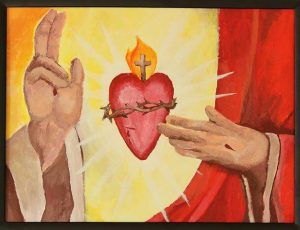
Of course, we are not alone in either the remembering or the resolving to do better. I hope it consoles you as much as it did me, to rediscover that no “yes” goes unseen by God. I think these yesses, that are the last to be thought of in this world, are the first to be remembered in His eyes, and the foremost to be felt by His heart. I think the more conscious of them that we become, the stronger we will be in remaining faithful to them.
God-willing, one day we too, will have the opportunity to make one of the “celebrated” yesses. But in the meantime, the silent ones are nonetheless real. Treasure your “yes” and allow the Lord to treasure you.
Dec 1, 2016 |
By Penny.
It was the day before I was due to leave Walsingham, England’s Nazareth, and head back down to London for my flight home. I’d hoped that by that stage I would have figured out some answers: do I have a religious vocation? If so, where? And when? My pilgrimage was almost over, though, and no clear answers were in sight. Instead, during my penultimate Mass in Walsingham, the priest gave a homily about waiting that has stayed with me for months.
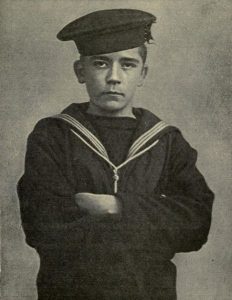
“Some of you,” he said, “may have heard of a boy named Jack Cornwell.” A lot of the older people in the congregation nodded. “He was a Boy Seaman, First Class, on board HMS Chester in 1916. The ship came under heavy fire from four German battleships, and all the sailors who were on deck manning the Chester‘s guns were killed or fatally wounded within fifteen minutes. Jack Cornwell was in one of the most exposed positions on the ship, but he remained at his gun awaiting orders from his captain – and that’s where they found him after the battle, barely alive and with his chest full of shrapnel, but still standing at his post, quietly waiting for orders.” He died two days later, at the age of sixteen. The priest went on to add that Boy Seaman Cornwell was awarded a posthumous Victoria Cross, the highest – and rarest – military honour in Britain, for “gallantry in the face of the enemy.” (According to Wikipedia, he was the third-youngest person ever awarded the VC.)
Jack Cornwell’s gun, aboard HMS Chester.
“I often feel,” the priest continued, “that I’m not doing a very good job of following God’s will – so often when I try to find out what He wants me to do, and to do it, I end up falling short. I want to push harder and try and force things to happen, but end up getting nowhere instead. You may find the same thing sometimes. But all of us – priests, laymen, religious – we are all called by God to stay at our posts, waiting for Him to give us our orders. Even when we’re wounded, that’s the way we are called to live: whoever we are, we are all standing where God has placed us, and quietly waiting for orders.”
The readings for the first Sunday of Advent, too, are about watching and being ready, “for no one knows the day or the hour.” Sometimes we are called to take action and make a leap of faith, but more often, we are called to wait: to remain alert and watchful, so that we are ready when the time comes and God calls us to move. I’m grateful to the priest for his openness about the sense of falling short in service to God, and for cutting through my own impatience with the reminder that we can’t force our lives forward, even in paths that might be His will, before His time comes. The greatest honour lies, instead, in remaining steady and awake at the post in which God has placed us, knowing that when it is time, His orders for each of us will come.
Oct 20, 2016 |
By Lucia Delgado.
For most of my life, I prayed often. I prayed for my family, friends, the country, and the whole world.
When I entered the Catholic Church in 2004, my prayer life was under development. I was introduced to the Rosary by the Dominican friars and they helped me understand the Blessed Mother more fully.
I guess that is why I decided to aspire with a Franciscan community under the protection of Our Lady of Sorrows. I was attracted by their desire for prayer. After a brief aspirancy period, I left the community after praying and asking the Blessed Mother for help. It seems that I was entering religious life to please others. Six months later, I met my fiancé and we have a wedding date set. During the discernment process I lived in fear; the marriage vocation scared me because of past family experiences. The Lord told me that everything will be fine… just follow Me. I sat up and accept the call to marriage and eventually motherhood. May God’s will be done.
The Virgin Mary was called not only to be a mother to the Lord; she was called to be a mother to all of us. Her fiat changed everything; she had peace know that God’s will be done.
In the month of the Rosary, I decided to reflect on this beautiful prayer which St. Dominic prayed in order to bring others to the Lord. I would that the brief aspirancy helped me to pray the Rosary and have a greater love for the Blessed Virgin Mary who leads us to Jesus.
By praying the Rosary, my fears are diminished. Mary was courageous enough to travel to visit her cousin Elizabeth; she trusted God throughout the pregnancy and the birth of Jesus.
She was sorrowful during the Passion but she knew that joy was coming.
For those who have left religious communities, know that joy is coming soon. We are not abandoned by our Lord and His Mother. He gives us His Mother to comfort us.
Hence each Ave Maria is a prayer for comfort.
Sep 28, 2016 |
By AfterEpiphany.
For the longest time after I returned home from the convent, I was afraid to move in a fixed direction or put down any roots. I didn’t want to commit to anything unless I was sure. Once burned, twice shy… that’s how it felt. I had given everything I could of myself when I was “living the life” in my community. I had committed entirely on an interior level, so when the call back out to the world came it hit me like a ton of bricks. The sense of purpose that I had prior to discerning out of religious life was a hard act to follow. Unless I could find a similarly purposeful direction to move in, I didn’t want to be tied down.
3 years after returning home, I moved out of my parents’ home and took out a lease on an apartment. I decided to allow myself to ENJOY setting up my new home. I went for uncluttered without being minimalist, with a few soft furnishings and bits and pieces to create a pleasant place to relax or to entertain… even a few prints of paintings by local artists of places to which I have travelled in my past… each one, a memory. It sure won’t be gracing the pages of any interior design mags, but it’s home.
Why is investing time, effort and $ in homemaking, even important, you might ask?
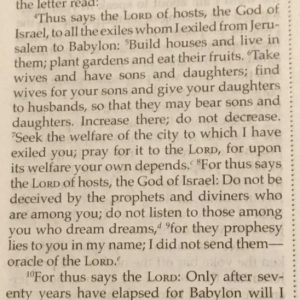
I’d invite you to pick up your Bible and flick to Jeremiah 29. No… not verse 11… that quote about a hope and a future that so many people explore on blogs like this one! Let’s have a look at something different! Go right back to the beginning of the chapter to where God addresses Himself to the exiles in Babylon.
He tells them to build houses, plant gardens, settle down, get married, seek the good of the society within which they are living. He told them that this exile was PART of His plan for them, that it wasn’t a thwarting of His plan. He reassured them that they were exactly where He willed for them to be, and gave them the confidence they needed to get on with living their exile well.
I’m still in the process of trying to work out how to do this well in my own context, and I dare say that this is going to look different for every one who has returned to the world from the convent. I know this much – putting my life into a holding pattern in the hopes that some wonderful life mission or purpose will materialise out of nowhere is not what He is asking me to do. Gabriel didn’t appear to our Blessed Mother in a waiting room. He delivered God’s message to her when she was at work.
So again, I invite you – sit down with this passage – and if possible, do so before the Blessed Sacrament. How is He speaking to you through this passage?
I pray you’ll find reassurance and peace!
Pictured Rocks, MI – captured by a local artist. It hangs on my wall to remind me of a wonderful memory kayaking under that archway with a dear friend of mine!
Q: What is “From My Inner Cell” all about?
A: From My Inner Cell: Conversations with God for convent-leavers
Sep 22, 2016 |
By Cinnamon.
I call it almost-discernment: where you’ve been bruised by a brush with convent life and are in no particular rush to repeat the experience, but at the same time, the idea of becoming a sister is like a distant phone in the background of your life that never stops ringing. Like when you hear about a new religious community and think, simultaneously,
a) I wonder if that will be the community God wants me to join?
and
b) I hope not because I don’t really want to be a sister anymore,
and
c) but I wish I could stop thinking about becoming a sister. (That phone is starting to drive me berserk: Lord, I’d answer it if I could figure out where it is. Could You please either point me in the right direction, or make it stop ringing?)
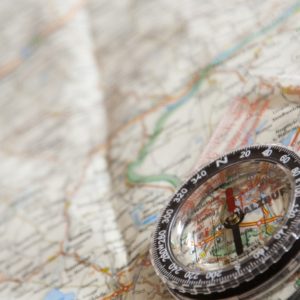
Discerning a religious vocation the first time around wasn’t easy by any means, but at least it was comparatively straightforward. The explanation I came up with for my spiritual director was this: the first time you enter religious life, it’s like turning a compass slowly until the needle points north and everything falls into alignment. God is the magnetic pole Who draws you to Himself, and you need only keep your eyes on the compass and follow the path north to Him.
Leaving the convent is like dropping the compass.
Of course, you pick it up again, and it looks fine on the outside – the glass unbroken, the case undented – but when you try to follow it, sooner or later you’ll find it’s been jarred out of alignment. The needle swings back and forth without stopping, on any bearing, let along north. God is still out there somewhere, and you keep waiting more or less patiently for the compass to settle down and start pointing you in the direction He wants for your life… and when it doesn’t, there’s no option but to start walking regardless, because that phone is just going to keep on ringing until you do. Discernment the second time around means having the courage to take even a single step forward, knowing that you have no real idea whether you’re heading north or south-south-west.
My post-convent discernment path has been largely comprised of zig-zags, punctuated occasionally by an “oof!” as
my faulty compass guides me straight into a tree. (I went on a nine-day orienteering camp when I was fourteen. Didn’t like it. Can you tell?) Our Lord told us, though, to keep on asking, seeking, and knocking; without a functioning compass, the walk will take longer, but one day – in His time – the underbrush will part suddenly and a clear path to Him will become visible. And He asks us to trust that, when each one of us gets to heaven and looks back down on the times when we felt most lost and helpless, meandering pointlessly in the scrub, we will see only one set of footprints.


 The “silent yes” to Him in not settling for a “celebrated yes” that I knew wasn’t His will for me.
 Of course, we are not alone in either the remembering or the resolving to do better. I hope it consoles you as much as it did me, to rediscover that no “yes” goes unseen by God. I think these yesses, that are the last to be thought of in this world, are the first to be remembered in His eyes, and the foremost to be felt by His heart. I think the more conscious of them that we become, the stronger we will be in remaining faithful to them.
 By Penny.
 By Lucia Delgado.
 By AfterEpiphany.
 He tells them to build houses, plant gardens, settle down, get married, seek the good of the society within which they are living. He told them that this exile was PART of His plan for them, that it wasn’t a thwarting of His plan. He reassured them that they were exactly where He willed for them to be, and gave them the confidence they needed to get on with living their exile well.
 By Cinnamon.
 my faulty compass guides me straight into a tree. (I went on a nine-day orienteering camp when I was fourteen. Didn’t like it. Can you tell?) Our Lord told us, though, to keep on asking, seeking, and knocking; without a functioning compass, the walk will take longer, but one day – in His time – the underbrush will part suddenly and a clear path to Him will become visible. And He asks us to trust that, when each one of us gets to heaven and looks back down on the times when we felt most lost and helpless, meandering pointlessly in the scrub, we will see only one set of footprints.
Recent Comments