Sep 22, 2016 |
 By Cinnamon.
I call it almost-discernment: where you’ve been bruised by a brush with convent life and are in no particular rush to repeat the experience, but at the same time, the idea of becoming a sister is like a distant phone in the background of your life that never stops ringing. Like when you hear about a new religious community and think, simultaneously,
a) I wonder if that will be the community God wants me to join?
and
b) I hope not because I don’t really want to be a sister anymore,
and
c) but I wish I could stop thinking about becoming a sister. (That phone is starting to drive me berserk: Lord, I’d answer it if I could figure out where it is. Could You please either point me in the right direction, or make it stop ringing?)
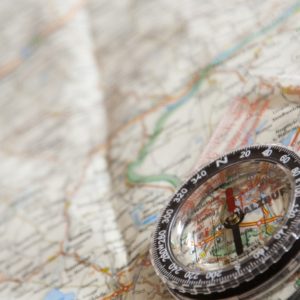
Discerning a religious vocation the first time around wasn’t easy by any means, but at least it was comparatively straightforward. The explanation I came up with for my spiritual director was this: the first time you enter religious life, it’s like turning a compass slowly until the needle points north and everything falls into alignment. God is the magnetic pole Who draws you to Himself, and you need only keep your eyes on the compass and follow the path north to Him.
Leaving the convent is like dropping the compass.
Of course, you pick it up again, and it looks fine on the outside – the glass unbroken, the case undented – but when you try to follow it, sooner or later you’ll find it’s been jarred out of alignment. The needle swings back and forth without stopping, on any bearing, let along north. God is still out there somewhere, and you keep waiting more or less patiently for the compass to settle down and start pointing you in the direction He wants for your life… and when it doesn’t, there’s no option but to start walking regardless, because that phone is just going to keep on ringing until you do. Discernment the second time around means having the courage to take even a single step forward, knowing that you have no real idea whether you’re heading north or south-south-west.
My post-convent discernment path has been largely comprised of zig-zags, punctuated occasionally by an “oof!” as
my faulty compass guides me straight into a tree. (I went on a nine-day orienteering camp when I was fourteen. Didn’t like it. Can you tell?) Our Lord told us, though, to keep on asking, seeking, and knocking; without a functioning compass, the walk will take longer, but one day – in His time – the underbrush will part suddenly and a clear path to Him will become visible. And He asks us to trust that, when each one of us gets to heaven and looks back down on the times when we felt most lost and helpless, meandering pointlessly in the scrub, we will see only one set of footprints.
Sep 8, 2016 |
By AfterEpiphany.
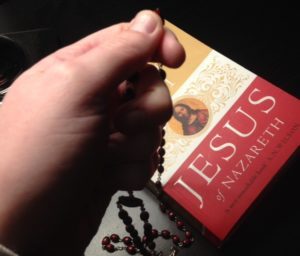
Don’t be scandalised… but it took me a while to get excited about the Luminous Mysteries when St John Paul the Great first gifted them to the Church. If even a tiny bit of me had held on to that initial lack of enthusiasm, that is now well and truly gone! The Luminous Mysteries of the Rosary have been a particular comfort to me over the past few months as I’ve faced some more-intense-than-usual challenges in my own post-convent journey.
Anyone who has spent any time at all in religious formation will know how painful it can sometimes be to grow in self-knowledge… and the growing and learning doesn’t stop when we return to the world. When faced with something about myself that is difficult to accept, it is unhelpful to hide from the Lord as did our first parents in a certain primordial garden. Facing difficult truths and difficult situations is far less intimidating when done in the presence of Our Lord, lifted up to Him in the Blessed Mother’s maternal embrace.
It was in this way – taking something that I found distressing about myself to my rosary one Thursday – that I got distracted from my distress as I reflected on what it was to invite our Lord to shine His light into difficult personal discoveries. It was almost like He was telling me to stop obsessing about the problem, and simply fix my contemplative gaze upon HIM. The moment I stopped looking at the figurative soot on my hands and started gazing deep into the dancing flames I felt drawn nearer to the Fire, taking comfort in the warmth it afforded, all the while dazzled by the brilliance of the light. This is where that meditation on the Luminous Mysteries ended up that day:
The Baptism of Our Lord: In Jesus of Nazareth, Pope Benedict XVI explained the significance of Our Lord’s Baptism as the moment where He took on His own shoulders the sins of the whole world throughout time and space. It was a prefigurement of His shouldering the Cross, it was a prefigurement of His harrowing of hell and it was a prefigurement of His Resurrection into new life, all at once. The weakness I’ve just discovered in myself was something Jesus already knew about in His eternal now and purposefully took upon Himself those centuries ago in history when He was baptised in the River Jordan. The Lord of Heaven and Earth, who loves me personally and perfectly, has long anticipated this moment when I would lay this very weakness of mine at His feet.
The Wedding Feast at Cana: Pope Benedict XVI also talks about how St John takes great care to say that the Wedding at Cana happened “on the third day” – clearly related to the Resurrection, of course, but also related to the traditional, Old Testament understanding of the appropriate time for “Theophany”, i.e. the manifestation of Divinity. At the Wedding Feast at Cana, Our Lord shows us that He is God, but also demonstrates that He is both able and willing to provide the good that is lacking in our lives. He can turn the insipid water of my weakness into the rich, abundant new wine of Christian joy!
The Proclamation of the Kingdom: As comforting as it is to know that Our Lord has taken my weakness upon Himself and is longing for me to let Him provide the good that is lacking my life, He also invites me – requires me, whilst never violating my freedom – to change. In filling me up with the new wine and revealing His goodness to me, He asks me to conform to a way of life that will help me to become more myself-as-He-created-me-to-be. We all need this reminder… and sometimes it is more helpful to focus on the virtue to which we aspire than it’s related vice with which we struggle. Meditating upon the beatitudes and His parables… what beautiful treasures He has given us to ponder in our hearts! Such pondering, after the example of Our Lady, will gradually enable Him to fashion our hearts into the new wineskins that will be able to contain that new wine He seeks to give us.
The Transfiguration: When I follow that invitation to change, and ponder His words and continue my interior dialogue with Him, He draws me still further… up a mountain, as it were, to contemplate not just the way He would have me live… but to look upon the radiance of His Face, to allow my desire for Him to be heightened as I behold His resplendence to the extent that He reveals that to me. As I’ve worked through my own recent challenges, I’ve been more drawn than ever to spend time with Him in the Eucharist and I do my best to get to make a holy hour several times a week wherever possible. I’m quite convinced that this increased desire is His doing and to be honest it’s a little exciting to wonder what changes in me He might be working away at whilst I sit and gaze upon Him, none the wiser as to the details, but growing in trust that He IS doing something!
The Institution of the Eucharist: With this increase in desire has come a reminder that the most important thing I will do on any given day is attend Mass and participate in the Eucharist. For me personally, this is gradually conforming my heart to be best able to receive the love He wants to give me, as I attend His sacrifice re-presented on the altar… but it also puts the rest of my day into perspective. The difficult meetings at my workplace and my frustrations with my own personal and daily failures pale into insignificance when considered alongside the beautiful half-hour during my lunch break where I get to witness the meeting of Heaven and Earth and receive Him in the Eucharist. This temporary union with Him, the magnitude of which I can only scratch the surface here on earth, truly is a foretaste of that eternity for which I was created…
As you can see… having followed all of the above line of thought I found myself all of a sudden marveling in His goodness to me and less and less distressed about that personal weakness that I took to prayer in the first place!! I still have my weakness… but now I’ve invited the Lord into that, and followed His invitation to dwell more on Him… my relationship with Him is strengthened in the dialogue, I’m less scandalised by my faults as I realise the truth of who I am and the truth of who He is, and my trust in Him and dependence on Him grows every time I get out of my own way, lay my troubles at His feet and ask the Blessed Mother to pray with me and for me.
Whilst it can be tempting to cast the Rosary aside, now that there’s no longer an Horarium requiring you to pray it, it’s really important to resist that temptation! I really can’t recommend the Rosary enough as one way of spending time in your inner cell, working through the challenges you face in everyday life with Him. Go to Our Lord through His Blessed Mother and let the light in!
Q: What is “From My Inner Cell” all about?
A: From My Inner Cell: Conversations with God for convent-leavers
Aug 11, 2016 |
By AfterEpiphany.
“Do not cling to me,” (c.f. Jn 20:17
The post-Resurrection encounter between Jesus and Mary of Magdala is one of my very favourite Scriptural accounts. Yet it poses a gentle challenge that I found very helpful upon returning to the world, if a little hard to hear, at first.
I’d invite you to step into Mary’s shoes for a moment. That moment of recognition at being called by name would obviously bring an unspeakable joy, an excitement, an awe. But I think there might also perhaps have been a sense that “now that He’s back, things will be just like they used to be…” Perhaps Mary was clinging to a set notion of the pre-Resurrection Jesus? She had to let go, to allow Him to return to His Father.
The words “do not cling to me” speak to me, also, as I ponder this account. I had certain ideas about my relationship with the Lord when I was in the convent. When I returned to the world, it was tempting to cling to these ideas. They were comforting, familiar. But they were my own ideas about Jesus – they weren’t actually Jesus.
How is Jesus revealing Himself to me in the present moment? Who am I before Jesus, now? How do we relate? Is my relationship with Him stagnating, because I am clinging to those old ideas? Perhaps it’s time for me to invite Him back in, to allow Him to love me, to grow in love for Him… a different kind of love…
Q: What is “From My Inner Cell” all about?
A:Â From My Inner Cell: Conversations with God for convent-leavers
Aug 5, 2016 |
By Amata
Some years ago, I was talking with a dear friend. She and her husband had been struggling to conceive, and she was sharing with me how painful this experience was. However, she said, if this was something that she needed to go through, to suffer, so that she could become holy, then so be it. She said she’d rather go to Heaven than have a baby, if that was what it took to get to heaven, if this experience of infertility was purifying her and sanctifying her through her pain.
Her words that day stuck with me. She’d rather go to heaven than have a baby, if that was what it took. I continued to ponder and to be amazed by those words. I grew up in a large family, where babies are seen as one of the greatest gifts God can give, and now I feel myself drawn to marriage. I love babies, and I could see the pain in my friend’s eyes as she spoke. And yet, she would rather go to Heaven than have a baby. Her desire for God, for sanctity, and for doing God’s will was greater than her desire to have a child of her own.
St. Ignatius talks about the indifference that is necessary for sanctity. He is not talking about a world in which we have absolutely no desires. Rather, he is talking about a world where our desires match God’s desires for us, where we make decisions based on God’s will, and where we subject our own desires to God’s desires for us. When I first heard of this idea, I struggled to understand what it really means. What does this holy indifference really look like in today’s world?
I think I saw it in my friend’s eyes that day. She’d rather go to Heaven. She was placing her own desires at the feet of God and accepting His will for her as necessary for her own salvation. And even as she spoke, there was a joy behind the pain. Nobody was twisting her arm making her accept the will of God. Rather, mingled with her tears there was a genuine desire for Heaven and an excitement at the thought of seeing God Himself face to face for all eternity. She’d rather go to Heaven.
I think that, in many ways, the greatest sufferings in our life come from a lack of this holy difference. If we are really
able to say “blessed be God” no matter what comes, if we can learn to let go of something because it does not correspond with God’s will for us at this moment, then I think our lives would be so much easier. Easier said than done, I know.
As I continue to ponder my own journey of discernment of religious life, through living active life and nearly joining a cloistered community, these words have stuck with me. Would I like to still be in my religious community, joking that I’ll be buried out back? Yes. But, I’d rather go to Heaven, and if living in the world as a layperson is my path to sanctity, then so be it. Would I rather have had that cloistered vocation that I explored? Somedays, yes. But, I’d rather go to Heaven.
And now, as I discern married life and am surrounded by friends and siblings with families of their own, it is easy to be frustrated. I never imagined that at this point in my life I would still be so… unsettled. Would I absolutely love to have a family of my own right now, or at least a serious boyfriend, so that I can be closer to the vocation God seems to have in mind for me? Oh, yes, by all means!
But, I’d rather go to Heaven.
Jun 9, 2016 |
By Anonymouse.
It was about four years ago now. I was on a discernment retreat and I heard Jesus speak to my heart that he was not calling me to be a religious sister. He was calling me to marriage.
I told Him about the beauty of religious life, how these women give everything to Him, their parents and siblings, their desires for children and for a spouse, their sexuality, and their hearts, to receive so much in return. I spoke to Him about how their hearts are so directed toward Him that at the hour of their death, they will not be staring into the unknown, but into the future they have with their Maker and their Husband.
He spoke to me of the great sacrifice He required of me, one that the religious life could not pull out of me in the same way that an imperfect man could. A sacrifice that would challenge me in a unique way, and squeeze love out of me, requiring me to respond with a love that is not my own. He spoke to me of a love that would pour over me every day, begging me to pour it out onto others. He heard what I spoke to Him, and yet still said, “But I will show you a still more excellent way.”
I was heartbroken, but I believed Him.
Three years after that, I lived the reality that I was not married, engaged, or dating. I was (and still am), “single as a pringle,” as one of my friends likes to say. As I tried to adjust the reality that I was not called to the religious life, but serendipitously, both of my sisters were, to two different communities, which were both different than the one I was discerning with. I felt far away from God in a way and I was tempted to wonder if I did enter the convent, how holy would I have been? Would I have been like Saint Therese in her little way, or like St. Teresa of Avila, in her big way? In response though, I was sobered by the Holy-Spirit-inspired question: is hypothetical holiness more important than obedient faith? Of course not; “Rather, blessed are those who hear the word of God and observe it.”
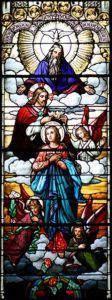
Almost exactly three years from that discernment retreat, I went on a day retreat, one based on Theology of the Body, and the keynote speaker was Dr. Janet Smith. Her words were maybe new, maybe repeated, but this time they stuck. She said that, “Marriage does not eradicate man’s loneliness, but only alleviates it.” Wow. She said that, “every human relationship, especially marriage is a sign, a symbol, of our real relationship with God.” Wow. She said that, “In images of the Coronation, Mary is the woman being crowned, but Mary is a type of the church, and thus a type of each one of us. In the image of the Coronation, imagine yourself being crowned by God the Father, God the Son, and God the Holy Spirit.” Wow. She said that “the Church is the bride of Christ, and thus each one of us is a bride of Christ.” Wow. She encouraged us to spend time in prayer imagining God the Father crowning us as His daughter, Jesus crowning us as His bride, and the Holy Spirit crowning us as His spouse. Wow.
In that moment, I realized that since the weekend I heard Jesus direct my steps away from the convent, I thought: He doesn’t want me to be His bride. He doesn’t want me. I regarded myself as unlovable and undesired. But, of course, that was (and is, and is to come) far from the truth. The expression of the spousal call may be different from the way it would be for a sister in vows, but as Dr. Smith said, I AM A BRIDE OF CHRIST simply because I am part of his Church. He is the one who makes me His bride. It is not a religious community that makes me Jesus’ bride. It is Jesus who makes me His bride. He has chosen me, and chooses me daily to be His bride. He reaffirms His love for me every day, an innumerable number of times, in a myriad of locations in the world, in the Holy Sacrifice of the Mass. There, on the cross, my bridegroom offers Himself to me. I am loved. I am lovable. I am his bride.
I do not now have a husband, fiance, nor a boyfriend (See pringle comment above). I have not found the secret to thinking something was so right for you and living the reality that you are called elsewhere. And I do not know my future. I do know that I am imperfect, I am sometimes emotionally constipated, I say the wrong things, and embody awkwardness in all of its delights. But I also know that I am lovable and loved. I know that God looks upon me and loves me. I learned from the religious community of one of my sisters that, “God sees you like no other person sees you. God loves you like no other person loves you. God does not look at you in your limits, in your failings. He looks at what is limitless in you. He looks at you in what is most profound in you.”
I have moments (days, weeks, months, etc.) when I doubt my future. When I give in to fear that what God promised
will never happen. It is in those moments that I must remind myself, that I must preach the Gospel to my own heart: everything is about Jesus. There is no relationship that has greater gravity than the one I have with Jesus. There is nothing greater than Jesus. It is in those moments that I repeat the words of St. Teresa of Avila:
“Hope, O my soul, hope. You know neither the day nor the hour. Watch carefully, for everything passes quickly, even though your impatience makes doubtful what is certain, and turns a very short time into a long one. Dream that the more you struggle, the more you prove the love that you bear your God, and the more you will rejoice one day with your Beloved, in a happiness and rapture that can never end.”
 By Cinnamon.
 my faulty compass guides me straight into a tree. (I went on a nine-day orienteering camp when I was fourteen. Didn’t like it. Can you tell?) Our Lord told us, though, to keep on asking, seeking, and knocking; without a functioning compass, the walk will take longer, but one day – in His time – the underbrush will part suddenly and a clear path to Him will become visible. And He asks us to trust that, when each one of us gets to heaven and looks back down on the times when we felt most lost and helpless, meandering pointlessly in the scrub, we will see only one set of footprints.
 As you can see… having followed all of the above line of thought I found myself all of a sudden marveling in His goodness to me and less and less distressed about that personal weakness that I took to prayer in the first place!! I still have my weakness… but now I’ve invited the Lord into that, and followed His invitation to dwell more on Him… my relationship with Him is strengthened in the dialogue, I’m less scandalised by my faults as I realise the truth of who I am and the truth of who He is, and my trust in Him and dependence on Him grows every time I get out of my own way, lay my troubles at His feet and ask the Blessed Mother to pray with me and for me.
 By Amata
 I think that, in many ways, the greatest sufferings in our life come from a lack of this holy difference. If we are really
 By Anonymouse.
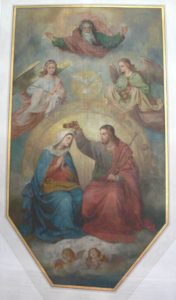 Almost exactly three years from that discernment retreat, I went on a day retreat, one based on Theology of the Body, and the keynote speaker was Dr. Janet Smith. Her words were maybe new, maybe repeated, but this time they stuck. She said that, “Marriage does not eradicate man’s loneliness, but only alleviates it.” Wow. She said that, “every human relationship, especially marriage is a sign, a symbol, of our real relationship with God.” Wow. She said that, “In images of the Coronation, Mary is the woman being crowned, but Mary is a type of the church, and thus a type of each one of us. In the image of the Coronation, imagine yourself being crowned by God the Father, God the Son, and God the Holy Spirit.” Wow. She said that “the Church is the bride of Christ, and thus each one of us is a bride of Christ.” Wow. She encouraged us to spend time in prayer imagining God the Father crowning us as His daughter, Jesus crowning us as His bride, and the Holy Spirit crowning us as His spouse. Wow.
 will never happen. It is in those moments that I must remind myself, that I must preach the Gospel to my own heart: everything is about Jesus. There is no relationship that has greater gravity than the one I have with Jesus. There is nothing greater than Jesus. It is in those moments that I repeat the words of St. Teresa of Avila:
Recent Comments