Mar 29, 2018 |
By Cara Ruegg.
I breathe the wind
Into swollen lungs
Red eyes blink
And all is gone.
It disappears
At least for a moment
Standing at the crossroads
Nervous and trembling
Do I even want anything?
There is no silent conviction
There is no conviction at all
There is nothing
My heart is torn
It is broken
It cannot decide
To be loved
In a special way
By a person I can see
And hear and touch
It seems much more real
Even if it’s not
Even if it’s in fact false
A fickle thing
This love of humans
Changes like the wind
God is eternal
His love infinite
And He gives me Himself
He gives me everything
Where is my gratitude?
The ground beneath my feet
Is hard
The grass cannot be seen
Under this dirt
What do I want?
Nothing
And everything
At once
The world’s vanities
Make me shrink
But so does the cross
Of my Jesus
Covered in blood
And I want to be brave
I want to give Him everything
All of me
Not counting the cost
But I’m a coward
And I stand here
At the crossroads
Wavering
“Dear God”
He seems far away
Gone
I once felt His peace
Such a wonderful calm
There is nothing now
I am numb
The little children huddle around me
But do they really care?
In the end, they go home
And I’m not ever there.
My Sisters laugh and joke
But still a barrier I hold
My heart can’t get attached
Not to a human soul
I want a shoulder to cry on
A friend to wipe my tears
I want to be loved by someone
But I am here
Before a silent God
Who I know is before me
But who I cannot see
And cannot hear
And cannot feel
At all.
The romance of the cross
Should be enough
It should be all
But the crucifix
On the wall
Is motionless
He beckoned me
And I responded
I said, “Yes,
I’d follow His call”
Now here He is
Silent
I’ve crossed the ocean
I’ve left behind my home
I let myself be forgotten
Erased from memories of loved ones
Affections have gone cold
They have changed, gone old
But I am here, frozen
I still care…too much
And they don’t know.
I cannot tell them.
And will I be happy
In the world?
I cannot see over this picket fence
And do not know
If there is any grass there at all.
And can I give up the treasure
Of a baby I can call my own
Tiny hands and soft feet
Eyes that look like my own?
For God. For God. For God.
How dry and tasteless
I feel
Shattered in a silent way
No tears
No pain
I’m just not happy
Waves aren’t crashing
All about me
I cannot even cry.
“Dear, God,
I want Your will
Not mine”

Jun 21, 2017 |
By LumenChristi.
May/June can be hard months for those of us still discerning our place in life. Weddings, ordinations, professions of vows, and entrances into religious communities are a painful reminder that another year has come without any such milestone in sight for us. We rejoice with our friends and families – do our best to put on yet another reception with love, and send yet another friend off to the convent/seminary with prayers. And sit through yet another homily about “celebrating a yes to the Lord and to one’s vocation.” And go to confession yet again for envy/self-pity/lack of trust in God.
Am I right? Or is that just me?
I read an article recently called “We said yes too” about the struggles of Catholic couples who struggle with a miscarriage or infertility. While those around them get celebrated for having many children, they often experience the implication that those who don’t have a wild 7+ member crew in tow “aren’t open to life” or “haven’t said yes.” The author goes on to explain how she and others like her have said yes – hidden yesses too deep and painful to share. Yes to giving back to God an unborn child gone too soon; yes to the surrender of hopes and dreams in the struggle with infertility; yes to allowing the gifts that God has given to be enough.
When I read her article, as a woman discerning her vocation who has hit many painful detours along the road, I identified deeply with what she said. Though my life and struggles are different, my heart leapt with bittersweet joy as every word resonated.
“I have said yes too,” I thought. Not the “yes” that gets celebrated during “vocation season.” Not the exhilarating “yes” of a vow to the Church or to another person to commit my life forever. But a silent, not-spoken-out-loud kind of yes, I had given.
The “yes” to surrender my will and my desires to God and trust him for the timing.
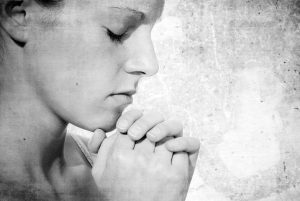
The “silent yes” to Him in not settling for a “celebrated yes” that I knew wasn’t His will for me.
The “yes” to being faithful in prayer even during the times where I was no longer sure who I was praying to. . .
As well as the little “yesses” too that can cost a lot at times. Yes, Lord, I will smile at my friend and share his/her joy right now even though I would rather run away and cry. . .Yes, Lord, I will bite my tongue and accept criticism in humility when a priest or leader in the church asks “haven’t I thought about my vocation?” (Believe me, I ‘ve thought about it!!! Too much maybe!”)
We, dear single, discerning ladies, have said our “yes” too. I am not arguing that these “yesses” become publically celebrated. Firstly, that would be awkward, but secondly, some yesses are meant to be hidden. As Christ lived the first 30 years of His life, so too are many of the yesses along the way to holiness, hidden – sometimes even disguised and misunderstood. Such is the brokenness of humanity and the mystery of God. But as I was reading this article and reflecting on my own “yes,” I realized how important it is to understand and treasure it myself . I think, in the future, it will help me to step back from others’ celebrations just long enough to pause, and pray. “I too have said yes, Lord and you know it. Give me the strength to keep saying yes, even when it is difficult.”
Each woman can fill in what her “yes” has been. . .
“Lord, I said “yes” to entering the religious life, following you while my family thought I was crazy. . .and then, when you sent me back to that same family, I said “yes” again just as generously, although this time it was with tears. . . “
“Lord, I followed you out of the convent and into the world, not knowing where it would lead. I’ve accepted every bump in the road and being “a fool for you” as I adjusted back to secular life . . .”
“Lord, I desire marriage and a family, but I’ve said YES to waiting for it to happen in your time and in your way. . .”
“Lord, I do not know where I’m going, but I’ve said “yes” to journeying joyfully even when I feel desolate. . .”
“Lord, being at Mass right now only brings me pain, but I say “yes” to being here with you anyway. . .”
Each of us can find a lot of these “yesses” in our lives, and I have realized it is important to remember them. I believe that for me such remembrances will be the key place where I will find the power to rejoice with those who rejoice, and to walk in faith when I would rather see.
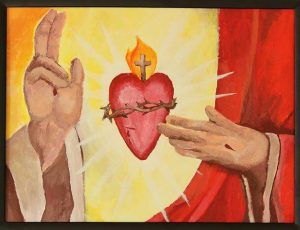
Of course, we are not alone in either the remembering or the resolving to do better. I hope it consoles you as much as it did me, to rediscover that no “yes” goes unseen by God. I think these yesses, that are the last to be thought of in this world, are the first to be remembered in His eyes, and the foremost to be felt by His heart. I think the more conscious of them that we become, the stronger we will be in remaining faithful to them.
God-willing, one day we too, will have the opportunity to make one of the “celebrated” yesses. But in the meantime, the silent ones are nonetheless real. Treasure your “yes” and allow the Lord to treasure you.
Aug 27, 2015 |
By Josepha.
Even though it has been over a year since I left the convent, I still feel like I do not know where my life is going or what God really wants for me. Great things have definitely happened in my life this past year and I don’t doubt my decision of leaving Religious Life, but I still feel like I wish I had more clarity in everything. My heart is still restless about the day-to-day things and I have flashbacks to the convent where things “seemed” so much more clear and directed. It is hard to trust that God really does have something better for me out here in the world.
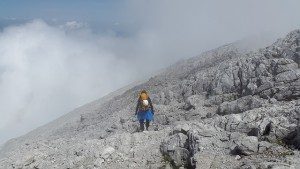
A few weeks ago, I went back and visited my previous community for their celebrations of Final and Temporary Vows. I am sure anyone who has been back to their communities after leaving can relate to this. The experience was really painful yet blessed all at the same time. I can see that I really needed to go and see myself as separate, but it was incredibly painful to be on the “outside” of everything for the first time and to be at a distance from those whom I entered the community with. Some Sisters were better than other at making me feel welcome, and for others I could see discomfort at my presence. I just wish it didn’t have to be that way. I wish we could just keep our friendships in some normal way, but I know that our relationships have to change for the good of them and me as well.
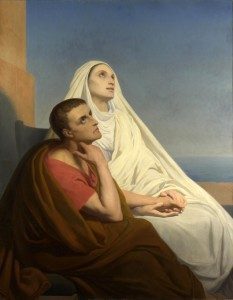
As I work through the painful separation from the life of a Religious Sister, I see Saint Monica as a source of hope. She persevered her whole life praying for something that seemed crazy to everyone around her and God blessed her perseverance. Saint Augustine eventually converted from a crazy life to life lived for God alone. So many days I just want to give up my prayer life and everything that goes along with my relationship with God, but I know that if I persevere, He will bless me and show me whatever He has waiting for me out here in the world. As Saint Augustine says, “You have made us for Yourself, O Lord, and our hearts are restless until they rest in You.” My heart may still be restless a year after leaving the convent, but I know the answer to that restlessness lies in God alone and persevering in my relationship with Him.
Aug 11, 2015 |
By Cinnamon.
Unusquisque:
1) Latin adjective (masculine singular), from unus (one) + quisque (each). Eg: Each one looks to You to give food in due season.
2) Tongue-twister from the Dominican prayer book, bane of my life in the early weeks of postulancy (see also: gloriosissimae; necessitatibus; famulorum famularumque).
I don’t know whether, in your former community, you tangled with this monster during the formal grace in Latin as I did (it’s pronounced oo-noos-QUISS-quay, by the way, and getting it right for the first time is a real buzz) but if you were in Dominican formation I bet that you’ve encountered these other eight-hundred-year-old traps for the unwary:
- Courtesy of the angels who started handing out bread at the junior end of the refectory table, you get to go first in everything! Want to wait invisibly at the back and watch the senior Sisters to find out what they do? Actually, you’re leading the procession. Good luck!
- You (finally) make a perfect profound bow. Everybody else makes a head inclination. Hopefully they’re all keeping custody of the eyes and missed it.
- For anyone who’s not naturally a soprano:
no further explanation is required. I used to do my choir practice down the local cemetery, figuring that my paint-peeling rendition of this beloved chant would take years off Purgatory for any Holy Souls who happened to be listening.
- Processions in general. Did anyone else crash into furniture on the way around the chapel? Execute an impeccable turn, and then realise that a partner had been left stranded because you were supposed to bow to her first? Meander off too far to the side and get patiently towed back in by one elbow? (Or maybe it’s just me. Who am I to judge?)
Also, unless your written work rivalled the perfection of the Summa, you will have found yourself on the receiving end of that other profoundly Dominican gesture: the uncapping of a red pen. Veritas. The deepest instinct of these Hounds of the Lord is to find out what’s wrong, and, for the glory of God, fix it. While still in the convent, I read the results of a survey about religious beliefs sent out to different communities of nuns in the 1960s: lots of sisters dutifully filled out and posted back their responses, but, surprising nobody except the authors, the Dominicans corrected the questions before they answered them. (It certainly didn’t surprise me. I’d just failed an essay for the first time since my early years in high school.)
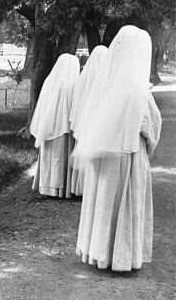
And you know something? I miss it all fiercely. As Dom Hubert Van Zeller points out, a yearning for the externals of the religious life doesn’t mean that my vocation was to stay in that community – of course I miss the processions of white habits, the candle-lit vigils before Jesus in the monstrance, the solemn Salve. It’s also obvious that when my health began to shatter under the demands of monastic life, all of those beautiful things weren’t enough to keep me there. So why, then, did I spend the better part of two years afterward fighting an irrational desire to turn up on the community’s doorstep one morning and ask them to let me have another try?
When I left, the most important thing that became forfeit was not my hope of wearing the veil that would set me apart for Our Lord, and the scapular for Our Lady, and nor was it the chance to spend my days with a lively, intelligent group of devoutly Catholic women of whom I had become fond. It wasn’t even the privilege of living in the cloister and chanting the Divine Office with them at the heart of the Church. What I surrendered was twofold: to be a bride of Christ, and a daughter of Saint Dominic. In my heart, I’m both. Officially, I’m neither. Worse is the thought that, if I died today, in heaven I’d be neither.
Of course, if it turns out after further discernment that I don’t have a religious vocation at all, I could become a tertiary, but I suspect for me that would feel a bit like winning the silver medal. Here’s why. The desire to be a sister first hit me in my teens when I was barely practicing the Catholic faith, and before the year was out I’d fallen head over heels in love with Jesus. Listening recently to the TEDx Talk on discernment that Jenni gave, I realized for the first time that, somewhere in those early days, I skipped a crucial step in the process: I wasn’t afraid of the path ahead. On the contrary, I was awed at having been noticed by God, and wildly excited about getting started in the religious life. Forget your people and your father’s house, for the King has desired your beauty!
Thanks to prosaic things like tertiary studies and the resultant debt, the better part of a decade passed before I got my wish. Enough time to get over the honeymoon, commit myself to some serious study, collect a few battle scars and get a realistic idea of what I’d be facing when I entered. It always surprised me, though, when people said, “Wow, that’s a big step to take! Aren’t you scared?” No, I’m not, was the honest reply – it’s just the next obvious step. Giddy romanticism dispensed with, I was still eagerly looking forward to entering: I’d discovered the Dominicans at World Youth Day, and found what I was looking for in a religious Order. Then, a few months after I entered, I finally met Saint Dominic.
I’d been struggling through an assignment about the founding of the Order (having, as previously mentioned, failed the first one) and, one morning, simply pushed all my other essays aside and buried myself for several hours in the life of this gentle, luminously holy man. The shy scholar who sold his books to feed the starving; the preacher with bleeding feet, on his own among thousands of heretics; the beacon of chastity whose sheepish deathbed confession was that he had sometimes enjoyed preaching to young women more than old; and the devoted spiritual father who promised after his departure to help the brethren by his prayers. By the time I put my books away and hurried off (as quietly as one can hurry down a cloister while dodging the squeakiest floorboards, that is) to help prepare lunch that day, I’d become a Dominican. An ordinary desire to follow Christ had crystallized into the desire to follow Christ just as Saint Dominic had, in contemplation and preaching of the Truth.
So, I’m starting discernment again from scratch, trying to find the place where my home on earth might be. And this time, I am scared. I know what can go wrong, and how badly – but also how beautiful it can be. That’s in the future, though. For now, I remember and continue to pray the exquisite Dominican prayers I learned in the convent – not in some useless pretence of monastic life, but because their meaning has become intertwined with my personality like silk threads woven into a piece of cloth, and I wouldn’t know how to pull them out if I wanted to. I’m still a Dominican inside. Please God, one day I’ll sing His praises in heaven as one, too.
Praedicator gratiae, nos junge beatis.
Jun 3, 2015 |
By two Leonie’s Longing writers.
Among the reasons for leaving religious life, the one that gets the least attention is that of being asked to leave the community.
Perhaps you know you: were too young, unhealthy, didn’t fit in, broke a rule, were unhappy, had conflict with your superior, had a misunderstanding, etc.
Or maybe you were like me and you weren’t told why you needed to go. You were simply asked to leave.
Even for those who have either discerned themselves or with the community to leave, there are still those looming questions, the “what if’s” or the “if only’s.” These questions, especially for those of us that are still wondering why, can echo in a seemingly empty soul.
Nature abhors a vacuum, and the evil one is all too willing to fill in that empty space of unknowing or uncertainty. He relentlessly lied to me and I had incredible difficulty fighting it. My sense of isolation and shame didn’t help.
These lies can include:
God doesn’t love you.
You weren’t good enough.
There’s something wrong with you.
How could you ever think you could be a sister?
They shouldn’t have let you into the community in the first place.
That peace and joy you experienced before entering was fake.
God doesn’t have a plan for you.
Only a really bad person is asked to leave a religious community.
Do these sound familiar?
So what is the truth? How do I combat these lies?
First of all, we must remember one simple fact: GOD IS GOD. Okay, I know you all know this, but sometimes we forget that God is bigger than our sins, failures, weaknesses, etc. Years ago I was told about a homily and it made an impression on me. In it the priest said: “God is big. God is bigger than big.” This is a simple reality, but one we often forget.
Besides this, who are we to call certain events and people failures? God often uses these “failures” to reveal his glory. It is easy to doubt that God is in our messes. But I would argue that it is exactly those places in which he wants to dwell.
These few little truths may help you combat the aforementioned lies:
- God STILL has great things planned for you. (We can’t “fail” our vocation. We can’t “fail” God’s plan for us.)
- Even though we are not religious anymore, that does not mean we are less valuable to God. Lumen gentium argues the exact opposite; there is a “universal call to holiness,” i.e. that holiness is not reserved for priests and religious. Furthermore, it is the laity that is given much of the task of preaching the Gospel and bringing Christ to others. You are given a special mission in your present lay life! You can reach others in a way that you couldn’t as a religious.
- Your fundamental identity as a Daughter of God and your relationship with God is UNCHANGABLE! You still belong to Him and are no less in His Eyes. He is arguably even closer to you in your suffering and pain, your grief and loss, and your shame and isolation. He experienced all of these things and is with you so intimately in these moments.
As we have reflected in the past few months on the mystery of the Resurrection, let us rise up out of those places that are dark, the “tombs” in our soul. Let us believe, without necessarily seeing, the good that God does with our “tragedies.” The Resurrection is proof of this reality that takes place within the human heart, within your heart.


 By LumenChristi.
 The “silent yes” to Him in not settling for a “celebrated yes” that I knew wasn’t His will for me.
 Of course, we are not alone in either the remembering or the resolving to do better. I hope it consoles you as much as it did me, to rediscover that no “yes” goes unseen by God. I think these yesses, that are the last to be thought of in this world, are the first to be remembered in His eyes, and the foremost to be felt by His heart. I think the more conscious of them that we become, the stronger we will be in remaining faithful to them.
 By Josepha.
 as separate, but it was incredibly painful to be on the “outside” of everything for the first time and to be at a distance from those whom I entered the community with. Some Sisters were better than other at making me feel welcome, and for others I could see discomfort at my presence. I just wish it didn’t have to be that way. I wish we could just keep our friendships in some normal way, but I know that our relationships have to change for the good of them and me as well.
 Saint Augustine eventually converted from a crazy life to life lived for God alone. So many days I just want to give up my prayer life and everything that goes along with my relationship with God, but I know that if I persevere, He will bless me and show me whatever He has waiting for me out here in the world. As Saint Augustine says, “You have made us for Yourself, O Lord, and our hearts are restless until they rest in You.” My heart may still be restless a year after leaving the convent, but I know the answer to that restlessness lies in God alone and persevering in my relationship with Him.
 By Cinnamon.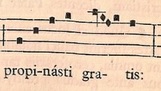
 the religious life doesn’t mean that my vocation was to stay in that community – of course I miss the processions of white habits, the candle-lit vigils before Jesus in the monstrance, the solemn Salve. It’s also obvious that when my health began to shatter under the demands of monastic life, all of those beautiful things weren’t enough to keep me there. So why, then, did I spend the better part of two years afterward fighting an irrational desire to turn up on the community’s doorstep one morning and ask them to let me have another try?
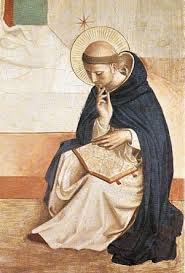 the first one) and, one morning, simply pushed all my other essays aside and buried myself for several hours in the life of this gentle, luminously holy man. The shy scholar who sold his books to feed the starving; the preacher with bleeding feet, on his own among thousands of heretics; the beacon of chastity whose sheepish deathbed confession was that he had sometimes enjoyed preaching to young women more than old; and the devoted spiritual father who promised after his departure to help the brethren by his prayers. By the time I put my books away and hurried off (as quietly as one can hurry down a cloister while dodging the squeakiest floorboards, that is) to help prepare lunch that day, I’d become a Dominican. An ordinary desire to follow Christ had crystallized into the desire to follow Christ just as Saint Dominic had, in contemplation and preaching of the Truth.
Recent Comments