Sep 25, 2016 |
O Saint Therese of the Child Jesus, who during thy short life on earth became a mirror of angelic purity, of love strong as death, and of wholehearted abandonment to God, now that thou rejoicest in the reward of thy virtues, cast a glance of pity on me as I leave all things in thy hands. Make my troubles thine own, speak a word for me to our Lady Immaculate, whose flower of special love thou wert, to that Queen of Heaven “who smiled on thee at the dawn of life.” Beg her as the Queen of the Heart of Jesus to obtain for me by her powerful intercession the grace I yearn for so ardently at this moment, and that she join with it a blessing that may strengthen me during life, defend me at the hour of death, and lead me straight on to a happy eternity. Amen.

Sep 24, 2016 |
O Saint Therese of the Child Jesus, who during thy short life on earth became a mirror of angelic purity, of love strong as death, and of wholehearted abandonment to God, now that thou rejoicest in the reward of thy virtues, cast a glance of pity on me as I leave all things in thy hands. Make my troubles thine own, speak a word for me to our Lady Immaculate, whose flower of special love thou wert, to that Queen of Heaven “who smiled on thee at the dawn of life.” Beg her as the Queen of the Heart of Jesus to obtain for me by her powerful intercession the grace I yearn for so ardently at this moment, and that she join with it a blessing that may strengthen me during life, defend me at the hour of death, and lead me straight on to a happy eternity. Amen.

Sep 23, 2016 |
O Saint Therese of the Child Jesus, who during thy short life on earth became a mirror of angelic purity, of love strong as death, and of wholehearted abandonment to God, now that thou rejoicest in the reward of thy virtues, cast a glance of pity on me as I leave all things in thy hands. Make my troubles thine own, speak a word for me to our Lady Immaculate, whose flower of special love thou wert, to that Queen of Heaven “who smiled on thee at the dawn of life.” Beg her as the Queen of the Heart of Jesus to obtain for me by her powerful intercession the grace I yearn for so ardently at this moment, and that she join with it a blessing that may strengthen me during life, defend me at the hour of death, and lead me straight on to a happy eternity. Amen.
Jul 25, 2016 |
A classic parlour game, with a Leonie’s Longing twist! Answers below.
a) My parents refused me permission to enter the convent because they could not give me a dowry. Several religious communities rejected my application to enter because I was poor and had little formal education.
b) I made three attempts to enter the religious life in active communities of sisters, none successful. Finally, I accepted my spiritual director’s advice to enter the Capuchin Poor Clares, a community to which I felt no attraction at all.
c) I entered the Sisters of Mercy in my early twenties, but my health collapsed and I returned home after eighteen months of religious life. I was unwell for nearly two years afterward. During this time of illness I began to feel called found my own religious community, but my spiritual director told me that this idea was a deception to be rejected.
d) As a young woman with poor health, I applied to the Sisters of Charity of Saint Vincent de Paul and was turned away. My sister was accepted by the Visitandines. I decided that, if I could not be a religious sister, I would raise a large family and dedicate my children to the Lord.
e) When I applied to the Passionists, the superior sent back a letter saying, “We will not have the convent contaminated by her.”
f) All of my sisters became nuns. My own first attempt at living the religious life lasted eight weeks; I made two more unsuccessful tries before persevering.
g) After years of struggling to keep up academically in my studies for the priesthood, I was dismissed from the seminary. I was re-admitted, and failed my examinations again. It took me eleven years to complete my studies and become a diocesan priest.
h) At the age of twenty-two, I applied to the Augustinian Canons of the Great Saint Bernard Hospice in the Swiss Alps, famous for rescuing pilgrims lost in the snow or endangered by the treacherous conditions. However, in order to be accepted I was ordered to learn Latin, a language which I found impossible; finally, I admitted defeat and accepted, to my great disappointment, that I did not truly have a religious vocation.
i) My spiritual director told me to put the idea of a religious vocation out of my head; I was poorly educated, and considered slow-witted. A few days later, however, he came back and asked me whether I really did believe that Jesus was calling me to religious life. When I said that I did, he asked me whether I could at least peel potatoes. Yes, I said, I can peel potatoes. So he told me to go to the convent to peel the potatoes, and I did!
j) I was enclosed in a church as an anchoress, and was resolved to stay there forever. There was fierce opposition when God called me out of my anchorhold to reform the Poor Clares; it was considered a betrayal of my vocation.
k) I applied to enter the Franciscans and was initially accepted, but later turned away after I confessed the details of my past life to one of the friars. I was devastated, and broke down in tears during my next Confession.
l) I was accepted as a novice by the Third Order Dominicans, and I made my first vows in the community; however, I found out that my true vocation lay in the cloistered life, and I left the Dominicans to become a Carmelite.
m) I was rejected by seven monasteries before I realised I was not called to religious life.
n) As a young seminarian, I felt a deep attraction to the life of a Carmelite friar, but my bishop told me to finish what I started, and would not permit me to transfer to the monastery. I finished my studies and became a diocesan priest instead.
And the answers…
a) Saint Maria Faustina Kowalska, mystic and Secretary of the Divine Mercy, canonized April 30th, 2000.
b) Servant of God Sister Consolata Betrone, mystic and victim soul.
c) Venerable Mary Potter, foundress of the Little Company of Mary.
d) Saint Zelie Martin, mother of Saint Therese of Lisieux.
e) Saint Gemma Galgani, mystic and victim soul, canonized May 2nd, 1940.
f) Servant of God Sister Francoise Therese (Leonie) Martin, sister of Saint Therese of Lisieux.
g) Saint John Marie Vianney, Patron Saint of priests, canonised 1925.
h) Saint Louis Martin, father of Saint Therese of Lisieux.
i) Saint Maria Bertrilla Boscardin, Dorothean Sister and nurse during the First World War, canonised June 8th, 1952.
j) Saint Colette of Corbie, foundress of the reformed branch of Poor Clares which bears her name, Colettine.
k) Father Thomas Merton, Trappist monk, priest and spiritual writer.
l) Blessed Elia of Saint Clement, spiritual writer.
m) Saint Benedict Joseph Labre, the pilgrim Saint, French mendicant and Franciscan tertiary, canonised December 8th, 1881.
n) Pope Saint John Paul II, canonised April 27th (Divine Mercy Sunday), 2014. Yes, really!
Can you add any others?
Oct 3, 2015 |
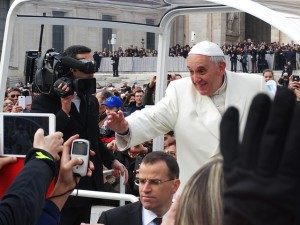
Last week, a Catholic friend was telling me about her parish priest. “He’s a very holy man,” she said, and added, “He’s really on the same wavelength as Pope Francis.”
To which I immediately replied, “I don’t think anyone’s on Pope Francis’ wavelength: I think he’s found one all his own.”
She thought for a second, then nodded agreement.
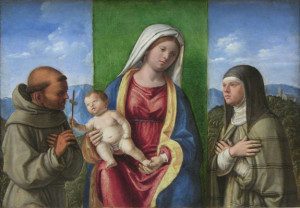
Pope Francis has a unique ability, wherever he goes, to make everyone – atheists and evangelicals, liberals and conservatives, traditional and fallen-away Catholics – sit back, tilt their heads to the side, and ask in unison, “What actually just happened?” It strikes me that this is probably not unlike the effect that a certain friar, not coincidentally also named Francis, would have stirred up around Umbria in the early 1200s. This rich merchant’s son began his religious life by stripping naked and abandoning all his worldly clothes in a heap in the town square, racing off to rebuild a crumbling church, and gaily inviting the whole world to come and join him. And thus comes a familiar chorus across the centuries:Â What on earth is Francis going to do next?
At first, it can seem paradoxical that deep, sincere humility and alarmingly unprecedented actions undertaken on one’s own authority can co-exist within the same person. At eight hundred years’ remove, however, we can see clearly that the humility of Saint Francis, the little poor man of Assisi, was the source of his openness to the Holy Spirit; he could hear the tiniest breath of grace and hare off after it without hesitation while everyone else tagged along behind him scratching their heads. Of course, mistakes can be made with this approach (Father Benedict Groeschel comments that St Francis’ greatest error was to allow indiscriminate entry to anyone who wanted to join his Order, with the result that by the time he died there were many in it who didn’t share his vision and oughtn’t to have been there) and confusion can be sown by off-the-cuff remarks (“Who am I to judge?”), but great good also comes from that openness.
Soon, we’ll leave the Year of Consecrated Life and enter the Year of Mercy – a year of reaching out to other Christians, ex-Christians, and non-Christians alike, to share with them the joy of the Gospel of Christ. Saint Francis, one of the greatest missionaries of true, unadulterated joy that the Church has ever known, would approve.
Saint Francis of Assisi, pray for us!

 A classic parlour game, with a Leonie’s Longing twist! Answers below.
 Last week, a Catholic friend was telling me about her parish priest. “He’s a very holy man,” she said, and added, “He’s really on the same wavelength as Pope Francis.”
 At first, it can seem paradoxical that deep, sincere humility and alarmingly unprecedented actions undertaken on one’s own authority can co-exist within the same person. At eight hundred years’ remove, however, we can see clearly that the humility of Saint Francis, the little poor man of Assisi, was the source of his openness to the Holy Spirit; he could hear the tiniest breath of grace and hare off after it without hesitation while everyone else tagged along behind him scratching their heads. Of course, mistakes can be made with this approach (Father Benedict Groeschel comments that St Francis’ greatest error was to allow indiscriminate entry to anyone who wanted to join his Order, with the result that by the time he died there were many in it who didn’t share his vision and oughtn’t to have been there) and confusion can be sown by off-the-cuff remarks (“Who am I to judge?”), but great good also comes from that openness.
Recent Comments