Dec 1, 2016 |
 By Penny.
It was the day before I was due to leave Walsingham, England’s Nazareth, and head back down to London for my flight home. I’d hoped that by that stage I would have figured out some answers: do I have a religious vocation? If so, where? And when? My pilgrimage was almost over, though, and no clear answers were in sight. Instead, during my penultimate Mass in Walsingham, the priest gave a homily about waiting that has stayed with me for months.
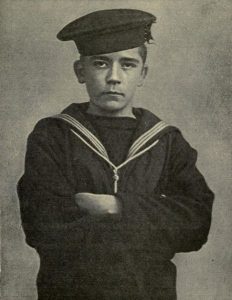
“Some of you,” he said, “may have heard of a boy named Jack Cornwell.” A lot of the older people in the congregation nodded. “He was a Boy Seaman, First Class, on board HMS Chester in 1916. The ship came under heavy fire from four German battleships, and all the sailors who were on deck manning the Chester‘s guns were killed or fatally wounded within fifteen minutes. Jack Cornwell was in one of the most exposed positions on the ship, but he remained at his gun awaiting orders from his captain – and that’s where they found him after the battle, barely alive and with his chest full of shrapnel, but still standing at his post, quietly waiting for orders.” He died two days later, at the age of sixteen. The priest went on to add that Boy Seaman Cornwell was awarded a posthumous Victoria Cross, the highest – and rarest – military honour in Britain, for “gallantry in the face of the enemy.” (According to Wikipedia, he was the third-youngest person ever awarded the VC.)
Jack Cornwell’s gun, aboard HMS Chester.
“I often feel,” the priest continued, “that I’m not doing a very good job of following God’s will – so often when I try to find out what He wants me to do, and to do it, I end up falling short. I want to push harder and try and force things to happen, but end up getting nowhere instead. You may find the same thing sometimes. But all of us – priests, laymen, religious – we are all called by God to stay at our posts, waiting for Him to give us our orders. Even when we’re wounded, that’s the way we are called to live: whoever we are, we are all standing where God has placed us, and quietly waiting for orders.”
The readings for the first Sunday of Advent, too, are about watching and being ready, “for no one knows the day or the hour.” Sometimes we are called to take action and make a leap of faith, but more often, we are called to wait: to remain alert and watchful, so that we are ready when the time comes and God calls us to move. I’m grateful to the priest for his openness about the sense of falling short in service to God, and for cutting through my own impatience with the reminder that we can’t force our lives forward, even in paths that might be His will, before His time comes. The greatest honour lies, instead, in remaining steady and awake at the post in which God has placed us, knowing that when it is time, His orders for each of us will come.
Sep 22, 2016 |
By Cinnamon.
I call it almost-discernment: where you’ve been bruised by a brush with convent life and are in no particular rush to repeat the experience, but at the same time, the idea of becoming a sister is like a distant phone in the background of your life that never stops ringing. Like when you hear about a new religious community and think, simultaneously,
a) I wonder if that will be the community God wants me to join?
and
b) I hope not because I don’t really want to be a sister anymore,
and
c) but I wish I could stop thinking about becoming a sister. (That phone is starting to drive me berserk: Lord, I’d answer it if I could figure out where it is. Could You please either point me in the right direction, or make it stop ringing?)
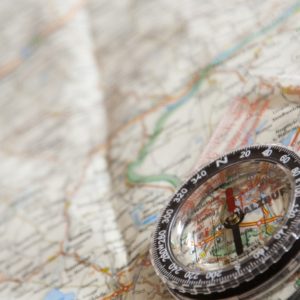
Discerning a religious vocation the first time around wasn’t easy by any means, but at least it was comparatively straightforward. The explanation I came up with for my spiritual director was this: the first time you enter religious life, it’s like turning a compass slowly until the needle points north and everything falls into alignment. God is the magnetic pole Who draws you to Himself, and you need only keep your eyes on the compass and follow the path north to Him.
Leaving the convent is like dropping the compass.
Of course, you pick it up again, and it looks fine on the outside – the glass unbroken, the case undented – but when you try to follow it, sooner or later you’ll find it’s been jarred out of alignment. The needle swings back and forth without stopping, on any bearing, let along north. God is still out there somewhere, and you keep waiting more or less patiently for the compass to settle down and start pointing you in the direction He wants for your life… and when it doesn’t, there’s no option but to start walking regardless, because that phone is just going to keep on ringing until you do. Discernment the second time around means having the courage to take even a single step forward, knowing that you have no real idea whether you’re heading north or south-south-west.
My post-convent discernment path has been largely comprised of zig-zags, punctuated occasionally by an “oof!” as
my faulty compass guides me straight into a tree. (I went on a nine-day orienteering camp when I was fourteen. Didn’t like it. Can you tell?) Our Lord told us, though, to keep on asking, seeking, and knocking; without a functioning compass, the walk will take longer, but one day – in His time – the underbrush will part suddenly and a clear path to Him will become visible. And He asks us to trust that, when each one of us gets to heaven and looks back down on the times when we felt most lost and helpless, meandering pointlessly in the scrub, we will see only one set of footprints.
Sep 8, 2016 |
By AfterEpiphany.
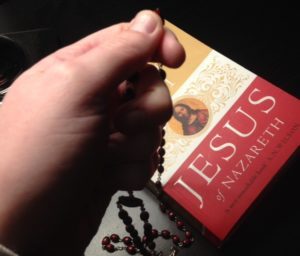
Don’t be scandalised… but it took me a while to get excited about the Luminous Mysteries when St John Paul the Great first gifted them to the Church. If even a tiny bit of me had held on to that initial lack of enthusiasm, that is now well and truly gone! The Luminous Mysteries of the Rosary have been a particular comfort to me over the past few months as I’ve faced some more-intense-than-usual challenges in my own post-convent journey.
Anyone who has spent any time at all in religious formation will know how painful it can sometimes be to grow in self-knowledge… and the growing and learning doesn’t stop when we return to the world. When faced with something about myself that is difficult to accept, it is unhelpful to hide from the Lord as did our first parents in a certain primordial garden. Facing difficult truths and difficult situations is far less intimidating when done in the presence of Our Lord, lifted up to Him in the Blessed Mother’s maternal embrace.
It was in this way – taking something that I found distressing about myself to my rosary one Thursday – that I got distracted from my distress as I reflected on what it was to invite our Lord to shine His light into difficult personal discoveries. It was almost like He was telling me to stop obsessing about the problem, and simply fix my contemplative gaze upon HIM. The moment I stopped looking at the figurative soot on my hands and started gazing deep into the dancing flames I felt drawn nearer to the Fire, taking comfort in the warmth it afforded, all the while dazzled by the brilliance of the light. This is where that meditation on the Luminous Mysteries ended up that day:
The Baptism of Our Lord: In Jesus of Nazareth, Pope Benedict XVI explained the significance of Our Lord’s Baptism as the moment where He took on His own shoulders the sins of the whole world throughout time and space. It was a prefigurement of His shouldering the Cross, it was a prefigurement of His harrowing of hell and it was a prefigurement of His Resurrection into new life, all at once. The weakness I’ve just discovered in myself was something Jesus already knew about in His eternal now and purposefully took upon Himself those centuries ago in history when He was baptised in the River Jordan. The Lord of Heaven and Earth, who loves me personally and perfectly, has long anticipated this moment when I would lay this very weakness of mine at His feet.
The Wedding Feast at Cana: Pope Benedict XVI also talks about how St John takes great care to say that the Wedding at Cana happened “on the third day” – clearly related to the Resurrection, of course, but also related to the traditional, Old Testament understanding of the appropriate time for “Theophany”, i.e. the manifestation of Divinity. At the Wedding Feast at Cana, Our Lord shows us that He is God, but also demonstrates that He is both able and willing to provide the good that is lacking in our lives. He can turn the insipid water of my weakness into the rich, abundant new wine of Christian joy!
The Proclamation of the Kingdom: As comforting as it is to know that Our Lord has taken my weakness upon Himself and is longing for me to let Him provide the good that is lacking my life, He also invites me – requires me, whilst never violating my freedom – to change. In filling me up with the new wine and revealing His goodness to me, He asks me to conform to a way of life that will help me to become more myself-as-He-created-me-to-be. We all need this reminder… and sometimes it is more helpful to focus on the virtue to which we aspire than it’s related vice with which we struggle. Meditating upon the beatitudes and His parables… what beautiful treasures He has given us to ponder in our hearts! Such pondering, after the example of Our Lady, will gradually enable Him to fashion our hearts into the new wineskins that will be able to contain that new wine He seeks to give us.
The Transfiguration: When I follow that invitation to change, and ponder His words and continue my interior dialogue with Him, He draws me still further… up a mountain, as it were, to contemplate not just the way He would have me live… but to look upon the radiance of His Face, to allow my desire for Him to be heightened as I behold His resplendence to the extent that He reveals that to me. As I’ve worked through my own recent challenges, I’ve been more drawn than ever to spend time with Him in the Eucharist and I do my best to get to make a holy hour several times a week wherever possible. I’m quite convinced that this increased desire is His doing and to be honest it’s a little exciting to wonder what changes in me He might be working away at whilst I sit and gaze upon Him, none the wiser as to the details, but growing in trust that He IS doing something!
The Institution of the Eucharist: With this increase in desire has come a reminder that the most important thing I will do on any given day is attend Mass and participate in the Eucharist. For me personally, this is gradually conforming my heart to be best able to receive the love He wants to give me, as I attend His sacrifice re-presented on the altar… but it also puts the rest of my day into perspective. The difficult meetings at my workplace and my frustrations with my own personal and daily failures pale into insignificance when considered alongside the beautiful half-hour during my lunch break where I get to witness the meeting of Heaven and Earth and receive Him in the Eucharist. This temporary union with Him, the magnitude of which I can only scratch the surface here on earth, truly is a foretaste of that eternity for which I was created…
As you can see… having followed all of the above line of thought I found myself all of a sudden marveling in His goodness to me and less and less distressed about that personal weakness that I took to prayer in the first place!! I still have my weakness… but now I’ve invited the Lord into that, and followed His invitation to dwell more on Him… my relationship with Him is strengthened in the dialogue, I’m less scandalised by my faults as I realise the truth of who I am and the truth of who He is, and my trust in Him and dependence on Him grows every time I get out of my own way, lay my troubles at His feet and ask the Blessed Mother to pray with me and for me.
Whilst it can be tempting to cast the Rosary aside, now that there’s no longer an Horarium requiring you to pray it, it’s really important to resist that temptation! I really can’t recommend the Rosary enough as one way of spending time in your inner cell, working through the challenges you face in everyday life with Him. Go to Our Lord through His Blessed Mother and let the light in!
Q: What is “From My Inner Cell” all about?
A: From My Inner Cell: Conversations with God for convent-leavers
Aug 11, 2016 |
By AfterEpiphany.
“Do not cling to me,” (c.f. Jn 20:17
The post-Resurrection encounter between Jesus and Mary of Magdala is one of my very favourite Scriptural accounts. Yet it poses a gentle challenge that I found very helpful upon returning to the world, if a little hard to hear, at first.
I’d invite you to step into Mary’s shoes for a moment. That moment of recognition at being called by name would obviously bring an unspeakable joy, an excitement, an awe. But I think there might also perhaps have been a sense that “now that He’s back, things will be just like they used to be…” Perhaps Mary was clinging to a set notion of the pre-Resurrection Jesus? She had to let go, to allow Him to return to His Father.
The words “do not cling to me” speak to me, also, as I ponder this account. I had certain ideas about my relationship with the Lord when I was in the convent. When I returned to the world, it was tempting to cling to these ideas. They were comforting, familiar. But they were my own ideas about Jesus – they weren’t actually Jesus.
How is Jesus revealing Himself to me in the present moment? Who am I before Jesus, now? How do we relate? Is my relationship with Him stagnating, because I am clinging to those old ideas? Perhaps it’s time for me to invite Him back in, to allow Him to love me, to grow in love for Him… a different kind of love…
Q: What is “From My Inner Cell” all about?
A:Â From My Inner Cell: Conversations with God for convent-leavers
Jun 28, 2016 |
By AfterEpiphany.
I think Joseph is quite a comfort to the average convent/seminary leaver. I’m not talking St. Joseph the Foster-Father of Jesus… he’s awesome, yes. But right now I’m talking about the owner of a certain Technicolour Dreamcoat.
We all recall that he was sold into slavery by his brothers who were offended that he seemed to think himself better than he really was. He was thrown into prison because he turned out to be better than the Pharoah’s wife thought he was. And if the irony of all of that wasn’t enough, throw in the fact that he was accompanied in his unjust fate by two others who deserved their punishment!
Unlike the Event for which this was a pre-figurement, where one of the thieves asked to be remembered by the Innocent One when He entered His Kingdom, in this case rather it was the innocent one who asked to be remembered:
“Only think of me when all is well with you, and please do me the great favor of mentioning me to Pharoah, to get me out of this place.” (Gen 40:14)
This request was made of the “chief cupbearer,” who promptly forgot all about Joseph when he left the prison. Joseph remained in prison for another two years.
What on earth went through Joseph’s mind and emotions over that two year period? What do you think he prayed about during that time? Did he give up hope that he would be remembered and freed? Was there some point at which he decided there was no way he was ever getting out of there, and was that belief something that sparked off the grief cycle for Joseph? Do you think He got angry at God? Perhaps he felt as though he had been forsaken? I wonder if that first little while after leaving the convent/seminary isn’t just a little bit like Joseph’s time in prison?
In the story of Joseph, we cannot help but notice that he did not return to Canaan. Yet as the adventure played out, albeit in a place other than that which Joseph had planned, it is worth remembering that God provided him with the means to put things right with his brothers, to be reunited with his father and to live a full and happy life.

 By Penny.
 By Cinnamon.
 my faulty compass guides me straight into a tree. (I went on a nine-day orienteering camp when I was fourteen. Didn’t like it. Can you tell?) Our Lord told us, though, to keep on asking, seeking, and knocking; without a functioning compass, the walk will take longer, but one day – in His time – the underbrush will part suddenly and a clear path to Him will become visible. And He asks us to trust that, when each one of us gets to heaven and looks back down on the times when we felt most lost and helpless, meandering pointlessly in the scrub, we will see only one set of footprints.
 As you can see… having followed all of the above line of thought I found myself all of a sudden marveling in His goodness to me and less and less distressed about that personal weakness that I took to prayer in the first place!! I still have my weakness… but now I’ve invited the Lord into that, and followed His invitation to dwell more on Him… my relationship with Him is strengthened in the dialogue, I’m less scandalised by my faults as I realise the truth of who I am and the truth of who He is, and my trust in Him and dependence on Him grows every time I get out of my own way, lay my troubles at His feet and ask the Blessed Mother to pray with me and for me.

Recent Comments