May 19, 2018 |
 By Christina M. Sorrentino (re-printed with permission from her blog Called to Love OSB).
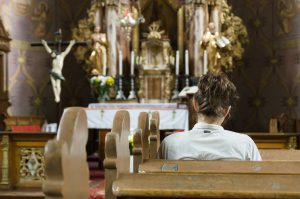
One of the greatest blessings of living in a monastery or convent is being able to live with the Blessed Sacrament. When young women would come on a discernment retreat and ask me what my favorite part was of being in religious life, I would always tell them, “Being in the constant presence of the most holy dwelling place”. There were some nights I would go down to the Eucharistic chapel and simply sit quietly alone with Jesus in the darkness with only the sanctuary lamp as my light. I cannot explain the feeling that would come over me as it is indescribable, and it is a feeling that I miss the most after leaving the monastery. I can no longer at night right before bed go downstairs and sit in the stillness before the Blessed Sacrament, and I can say that is my greatest sadness and loss of no longer being in religious life.
As in the words of Fr. Michael E. Gaitley, MIC, I find myself with a sort of “holy envy” in that I wish that I lived in the same house in such closeness to the Eucharist. Religious sisters and nuns are truly blessed in that they actually live in the same house as the Blessed Sacrament, and can visit with Jesus as often as they wish to visit him. I remember after Compline visiting the Eucharistic Chapel on my way back to the Sisters’ residence, and whispering to Jesus, “Good night”.
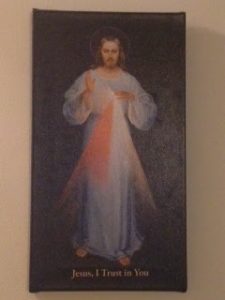
 My heart yearns for the day when I will once again be living in the same house as the Blessed Sacrament. I do not find it a coincidence that not too long after my departure I was given an image of the Divine Mercy, which is such a beautiful image of his grace. I told my father I wanted to hang the image on the wall in my parents’ living room, and I was surprised when he told me that I could do so, and already I knew that Jesus was pouring out his merciful love.
Although the image is not the Blessed Sacrament, it will be a reminder of the merciful love of Jesus for me and for my family. The Divine Mercy Image Enthronement is an invitation to allow Jesus to reign not only in our home, but also in our hearts, and I will remember to trust Jesus and his divine will. This image of great grace brings Christ into our home, and until the day that I can once again live in closeness to the Eucharist I will consider myself blessed that the Image of Divine Mercy will remind me that Jesus is always with me, and to trust him.
Apr 30, 2018 |
Thank you to all our volunteers, supporters, and friends! We’ve made a video to celebrate, and hope that you enjoy sharing this milestone with us!
Feb 6, 2018 |
By Girasol.
Sometimes Scripture consoles us; at other times it shakes us up and pulls us out of our comfort zone. Sometimes the words on the page easily pass through our own lips as a prayer to the Most High; at other times we can barely bring ourselves to read the words, let alone allow them to penetrate our hearts.
One recent morning during my personal prayer I sat with the first reading from Mass, the third chapter of the first book of Samuel. It is the story of young Samuel hearing the Lord call three times during the night, without yet knowing who it is. He believes it to be Eli, his mentor, calling him and promptly replies, “Here I am. You called me.” Eli tells Samuel to return to sleep, but after the second instance, the wise man understands the truth and counsels his apprentice to respond to the voice of God, saying, “Speak, Lord, for your servant is listening.”
I finish my perusal of the first reading and glance at the Responsorial Psalm paired with it. It echos the active response to God’s call with the words, “Here I am, Lord; I come to do your will.”
Speak, Lord, for your servant is listening…Here I am, Lord; I come to do your will. Try as I might to make these words my own in this moment, I am finding it near impossible. I do want to hear God’s voice and do His will, but my previous attempts seem to have failed. I’ve spent some time being sluggish toward fully embracing His plans. Now I want to get back on track, but I’m dealing with the consequences of my wanderings. I don’t feel worthy of uttering these words, much less capable of bringing them to fulfilment in my life.
I scan the page to see if I can latch onto another phrase to carry with me through the day. I continue reading the verses of the Psalm… “To do your will, O my God, is my delight.” I sigh. Beautiful words, but I’m not quite there yet. Delighting in God’s will doesn’t seem to be my current state of mind. I’m working on getting there, but “delight” doesn’t seem to describe anything within me right now.
“Here I am…” I stop there. Here I am. Yes, I can say that much. I can be here. I can show up. I might not be able to do much more at this point. I can’t pray as I ought. I can’t lay down my life in joyful surrender (just yet). But I can come to prayer and say “Here I am, Lord.” That is, after all, where Samuel began. His “here I am” turned into a willing “speak Lord, your servant is listening.” And we can surely imagine him going on to say, “to do Your will is my delight.”
I’ll get there too. But right now, I start by making that small act of being present, and allowing Him to mold my faint heart into one that finds delights in doing His will once again.
Nov 24, 2017 |
Dear sister, may the love of God, the peace of our Lord Jesus Christ, and the fellowship of the Holy Spirit be with you!
I write this letter to you, my sister in Christ, who has had the courage and love to respond to a desire, an invitation, and a mystery: to belong wholly to God. You prayed, you strove to discern if this was a call to religious life, and you took a leap of faith. Now you are at a new stage in your discernment, one which is no less a leap of faith. You have left the community in which you lived, prayed, worked, laughed, cried, loved, and have come back into the “the world.” Please do not believe that you are alone. I want you to realize that there is a community of women throughout the world who have also made this step in and out of the convent. For many, if not all, this journey to and from has come with great sacrifice.
Dear sister, the Lord knows your sacrifice. The Lord knows our going and coming and He accompanies us on each step. Psalm 121:8 “The LORD will guard your coming and going both now and forever.” The journey you are on may be sorrowful or joyful—either way, the Lord intends to journey with you. “For the Lord will not abandon his people nor forsake those who are his own.” (Psalm 94:14).
Recently, my spiritual director shared with me about an article he read wherein a novice mistress sadly described the wounds that women carry when they leave the convent. She noticed that for many, who believed that they were to become the “bride of Christ,” leaving felt like a divorce, a rejection. The pain of this wound can be felt so acutely, it leads women out of the Church.
I would like to say to these women: your grief is real, your wounds are real, but please do not confuse your pain with how Jesus feels about you. Please do not believe that He no longer cares. Jesus does not reject anyone who comes to Him (even if it may feel like it and even if you say: well, I have left Him). Sometimes we may be tempted to imagine ourselves as that “ideal sister” we thought we were called to be, to the point of losing our own identity. We compare ourselves to that image of a “fervent aspirant” or “generous postulant” that was ready to do whatever God asked. Then, at some moment along the way of our discernment, we realized that we cannot live up to that ideal. What do we do with this realization?
A major moment of insight and growth came to me in prayer one day (after I had already left the convent) when the Lord lovingly revealed to me that my offering to Him was lacking something. I didn’t understand at first, thinking I had given up everything. But He told me that my offering lacked something personal. As I pondered this, I realized that I wasn’t being authentic with Him because I had been striving to live up to what was asked of me as a sister, while not offering everything that was really happening inside my mind and heart. I was burying the real me in favor of an image of who I thought I should be. What I was trying to offer to God was something other than me.
When Jesus said in John 6:37, “Everything that the Father gives me will come to me, and I will not reject anyone who comes to me,” He did not intend this statement to be true only if you become a nun. Jesus said two very important words: everything and anyone. Can you exclude yourself from this invitation to hope? So, if you feel rejected, alone, and are struggling (I totally get that—I cried every day for two straight months when I realized I was leaving the convent), please reach out to someone you can trust. Jesus did not give us the grace of courage and love to enter religious life, only to abandon us and expose us to useless pain. “The gifts and the call of God are irrevocable.” (Romans 11:29). Please, do not lose sight of what you have received in Christ.
In Baptism, you are a beloved daughter of God, a temple of the Holy Spirit, called to intimate communion with the Most Holy Trinity and all the members of the Body of Christ. You are beloved and you belong. You are called by name and have a real family that prays for you throughout the world. God has a purpose and a mission for your life which is a secret of His love and Providence. In Confirmation you were sealed with the Spirit with an eternal seal of love.
So please remember, Bride of Christ, that your soul remains His. As a member of the Body of Christ, you remain His Bride. You are that betrothed, chaste virgin spoken of in St. Paul’s letter (2 Corinthians 11:2). Not wanting anyone to be led away from the love of Jesus which remains and endures forever, I share in the sentiment of St. Paul because I too love you, my sister in Christ, and I pray that you may continue to know the love of God and the peace of Christ “that surpasses understanding” (Philippians 4:7) as you continue your courageous and loving journey into the arms of God.
– Aimée Dominique
Jun 21, 2017 |
By LumenChristi.
May/June can be hard months for those of us still discerning our place in life. Weddings, ordinations, professions of vows, and entrances into religious communities are a painful reminder that another year has come without any such milestone in sight for us. We rejoice with our friends and families – do our best to put on yet another reception with love, and send yet another friend off to the convent/seminary with prayers. And sit through yet another homily about “celebrating a yes to the Lord and to one’s vocation.” And go to confession yet again for envy/self-pity/lack of trust in God.
Am I right? Or is that just me?
I read an article recently called “We said yes too” about the struggles of Catholic couples who struggle with a miscarriage or infertility. While those around them get celebrated for having many children, they often experience the implication that those who don’t have a wild 7+ member crew in tow “aren’t open to life” or “haven’t said yes.” The author goes on to explain how she and others like her have said yes – hidden yesses too deep and painful to share. Yes to giving back to God an unborn child gone too soon; yes to the surrender of hopes and dreams in the struggle with infertility; yes to allowing the gifts that God has given to be enough.
When I read her article, as a woman discerning her vocation who has hit many painful detours along the road, I identified deeply with what she said. Though my life and struggles are different, my heart leapt with bittersweet joy as every word resonated.
“I have said yes too,” I thought. Not the “yes” that gets celebrated during “vocation season.” Not the exhilarating “yes” of a vow to the Church or to another person to commit my life forever. But a silent, not-spoken-out-loud kind of yes, I had given.
The “yes” to surrender my will and my desires to God and trust him for the timing.
The “silent yes” to Him in not settling for a “celebrated yes” that I knew wasn’t His will for me.
The “yes” to being faithful in prayer even during the times where I was no longer sure who I was praying to. . .
As well as the little “yesses” too that can cost a lot at times. Yes, Lord, I will smile at my friend and share his/her joy right now even though I would rather run away and cry. . .Yes, Lord, I will bite my tongue and accept criticism in humility when a priest or leader in the church asks “haven’t I thought about my vocation?” (Believe me, I ‘ve thought about it!!! Too much maybe!”)
We, dear single, discerning ladies, have said our “yes” too. I am not arguing that these “yesses” become publically celebrated. Firstly, that would be awkward, but secondly, some yesses are meant to be hidden. As Christ lived the first 30 years of His life, so too are many of the yesses along the way to holiness, hidden – sometimes even disguised and misunderstood. Such is the brokenness of humanity and the mystery of God. But as I was reading this article and reflecting on my own “yes,” I realized how important it is to understand and treasure it myself . I think, in the future, it will help me to step back from others’ celebrations just long enough to pause, and pray. “I too have said yes, Lord and you know it. Give me the strength to keep saying yes, even when it is difficult.”
Each woman can fill in what her “yes” has been. . .
“Lord, I said “yes” to entering the religious life, following you while my family thought I was crazy. . .and then, when you sent me back to that same family, I said “yes” again just as generously, although this time it was with tears. . . “
“Lord, I followed you out of the convent and into the world, not knowing where it would lead. I’ve accepted every bump in the road and being “a fool for you” as I adjusted back to secular life . . .”
“Lord, I desire marriage and a family, but I’ve said YES to waiting for it to happen in your time and in your way. . .”
“Lord, I do not know where I’m going, but I’ve said “yes” to journeying joyfully even when I feel desolate. . .”
“Lord, being at Mass right now only brings me pain, but I say “yes” to being here with you anyway. . .”
Each of us can find a lot of these “yesses” in our lives, and I have realized it is important to remember them. I believe that for me such remembrances will be the key place where I will find the power to rejoice with those who rejoice, and to walk in faith when I would rather see.
Of course, we are not alone in either the remembering or the resolving to do better. I hope it consoles you as much as it did me, to rediscover that no “yes” goes unseen by God. I think these yesses, that are the last to be thought of in this world, are the first to be remembered in His eyes, and the foremost to be felt by His heart. I think the more conscious of them that we become, the stronger we will be in remaining faithful to them.
God-willing, one day we too, will have the opportunity to make one of the “celebrated” yesses. But in the meantime, the silent ones are nonetheless real. Treasure your “yes” and allow the Lord to treasure you.

 My heart yearns for the day when I will once again be living in the same house as the Blessed Sacrament. I do not find it a coincidence that not too long after my departure I was given an image of the Divine Mercy, which is such a beautiful image of his grace. I told my father I wanted to hang the image on the wall in my parents’ living room, and I was surprised when he told me that I could do so, and already I knew that Jesus was pouring out his merciful love.
 Dear sister, may the love of God, the peace of our Lord Jesus Christ, and the fellowship of the Holy Spirit be with you!
 I would like to say to these women: your grief is real, your wounds are real, but please do not confuse your pain with how Jesus feels about you. Please do not believe that He no longer cares. Jesus does not reject anyone who comes to Him (even if it may feel like it and even if you say: well, I have left Him). Sometimes we may be tempted to imagine ourselves as that “ideal sister” we thought we were called to be, to the point of losing our own identity. We compare ourselves to that image of a “fervent aspirant” or “generous postulant” that was ready to do
  So please remember, Bride of Christ, that your soul remains His. As a member of the Body of Christ, you remain His Bride. You are that betrothed, chaste virgin spoken of in St. Paul’s letter (2 Corinthians 11:2). Not wanting anyone to be led away from the love of Jesus which remains and endures forever, I share in the sentiment of St. Paul because I too love you, my sister in Christ, and I pray that you may continue to know the love of God and the peace of Christ “that surpasses understanding” (Philippians 4:7) as you continue your courageous and loving journey into the arms of God.
 By LumenChristi.
 The “silent yes” to Him in not settling for a “celebrated yes” that I knew wasn’t His will for me.
 Of course, we are not alone in either the remembering or the resolving to do better. I hope it consoles you as much as it did me, to rediscover that no “yes” goes unseen by God. I think these yesses, that are the last to be thought of in this world, are the first to be remembered in His eyes, and the foremost to be felt by His heart. I think the more conscious of them that we become, the stronger we will be in remaining faithful to them.
Recent Comments