Aug 11, 2015 |
 By Cinnamon.
Unusquisque:
1) Latin adjective (masculine singular), from unus (one) + quisque (each). Eg: Each one looks to You to give food in due season.
2) Tongue-twister from the Dominican prayer book, bane of my life in the early weeks of postulancy (see also: gloriosissimae; necessitatibus; famulorum famularumque).
I don’t know whether, in your former community, you tangled with this monster during the formal grace in Latin as I did (it’s pronounced oo-noos-QUISS-quay, by the way, and getting it right for the first time is a real buzz) but if you were in Dominican formation I bet that you’ve encountered these other eight-hundred-year-old traps for the unwary:
- Courtesy of the angels who started handing out bread at the junior end of the refectory table, you get to go first in everything! Want to wait invisibly at the back and watch the senior Sisters to find out what they do? Actually, you’re leading the procession. Good luck!
- You (finally) make a perfect profound bow. Everybody else makes a head inclination. Hopefully they’re all keeping custody of the eyes and missed it.
- For anyone who’s not naturally a soprano:
no further explanation is required. I used to do my choir practice down the local cemetery, figuring that my paint-peeling rendition of this beloved chant would take years off Purgatory for any Holy Souls who happened to be listening.
- Processions in general. Did anyone else crash into furniture on the way around the chapel? Execute an impeccable turn, and then realise that a partner had been left stranded because you were supposed to bow to her first? Meander off too far to the side and get patiently towed back in by one elbow? (Or maybe it’s just me. Who am I to judge?)
Also, unless your written work rivalled the perfection of the Summa, you will have found yourself on the receiving end of that other profoundly Dominican gesture: the uncapping of a red pen. Veritas. The deepest instinct of these Hounds of the Lord is to find out what’s wrong, and, for the glory of God, fix it. While still in the convent, I read the results of a survey about religious beliefs sent out to different communities of nuns in the 1960s: lots of sisters dutifully filled out and posted back their responses, but, surprising nobody except the authors, the Dominicans corrected the questions before they answered them. (It certainly didn’t surprise me. I’d just failed an essay for the first time since my early years in high school.)
And you know something? I miss it all fiercely. As Dom Hubert Van Zeller points out, a yearning for the externals of 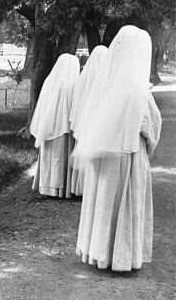 the religious life doesn’t mean that my vocation was to stay in that community – of course I miss the processions of white habits, the candle-lit vigils before Jesus in the monstrance, the solemn Salve. It’s also obvious that when my health began to shatter under the demands of monastic life, all of those beautiful things weren’t enough to keep me there. So why, then, did I spend the better part of two years afterward fighting an irrational desire to turn up on the community’s doorstep one morning and ask them to let me have another try?
When I left, the most important thing that became forfeit was not my hope of wearing the veil that would set me apart for Our Lord, and the scapular for Our Lady, and nor was it the chance to spend my days with a lively, intelligent group of devoutly Catholic women of whom I had become fond. It wasn’t even the privilege of living in the cloister and chanting the Divine Office with them at the heart of the Church. What I surrendered was twofold: to be a bride of Christ, and a daughter of Saint Dominic. In my heart, I’m both. Officially, I’m neither. Worse is the thought that, if I died today, in heaven I’d be neither.
Of course, if it turns out after further discernment that I don’t have a religious vocation at all, I could become a tertiary, but I suspect for me that would feel a bit like winning the silver medal. Here’s why. The desire to be a sister first hit me in my teens when I was barely practicing the Catholic faith, and before the year was out I’d fallen head over heels in love with Jesus. Listening recently to the TEDx Talk on discernment that Jenni gave, I realized for the first time that, somewhere in those early days, I skipped a crucial step in the process: I wasn’t afraid of the path ahead. On the contrary, I was awed at having been noticed by God, and wildly excited about getting started in the religious life. Forget your people and your father’s house, for the King has desired your beauty!
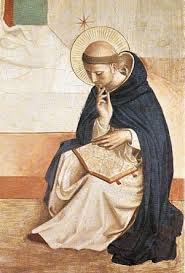
Thanks to prosaic things like tertiary studies and the resultant debt, the better part of a decade passed before I got my wish. Enough time to get over the honeymoon, commit myself to some serious study, collect a few battle scars and get a realistic idea of what I’d be facing when I entered. It always surprised me, though, when people said, “Wow, that’s a big step to take! Aren’t you scared?” No, I’m not, was the honest reply – it’s just the next obvious step. Giddy romanticism dispensed with, I was still eagerly looking forward to entering: I’d discovered the Dominicans at World Youth Day, and found what I was looking for in a religious Order. Then, a few months after I entered, I finally met Saint Dominic.
I’d been struggling through an assignment about the founding of the Order (having, as previously mentioned, failed the first one) and, one morning, simply pushed all my other essays aside and buried myself for several hours in the life of this gentle, luminously holy man. The shy scholar who sold his books to feed the starving; the preacher with bleeding feet, on his own among thousands of heretics; the beacon of chastity whose sheepish deathbed confession was that he had sometimes enjoyed preaching to young women more than old; and the devoted spiritual father who promised after his departure to help the brethren by his prayers. By the time I put my books away and hurried off (as quietly as one can hurry down a cloister while dodging the squeakiest floorboards, that is) to help prepare lunch that day, I’d become a Dominican. An ordinary desire to follow Christ had crystallized into the desire to follow Christ just as Saint Dominic had, in contemplation and preaching of the Truth.
So, I’m starting discernment again from scratch, trying to find the place where my home on earth might be. And this time, I am scared. I know what can go wrong, and how badly – but also how beautiful it can be. That’s in the future, though. For now, I remember and continue to pray the exquisite Dominican prayers I learned in the convent – not in some useless pretence of monastic life, but because their meaning has become intertwined with my personality like silk threads woven into a piece of cloth, and I wouldn’t know how to pull them out if I wanted to. I’m still a Dominican inside. Please God, one day I’ll sing His praises in heaven as one, too.
Praedicator gratiae, nos junge beatis.
Jul 29, 2015 |
How to deal with anxiety, from the pen of a paranoid schizophrenic.
By Stephanie Grace Cesare.
Jeremiah 29:11: Yes, I know what plans I have in mind for you, Yahweh declares: plans for peace, not for disaster, to give you a future and a hope.
Trust has been a major problem in my past, but if we believe in God’s goodness, how can we not trust in Him completely? Every second of our life God knows and allows to happen to us. “There is a spiritual world all around us, can you not see it?” – Jane Eyre.
Because of my condition I am always worried that the worst thing possible is going to happen at any second. The only way I could overcome that was to believe in God’s loving providence: to actually live second to second with a great belief that everything was in some kind of play book for my life. It is when the waves start crashing in on us, when we think we are alone and will drown, that God says, “O you of little faith”. In that moment the Apostle Peter cried, “Lord, we are going to drown, don’t you care?” Whenever we take our eyes away from God, that is when we become anxious, scared, feeling we are on our own and will drown in worries: that is when we need to cry, “LORD!”
This is where suffering must be understood.
Luke 11:11-15 says, “What father among you, if his son asked for a fish, would hand him a snake? Or if he asked for an egg, hand him a scorpion?” Suffering as the saints know it has infinite worth. God allows suffering to come upon us for this reason, that we may fill up what is lacking in the wounds of Christ, and that we may actually participate in God’s salvific mission for the world. God works through us when we accept life’s difficulties
2 Cor 12:7-10: “Wherefore so that I should not get above myself I was given a thorn in the flesh, a messenger from Satan to batter me and prevent me from getting above myself about this. I have three times pleaded with the Lord that it might leave me but he has answered me, “My grace is enough for you.” For power is at full strength in weakness. It is then about my weaknesses that I am happiest of all to boast, so that the power of Christ may rest upon me, and that is why I am glad of weaknesses, insults, constraints, persecutions and distress for Christ’s sake, for it is when I am weak that I am strong.”
Some examples in my life… God is in the details. To let go and realize every detail of the day is God’s will, will give you an extreme amount of peace. One day I realized I wasn’t going to be able to have a job because it was so stressful so I gave it up to God. I am a cosmetologist and I am supposed to take the next person on the computer list no matter what they want done, so I said, “Lord, please send me the people that I would be able to handle.” This went really well. Every time I went to the list I had the confidence that the Lord would help me with the next customer. He must really want me to have this job so I trusted.
I was in a religious community when I was having signs of schizophrenia and had decided to leave. I went into an extreme depression that landed me in the hospital several times. I didn’t know how a good God could push me away from him and not want a girl who dreamed all her life since the age of reason to be his spouse; to be incapable of it! How could a good God abandon me like that? “And I will dwell in the house of the Lord all the days of my life” – that just wasn’t true – or, “She has chosen the better part and it will not be taken from her” – hmm, what about that one? I was telling God how to make me holy rather than trusting that he knew the best way. Then one day, I read that God sent the man who had asked to be his disciple to go home and be a witness to his family and home town – “How can I do that?” I thought. Well, I have had the chance to help those in the world with me more than I ever had in the convent with my peers, family and customers. I am planning on volunteering at a nursing home so I can talk to the infirm about God while doing their hair. I never had this in the convent…the chance to get close to people and love them. To get to know them, unlike I would ever have in the convent. That’s when I realized I was called to the single life and so be a witness.
One night I was crying hysterically over the fact I left the convent when my parents came home from Louisville with a note from a homeless person on the street to me. It said, “I have chosen you to bear fruit.” That was the quote at my clothing in the convent on my card. It made me realize that I have a mission greater than I could ever imagine as long as I did God’s will.
I was chosen, but how and for what? The most anxiety you go through is not knowing your calling in life and the second is not trusting and giving up your will to God. Mother Teresa said, “If you want to make God laugh, tell him your plans”.
The teenager days are usually the most arrogant. I’m going to be rich, I’m going to change the world, I’m going to be famous. There is nothing wrong with having these goals, as long as we give our will to God, but many do not and go into despair when they do not accomplish what they desire. This has caused many college-age students to commit suicide because their goals are so high. Many people come out of religious life and this can be devastating to live a humble life of a lay person or the married state. In Abandonment to Divine Providence, Fr. Caussade explains that it is not in seeking holy things or circumstances, but seeking holiness in all our circumstances, that makes saints.
We will never have peace unless we trust that doing what is in front of us is God’s will and that doing it well (little detail by little detail) will take away the anxieties of life and will lead to greater, wonderful things. Think, when you offer your life to God in your daily duties, of how much more God in his generosity will give you to accomplish in your life. He is all goodness, so do you not believe he will give you a grand adventure – one that will bring you to heaven?
In living each moment the way God calls (the little details) God will give greater things for you to do. I love St. Therese because she taught the little way to heaven. Doing every little thing because it is most humbling and therefore more meritorious in the eyes of God. Once we realize the great worth of these small details, the more at peace we will be. Believe in PROVIDENCE! Just realize that our daily duties are so important when done with love – how much more at peace. God will always outdo us with love, and the more we offer up these small things, the greater the things he will call us to, and we will be at peace in his love.
Psalm 131, song of quiet trust: “O Lord my heart is not lifted up, my eyes are not raised too high. I do not occupy myself with things too great and too marvellous for me, but I have calmed and quieted my soul, like a child that is quieted at its mother’s breast; like a child that is quieted is my soul.”
Our Lady of Guadalupe to Juan Diego: “Listen, put it into your heart, my youngest and dearest son, that the thing that disturbs you, the thing that afflicts you, is nothing. Do not let your countenance, your heart be disturbed. Do not fear this sickness of your uncle or any other sickness, nor anything that is sharp or hurtful. Am I not here, I, who am your Mother? Are you not under my shadow and protection? Am I not the source of your joy? Are you not in the hollow of my mantle, in the crossing of my arms? Do you need anything more? Let nothing else worry you, disturb you.”
Jun 3, 2015 |
By two Leonie’s Longing writers.
Among the reasons for leaving religious life, the one that gets the least attention is that of being asked to leave the community.
Perhaps you know you: were too young, unhealthy, didn’t fit in, broke a rule, were unhappy, had conflict with your superior, had a misunderstanding, etc.
Or maybe you were like me and you weren’t told why you needed to go. You were simply asked to leave.
Even for those who have either discerned themselves or with the community to leave, there are still those looming questions, the “what if’s” or the “if only’s.” These questions, especially for those of us that are still wondering why, can echo in a seemingly empty soul.
Nature abhors a vacuum, and the evil one is all too willing to fill in that empty space of unknowing or uncertainty. He relentlessly lied to me and I had incredible difficulty fighting it. My sense of isolation and shame didn’t help.
These lies can include:
God doesn’t love you.
You weren’t good enough.
There’s something wrong with you.
How could you ever think you could be a sister?
They shouldn’t have let you into the community in the first place.
That peace and joy you experienced before entering was fake.
God doesn’t have a plan for you.
Only a really bad person is asked to leave a religious community.
Do these sound familiar?
So what is the truth? How do I combat these lies?
First of all, we must remember one simple fact: GOD IS GOD. Okay, I know you all know this, but sometimes we forget that God is bigger than our sins, failures, weaknesses, etc. Years ago I was told about a homily and it made an impression on me. In it the priest said: “God is big. God is bigger than big.” This is a simple reality, but one we often forget.
Besides this, who are we to call certain events and people failures? God often uses these “failures” to reveal his glory. It is easy to doubt that God is in our messes. But I would argue that it is exactly those places in which he wants to dwell.
These few little truths may help you combat the aforementioned lies:
- God STILL has great things planned for you. (We can’t “fail” our vocation. We can’t “fail” God’s plan for us.)
- Even though we are not religious anymore, that does not mean we are less valuable to God. Lumen gentium argues the exact opposite; there is a “universal call to holiness,” i.e. that holiness is not reserved for priests and religious. Furthermore, it is the laity that is given much of the task of preaching the Gospel and bringing Christ to others. You are given a special mission in your present lay life! You can reach others in a way that you couldn’t as a religious.
- Your fundamental identity as a Daughter of God and your relationship with God is UNCHANGABLE! You still belong to Him and are no less in His Eyes. He is arguably even closer to you in your suffering and pain, your grief and loss, and your shame and isolation. He experienced all of these things and is with you so intimately in these moments.
As we have reflected in the past few months on the mystery of the Resurrection, let us rise up out of those places that are dark, the “tombs” in our soul. Let us believe, without necessarily seeing, the good that God does with our “tragedies.” The Resurrection is proof of this reality that takes place within the human heart, within your heart.
May 20, 2015 |
By Spiritu.
Here’s one thing that works to my advantage: I’ll never need to pay a psychoanalyst to decipher the hidden meaning of my dreams. Last night, for example, I was kneeling in my parish church when the Sisters from my former community unexpectedly walked in. They didn’t see me, but I watched them as they genuflected and took their seats near the front, and I wondered whether or not to go over and join them, since I wasn’t wearing my postulant uniform. Then I woke up.
Nearly two years out of the convent, my subconscious clearly still hasn’t quite let go of what might have been. Thankfully, it’s better than it was: at around the time I would have received the habit, for example, I started waking up in the middle of my Clothing ceremony several nights a week. (At least my community had the understated custom of giving the novice’s religious name at the start of the ceremony rather than the end, so I always got that far!) After about a year back in the world, I’d dream myself standing outside the convent in twilight, just as I had stood in real life while wheeling out the bins each week during postulancy, looking up through a window into the brightly-lit community room where the Sisters were gathering for evening recreation. Now, I wonder what that dream means?
For a long time after returning to the world, I slept a lot, but badly: going to bed at 8.30pm, waking up as late as possible the next day, and getting dizzy with tiredness sometime in the late afternoon. A number of times, I was appointed designated driver home from outings when, despite being stone-cold sober, by 10pm by I was definitely no safer to drive than anyone else in the car. (If I make it to heaven one day, I confidently expect that Saint Christopher will be waiting just inside the pearly gates to deliver a lecture on the subject that I’ll never forget.)
Not being a doctor, I can’t offer medical advice, but if you’re in this situation I can tell you a few things that have worked for me:
1) For a short-term rescue if you’re getting faint during the day, forget the sugar and eat a salami stick. I started carrying some around with me (the individually-wrapped ones), and found that the salt, fat and juices gave a much better energy boost than chocolate.
2) The biggest one: no screens for an hour before bed-time. No phone, computer or even TV, as the bright lights apparently interfere with the brain’s sleep cues. (Well, minimal screens, anyway. I cheat. I’m cheating as I write this now, in fact.) This one actually fixed most of my sleep problems in one go, and drastically reduced the dizzy spells next day.
3) Chamomile tea. If you’re like me, the challenge, waking or sleeping, is to find a channel in your mind that’s not playing repeats of Life in the Convent. Slowly drinking a cup of chamomile tea just before turning out the light can help gently disconnect those loops of thought and take you downward into sleep.
And then there’s the 2am demon: what if I’d…/perhaps if I’d…/if only I’d… (Or its evil twin, what if they’d…/perhaps if they’d…/if only they’d…) The only thing that helps here, unfortunately, is time and a conscious effort to understand and process the grief. It’s as though every memory of life in the convent, good or bad, is a sharp edge that needs to be gone over with sandpaper a certain number of times before it gets dull enough that you can handle it. However, it’s 2am and you’d really like to go back to sleep, so what can be done for some relief in the meantime?
Here, I’ll pass on three suggestions from the wise and patient priest who suddenly found a wildly unhappy recent ex-postulant in his confessional back in 2013.
1) If you’re playing certain scenes over and over, perhaps making magnificent speeches where you actually once stood mute, bring your sense of the absurd into play. Imagine the scene with Bert and Ernie in the background reacting to what’s going on, or Mr. T providing a running commentary. If it sounds extremely stupid, that’s because it is… but I actually laughed out loud the first time I tested it on one of my painful convent memories.
2) Or, if that’s just too silly for words, how about this? Imagine you’re sitting at a table so long that the far end disappears into the distance, and slowly, gently slide the people you’re angry with down the table away from you, further and further until they’re so small you can’t see them anymore. Keep them there and turn your mind to something else.
3) If all else fails or – worse – the person you’re angry with is yourself, then turn the light on and write down, very specifically, what is bothering you. Then (my own later addition), decide on something concrete that you will do in the morning to move on from that situation. I will say a decade of the Rosary for someone’s intentions. I will put $5 in the Saint Vincent de Paul box. I will make coffee for my parents/housemates. I will say the Office of the Dead for the souls in Purgatory. Anything, as long as it’s clear, charitable and constructive. Then turn the light off and, for heaven’s sake, go back to sleep.
And me? Self-evidently, I’m not “over” the most vivid months of my life just yet. But two years out is a hell of an improvement over two months out, no longer bittersweetly receiving the habit night after night being but one example. The Sisters still walk through my dreams sometimes (do I ever, I wonder, walk through theirs?), but slowly, a couple of years behind schedule, my heart and mind are catching up to my life in the outside world. Thanks be to God.
Oct 16, 2014 |
By Misericordia
Today, the Church celebrates the Feast of a Saint very dear to my heart (no pun intended), Saint Margaret Mary Alacoque. She spearheaded the promulgation of the devotion to the Sacred Heart of Jesus (who was spear-hearted!), which was always present in the Church in one form or another but not formally recognized until then.
Before I started telling my own story about leaving the Convent and struggling with my eating disorder, I used to envy others who had seemingly more glorious stories. I thought my story was boring and embarrassing. Later on, however, I learned that my friends and acquaintances thought otherwise. And I soon realized that the Lord was a big fan of my story, not because it was particularly intriguing, but because it was the beginning of the story of my redemption. I started to see my wounded past as salvific, instead of shameful.
And if I can have this kind of experience – that my story is important and that my life has meaning and purpose – then certainly you can too! Each of our lives is so filled to the brim with extra-ordinariness in the midst of ordinariness, with grace in the midst of trial, with love in the midst of fear and pain, and mercy and forgiveness in the midst of apparent failure. So no matter who you are and what you struggle with, those sufferings are valuable gems. They are like the jewels on the Cross that represent the 5 Wounds of Christ. The points of access to redemption and salvation.
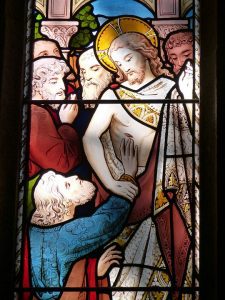
I love the images of Saint Thomas the Apostle when the Lord asked him to but his finger in his side, revealing to him and to us the gaping wound in His Side.
It is in His Wounds that we find refuge. There we realize that He knows our pain and our wounds. And as we put our finger into His Side we experience His vulnerability and humility. We realize the boldness of His trust in the Father’s Love that led Him to the Cross, to His seeming abandonment by the Father, and to His suffering and death.
But this wound is not a sign of failure and pain. It is the mark of His glorious Resurrection and Ascension into Heaven. In His Wounded Side we find, for us, the Love of His Sacred Heart, the Mercy He lavishes upon us, and the freedom He offers us in uniting our wounds to His. Yes, in Him we find freedom. Apart from Him there is nothing. When we try to rely on own accomplishments for affirmation and self-worth we end up being trapped under an avalanche of guilt, shame, unworthiness, loneliness, fear, and anxiety. But when we open our wounds to Christ and have the audacity to let Him see us as we really are, broken and in need of so many things, it is then that he pours Himself into us.
And despite the nothingness we may feel at times, the messiness of our life we finally admit to ourselves, and the rawness of the feeling of those wounds, we are finally filled. We no longer have this gaping empty bandaided wound because the Precious Blood of Jesus has finally gained access.
As we celebrate Saint Margaret Mary, who was given the vision of the Sacred Heart and who united her own heart to His, let us make a gift of our wounded hearts to the Lord and see Him graciously accept them, heal them, and care for them.

 By Cinnamon.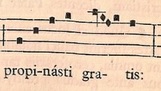
 the first one) and, one morning, simply pushed all my other essays aside and buried myself for several hours in the life of this gentle, luminously holy man. The shy scholar who sold his books to feed the starving; the preacher with bleeding feet, on his own among thousands of heretics; the beacon of chastity whose sheepish deathbed confession was that he had sometimes enjoyed preaching to young women more than old; and the devoted spiritual father who promised after his departure to help the brethren by his prayers. By the time I put my books away and hurried off (as quietly as one can hurry down a cloister while dodging the squeakiest floorboards, that is) to help prepare lunch that day, I’d become a Dominican. An ordinary desire to follow Christ had crystallized into the desire to follow Christ just as Saint Dominic had, in contemplation and preaching of the Truth.
 How to deal with anxiety, from the pen of a paranoid schizophrenic.
 with a great belief that everything was in some kind of play book for my life. It is when the waves start crashing in on us, when we think we are alone and will drown, that God says, “O you of little faith”. In that moment the Apostle Peter cried, “Lord, we are going to drown, don’t you care?” Whenever we take our eyes away from God, that is when we become anxious, scared, feeling we are on our own and will drown in worries: that is when we need to cry, “LORD!”
 so I gave it up to God. I am a cosmetologist and I am supposed to take the next person on the computer list no matter what they want done, so I said, “Lord, please send me the people that I would be able to handle.” This went really well. Every time I went to the list I had the confidence that the Lord would help me with the next customer. He must really want me to have this job so I trusted.
 y peers, family and customers. I am planning on volunteering at a nursing home so I can talk to the infirm about God while doing their hair. I never had this in the convent…the chance to get close to people and love them. To get to know them, unlike I would ever have in the convent. That’s when I realized I was called to the single life and so be a witness.
 We will never have peace unless we trust that doing what is in front of us is God’s will and that doing it well (little detail by little detail) will take away the anxieties of life and will lead to greater, wonderful things. Think, when you offer your life to God in your daily duties, of how much more God in his generosity will give you to accomplish in your life. He is all goodness, so do you not believe he will give you a grand adventure – one that will bring you to heaven?
 that disturbs you, the thing that afflicts you, is nothing. Do not let your countenance, your heart be disturbed. Do not fear this sickness of your uncle or any other sickness, nor anything that is sharp or hurtful. Am I not here, I, who am your Mother? Are you not under my shadow and protection? Am I not the source of your joy? Are you not in the hollow of my mantle, in the crossing of my arms? Do you need anything more? Let nothing else worry you, disturb you.”
 By Spiritu.
 apparently interfere with the brain’s sleep cues. (Well, minimal screens, anyway. I cheat. I’m cheating as I write this now, in fact.) This one actually fixed most of my sleep problems in one go, and drastically reduced the dizzy spells next day.
 wo years out is a hell of an improvement over two months out, no longer bittersweetly receiving the habit night after night being but one example. The Sisters still walk through my dreams sometimes (do I ever, I wonder, walk through theirs?), but slowly, a couple of years behind schedule, my heart and mind are catching up to my life in the outside world. Thanks be to God.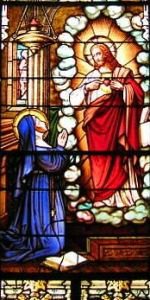
Recent Comments