Jul 20, 2014 |
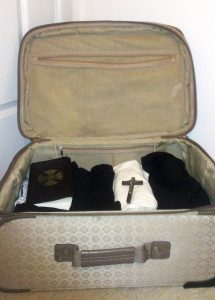 I was once told that leaving during postulancy is the equivalent of ending a relationship after a couple of dates: it was only a trial, a getting-to-know you period, and no commitment had been made on either side. Unfortunately, that’s not what it feels like. When I hear people describing what it was like to pack their bags and move out of an apartment shared with someone they’d eventually hoped to marry, I now feel a strange kind of empathy: that’s what it feels like. (Did you sometimes look around at the other postulants and novices and imagine what you’d all be like together as a group of old nuns one day? Yep, me too.)
If not yet formally committed to the religious life, a postulant is at least invested in it, and it won’t go quietly from the heart or mind afterward. Insignificant things suddenly remind you that you’re not on the path to being a nun anymore. It hits like an actual punch to the ribs, and all you can do is brace yourself and think: Ouch.
A few weeks after I left the convent, I looked around my new bedroom for somewhere to flop down and read, and realised with a shock that I was no longer subject to the custom that forbade sitting on the bed, because I was no longer part of the community which held that custom. Ouch.
At Mass six months afterward, I stood for the Our Father and tucked my hands under the long cotton scarf I was wearing. I had left well before receiving the habit, but suddenly realised what a scapular would feel like draped over my hands, and that I would have been wearing one by then if I had stayed. Right on cue: Ouch.
A couple of months after that, we had the story of the rich young man as the Sunday Gospel. To describe the result, I will need bold text, Caps Lock, and a minimum of three exclamation marks: OUCH!!! The story is far too familiar to need repeating here. Have you ever read a vocations guide that didn’t include it? For balance, I wish there were resources for discerners that included this story:
And the whole crowd of people from the district surrounding the Gerasenes’ country begged Jesus to go away from them, for they were thoroughly frightened. Then He re-embarked on the boat and turned back.
The man who had the evil spirits kept begging to go with Jesus, but He sent him away with the words, :Go back home and tell them all what wonderful things God has done for you.” So the man went away and told the marvellous story of what Jesus had done for him, all over the town.
Luke 8:37-39
Why had I never noticed it before? This one lonely everyman, overwhelmed by the love shown him by Jesus, begged to follow Him, and was gently told to go back to his family instead.
When I read that story during Lent, it was like letting out a breath that I’d been holding for the best part of a year. I was not the rich young man who had turned away sorrowfully out of love for the world. I was not the foolish bridesmaid who had brought a lamp but neglected the oil. Most of all, I was not the worker who put my hand to the plough and looked back. I was the one who knelt at His feet and said, “Lord, let me come with You!” and received instead the loving instruction to go home.
Naturally, there are still things that catch me off-guard: During the morning Mass on Easter Sunday, I felt a rush of emotion as the familiar opening notes of Haec Dies flowed through the church. If your Sisters sang it every morning throughout Easter week, as mine did, you could probably chant the first two words in your sleep. Ouch. Forget nostalgia: this felt like hunger.
God’s gift to me is the grace to be able to say now when that happens, “Lord, thank you for this pain – please turn it into something productive.” It took ten months for me to reach this level of acceptance, and I have a long way to go yet, but I’m grateful to be here.
By Spiritu
At the age of seventeen, Spiritu watched some elderly nuns laughing together after Mass and decided instantly that this was what she wanted to do with her life. After six years of intense study about the Catholic faith and the religious vocation, she entered a beautiful community in her own country, Australia. Seven months later, she returned to the world, saddened that her discernment hadn’t worked out as she’d hoped. She is now exploring other possible options for the future, and owes an enormous debt of gratitude to her family for their love and help.
Jul 13, 2014 |
 I have taken for myself the parents of the Martin Girls as my patrons for trying to live the ordinary demands of an ordinary life, as an authentic path for seeking God. Perhaps it sounds odd, but accepting the ordinary has been very difficult for me.
One of the hardest lessons I have had to learn in the spiritual life is the reverence that the ordinary, natural elements of life deserve. It is only in being grounded in the rich earth of ordinary life that the supernatural can be authentically received. In spite of my lifelong devotion to St. Thérèse, I spent many years quite frustrated by the routine and pressures of living the demands of daily life.
Mounds of laundry and dishes, hurrying to work, and hurrying home again to family expectations: all these felt like barriers to responding to God. The realities of my life did not seem to match any concept of holiness that might refer to me.
What did it take to open my eyes to the very real presence of God hidden beneath the surface of the demands of ordinary life? Years of simply doing what looked like the next right thing and a flood of graces. What did I ponder on in those days? Mostly survival from one necessity to the next. But once I began to believe that the call to holiness is universal and specific to each circumstance, then my soul was free to rejoice in all things.
What moved my soul beyond survival mode to the awareness of the presence of God? Fidelity to Mass, I think, even though I judged that I was not really praying. I carried a rosary in my pocket, even though as a young woman I rarely actually said it all, let alone meditate on a Mystery. The mystery to me was how profoundly I loved my family even though I was totally overwhelmed by them. By such tiny, desperate steps I began to believe that nothing can separate me from the love of Christ, because He chooses to be with me in all the chaos that I often considered my daily life to be.
If I’m not aware of God in the ordinary joys and sorrows of life, not in a state of deep gratitude for the natural elements of life, then I’m not yet truly in love with Our Father who created the natural, and said that it was good.
All things are created by God. Therefore, the most natural, common elements of life have the potential to be a revelation of God Himself. Growth in holiness cannot be His gift to me if I don’t learn to recognize the gifts that He has already given me and is giving me each day.
I’m just beginning to appreciate the importance of the teachings of St. Thomas Aquinas and St. Augustine on the relationship between grace and nature. The God-given nature of each individual is specifically given as the foundation for the relationship that He desires to offer to that soul. By means of the characteristics of my particular personality, profession, and limitations, God chooses to reveal Himself to me, and through me. There are no separate categories of life in respect to encountering the living God. God is all in all.
By Jacqueline-Thérèse
Living the Sacrament of Matrimony with a small flock of children and grandchildren. Greatly influenced by the Eucharist, the Oblation of St. Therese and the Rule of St. Benedict. In service through retreat work, fostering lay communities and vocation discernment.
Jul 6, 2014 |
When I left the convent nine years ago, I was entirely unprepared for my biggest struggle: the temptation to give up on prayer. I hate to admit it, but I kinda let prayer hang by a string for a while. I wish I were unique in this, but I suspect others have the same temptation, and I’ll bet no one warned you. So I want to share my thoughts in hopes of helping you avoid my errors.
What caused this temptation? First, I’d really wanted to be a Sister, I loved my community, and I’d really thought God wanted me there, so discerning otherwise took the wind out of my sails. Second, when faced with learning how to balance prayer, work, and life as a laywoman, I found it too easy to slack off. Like a pendulum, I swung from the convent-extreme of lots of prayer to the extreme of practically none. I never skipped Mass, but many days found me doing very little else.
At bottom, however, the real perpetrator was that ignoring God was less painful than facing Him. I eschewed confronting Him in emptiness and sorrow to avoid being exposed and vulnerable and, because He was so awfully silent then, having no answers or consolation. If I curtailed serious interior prayer, then I could forget I was a gaping wound.
Problem is, this is a time when we need serious prayer. We can’t pray as much as we used to, but we also shouldn’t stop praying as well as we did. So why do we feel tempted to give up on prayer in this time of weakness? Honestly, I think a lot is due to the devil wanting to kick you while you’re down. You’re already vulnerable, so he tries to convince you to despair and to stop talking to precisely the One Person who can give you healing, peace, and hope.
The remedy is to keep communicating with the Lord at all costs. At ALL costs. He can work with any little bit you can give or throw at Him. Really.
When I started to crawl out of the nefarious hole that is acedia, I found my best recourse was what I call the “park it” (as in “park your tukhas right there, young lady”) prayer method, because sometimes all you can muster up the heart for is to sit there. Your very presence is something He can work with.
So park yourself in the nearest church or adoration chapel, or if that’s not available, park it wherever you can pray. Don’t bring a rosary or breviary or Bible for this visit. Just bring you. Commit yourself to some amount of time: a half hour, an hour, whatever, and just sit with the Lord. OK, so you don’t have the heart to talk with Him? Maybe you feel like yelling at Him instead? Go ahead! Holler, scream at Him. (I mean the interior versions of these, unless you’re absolutely certain there’s no one around who might hear you!) Scowl at Him and be silent. Complain to Him about how hard this is. Tell Him how disappointed you are and how much you feel like a failure and all the other ugly things you feel. Or sit there and just let yourself weep in His presence. God’s strong enough to take anything you dish at Him, so let Him have it. And I’ll bet you dollars to donuts He’d rather have this honest, raw, hurting you who’s hurling gripes at Him than not hear from you at all. Maybe you’re not a Sister anymore, but you’re still His beloved, and He wants to hear from you.
Don’t stop there, and don’t move that tukhas yet. Don’t budge until the time to which you’ve committed is up. Is the Lord still not talking? Beg Him to talk to you, plead with Him to speak to your heart and heal it. Is He still not talking? Keep sitting there, and keep asking. Maybe He won’t say anything today, and maybe He won’t seem to say anything for a lot of todays, but you know what? The more todays you park it, the more you keep open those lines of communication. You’ve told Him, by your daily parking it, that He’s still more important to you than your hurt and disappointment. You’re showing that you still know you need Him and aren’t willing to rely on yourself. You’re showing that He’s still your everything, despite your disappointment, anger, and whatever else you’re experiencing, and despite the difficulty in focusing on Him. And this is a very real, deep form of abandonment and surrender.
You know the awesome, amazing thing that this does? It will gradually bring you to an entirely new level of prayer because, before you know it, you’ll start to hear Him speaking in new ways that you never expected. You’ll find that He’s started teaching you a new way of listening to Him, and then all of a sudden, you’ll see that He really is speaking to you after all, in a voice much more sonorous, healing, and loving than you could have ever imagined. Slowly but surely, the darkness will start to fade, and you’ll see bright sky peeking through, and prayer will bring you joy again.
Trust me, ladies. I’ve been where you are. It really, truly does get better because the Lord will make it better for you if you give Him the chance and the time. It took me a year to climb out of the hole, but it worked, and it was worth it! If you cling to the Lord when it hurts, you will find that great peace and joy come in and eclipse the hurt. And after all, this Lord of ours who clings to us eternally is so very worth clinging to, is He not?
By Cafea Fruor
Cafea Fruor is a former active religious sister who is now discerning a vocation to the contemplative life. She thinks that coffee, bacon, and Reese’s Peanut Butter Cups are God’s finest creations, but she’d give these up in a heartbeat to enter the monastery. Please pray for her continuing discernment.
Jun 15, 2014 |
Well, in a manner of speaking. God alone saves, but in my case, He decided to use art for that purpose. Leaving that community of prayer and mutual spiritual support left my soul feeling lost and starved, my heart with feelings of bitterness and despair. I did not immediately realize after I left that I needed to have a healthy outlet for these feelings or they would destroy me. And for several months they did indeed tear me down.
I’d always been a bit of an art nerd. I took lots of art history classes in college, without much idea of how to use them other than to soak up my elective credits, despite the continued objections of my academic advisor who thought I was crazy and needed something more practical. I took all my class notes as a series of random doodles, partly from love of doodling, and partly because I have ADD so bad I couldn’t actually take proper notes. The pictures formed for me a kind of pictorial mnemonic device for remembering what I’d learned that particular day.
By the end of my 4 years in college there were guys who would come to me at the end of the semester just to see my notebooks. I really didn’t understand why they were fascinated. The staff there thought it was inexcusable, that I was treating my academics like a joke by spending all my time doodling, so naturally I felt that way too. For me, those scratches represented what I perceived as my own personal weakness and laziness, my inability to be a “good seminarian.”
I eventually would go on to show those scribbles to family and friends outside of seminary, and almost overwhelmingly I would be asked, “Is there any more? Will you please make more?” I had no inkling that this art thing was anything important, but my spiritual director had just reminded me that when you have a gift from God, the Holy Spirit will draw people to it, and they will come to you and ask for it. So I went back to drawing.
I didn’t think I was very good. Actually, I was objectively bad! But I drew because I needed it, as a way to heal. And because other people needed it, and I needed to feel that people needed me, too. In prayer, God made it clear that I needed to do this for Him, because He had people who needed what I could make.
So I learned how to draw in new ways, using new tools. I learned how to use paint. I learned how to engrave. Some people meditate over Scripture by reading it over and over again, but I would imagine it over and over again, and then draw it. Other times, when my imagination would run wild in the Adoration chapel and I couldn’t get an image out of my head, I’d draw it, and then listen to see what He thought.
There were also times that I would draw with the intention of making something for selling, without listening to God or presenting my work to Him – worshiping mammon with the work of my hands, as it were. In these cases I almost always failed. It was humbling to see how my work is empowered by Him, how even when I will not obey His commands, the work of my hands is still the work of His hands.
Through all of this, I was constantly reminded that drawing was something that was for my healing. Not because it stroked my ego (though it sometimes did) but because God made my hands and I was using them to do something for Him, even though I didn’t understand exactly how. I don’t always pray before I pick up my pencil or brush, but in those early days I learned a sense of working with God on this hobby of mine. Or more precisely, this hobby of ours.
I discovered that I didn’t have to change the whole world to be holy or happy outside of a religious community. My vocation to personal holiness and communion with God can sometimes just be about making scribbles and giving them to Him.
By Anthony
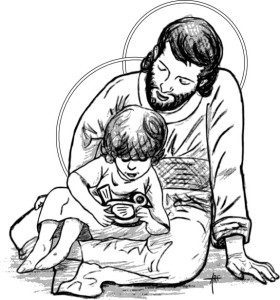
Anthony is a thoroughly lovable former seminarian, artist, and Catholic blogger. He is not only the author of this week’s post, but also the creator of its featured image. If you’ve never seen his artwork, check out his blog at http://weaselsgonarf.blogspot.com/.
And please PRAY FOR ANTHONY, because he’ll be marrying the lovely Katie on the Solemnity of the Assumption (this coming August 15th)!
Leonie’s Ladies: What have you found works as an “outlet” for you since returning to the world? Has something in particular helped you to heal, to process feelings, to readjust? Please share in the commboxes below so others can get ideas that may help them!
Jun 9, 2014 |
This past week we explored the process of grief in the context of leaving the religious life. The final stage of grief, Acceptance, can seem a far way off when one is in the deep valley of anger, depression, or denial. Yet it does, and will come to all of us.
Today is Ascension Sunday, the day when Christ, in all His glory, is taken up to heaven to be with His Father. What a contrast to his prior exit from this earth – one of bloody defeat to one of triumphant victory.
Despite the contrast of Christ’s two exits from earth, one aspect remained – His wounds. Why did He keep them? Perhaps it is more than a symbol of what He did for us. Perhaps it is a lesson in suffering – that it has a purpose, that it shapes our identity and our mission in life. Our past wounds, Christ shows, are not to be hidden, but to be a sign of triumph and transformation.
The final stage of Acceptance is not forgetting about our loss, but embracing it as a part of who we are and who we are to become. It was said once that where our wounds are, there is our mission. How paradoxical that sounds. Yet, if you look around, you will find this truth.
By Wendy Macagno
Wendy has received her MA degree in Counseling Psychology from Regis University and her BA in Religious Studies from Benedictine College. She has served her community as a career coach in both the non profit and government sectors.
May 29, 2014 |
On May 29th 2014, we explored the stages of grief and discussed healthy ways of coping with the pain experienced by those who have been in religious life and returned to the world. We sincerely hope you benefit from this video! May God bless you.

 I have taken for myself the parents of the Martin Girls as my patrons for trying to live the ordinary demands of an ordinary life, as an authentic path for seeking God. Perhaps it sounds odd, but accepting the ordinary has been very difficult for me.
 Well, in a manner of speaking. God alone saves, but in my case, He decided to use art for that purpose. Leaving that community of prayer and mutual spiritual support left my soul feeling lost and starved, my heart with feelings of bitterness and despair. I did not immediately realize after I left that I needed to have a healthy outlet for these feelings or they would destroy me. And for several months they did indeed tear me down.
Recent Comments