Dec 18, 2019 |
By Emma.
It was one year since I left the monastery. I knelt on the stone floor of the retreat center chapel, my Bible opened to the Gospel of John, chapter 11. The story of the raising of Lazarus.
It seemed fitting to spend some time with this moment in Jesus life for so many reasons. The friends of Lazarus begged Him to come when her friend was sick – to save Lazarus from death. Like them, I begged Jesus to come and make up for my frailty with His love and His peace – to give me the grace of perseverance in the vocation He called me to. And instead He waited. He waited as Lazarus died. He waited as I left the convent doors and no longer walked the cloisters of the monastery.
How similar to Mary and Martha I was when I told Jesus that “If You would have been there, I would not have had to leave.” How much I didn’t understand His ways, as He was in the midst of revealing to me that He is the resurrection and the life. And that in order for there to be the beauty of resurrection, there must come first the sorrow of death.
Death is hard – in whatever forms it comes in. The death of loved ones. The death of dreams. The death of fervor. The death of opportunities. The death of relationships. The death of meanings… When faced with death, the friends of Lazarus placed him in the tomb. And then, days later, Jesus arrives. And asks where Lazarus is laid.
Then Jesus wept.
And it struck me. Perhaps it was not the death of Lazarus that caused tears to flow from the eyes of our Lord, but rather the reaction of Lazarus’ friends. When faced with sickness they begged Jesus to come. They begged Him to heal their friend who was ill. They had faith. But when sickness turned to death, they gave up. They placed Lazarus in the tomb. They believed the situation was beyond hope. They had Jesus, who is the Resurrection and the Life, in their midst, and they continued their mourning. They thought the story was over. And Jesus wept.
This left me to be determined to believe that, as difficult as things sometimes are during this time outside of the monastery, Jesus can create something beautiful out of it. It challenged me to have the faith that will trust in Him even in the face of death – the death of my identity as a sister. It challenged me to have the vulnerability to place this death before Jesus, and not seal it in a tomb. And it challenged me to believe in the Resurrection – not just two thousand years ago or at the parousia, but also here and now in the moments of my life. I do not know how the Resurrection will manifest itself in my particular story, but placed in the hands of Jesus I know it will be beautiful.
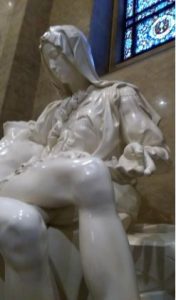 “And all through Lent we had this beautiful statue
to help us meditate on Mary and her faith.
And that faith in the face of failure.
In the face of death.
In the face of shattered dreams.
In the face of enthusiasm that had been spent
and hopes that had been dashed in a worldly messiah
that was going to come and liberate them from the Romans.
But Mary had a quiet faith
and she waited in expectation of the Resurrection.
It didn’t take away the pain of the moment.
But it gave her direction.”
– Fr. Joseph Johnson (November 3, 2018)
Mar 5, 2019 |
 By Sean O’Neill.
So heed me now, though all my quondam whimpers rise
From darknesses and little deaths You did despise,
Or seemed to. Your tremendous volte-face preyed each year
Upon my gullibility to bend Your ear
And racked this ruined soul with frames of phantom guilt.
Your accidental turning broke the barns I built
To store unrealised the mildewed fruit I bore.
I listened and ran bleating to Your closing door.
But when you turned I never saw your fabled smile
But wept upon Your thorny brow, to lose my guile
Where rivulets of blood do still obscure Your eyes
And gather where my hopes and weathered dreaming dies.
But here I lie, and ever did I, catlike, do.
For once, I now remember, where the olives grew
With mists between the small hills and dawn on the felled
Ancient castellations of the Marches, You held
My eyes and opened them on glimpses of Your face.
And have You changed? Is this now why there is no trace?
But now I think I mind a moonlit path I walked
Where all the trees were dancing with your voice and talked
Between themselves and lifted their long-fingered praise.
And You stopped me like a traveller with your gaze
And bade me lift this old, old burden from my back.
You have not changed. But surely I must learn my lack.
Then other places where Your love drew near, precious
And strong , or weeping and long, like milestones, conscious
Of me, spread along these dusts. I pine in my sleep,
Now. Now Your mercies crowd upon me from some deep
And dead forgotten cavern of my wayward heart.
I am the lost sheep. But no sooner do we start
Back on the pasture than I stray among the rocks
Or bandy words with here a wolf or there a fox.
Brand my hide with Your blood-red love, sacred shepherd.
Teach me the strong timbre of your speech that, once heard,
Will ever be obeyed; and lead me, lead me now
To grasses greener, sweeter than the heart knows how.
This poem first appeared in First Things, June/July 2004. Poem and image © Sean O’Neill, used with permission from the author.
Feb 13, 2019 |
By Katita Luisa
“Go to the desert and you’ll understand”.
So I went there this year.
I dipped my toes in that hot sand
and out of love for Him,
I was soon all in
with each grain rubbing against me,
scratching and removing what I wanted most,
purifying me
and my dreams
and my will.
I went there.
I stuck my neck out in that unrelenting heat,
feeling the burn on the most delicate of skin,
reddening,
but out of love for the Son,
I continued-
realizing He was not merciless
but rather merciful,
exposing and toughening
my weaknesses
for the path that would unfold.
I went there.
I reached for my canteen
only to find it empty,
surrendering
my own preparations,
expectations,
wishes
and comfort,
and was invited
to rely solely on Him,
embracing the unknown,
thirsting for Him alone.
And out of love for me,
we went there.
We grew closer rather than apart.
I found refuge in His Heart.
I even saw flowers bloom in that desert-
promises fulfilled,
so unexpected
yet expected,
because I can take Him at His word.
Lessons taught and learned,
my heart broken only to start to heal,
making room for Truth to sink in,
deeper than the cracks of my sin
and the holes of my doubt.
Yes, my cup overflows,
only because it had to be emptied first.
And as we left and I dusted off the sand from my sandals,
I took His hand and said,
“Out of love for You,
I’d do it all again.”
He looked at me, smiled, and said,
“Now you’re beginning to understand.”
Nov 12, 2018 |
By Aimee Dominique.
Journaling is a means by which I prefer to pray. I dialogue with God, ask Him questions, listen to His Word and sometimes write down what I’m grateful for at the end of the day. I like to go back and re-read my prayer journals to see how God has answered prayers, taught me, consoled me, forgiven me, and walked with me. Often I need a reminder of how God has been leading me, how much He has done for me. Sometimes I am surprised to see that I am tempted by similar things from year to year. Journaling has been a privileged means of seeing God’s presence in my life. Through journaling I get to see how God wants to work with my apparent failures.
Honestly, leaving religious life has felt like nothing less than leaving one culture and entering into another. It’s even more challenging when the culture I’ve returned to is supposed to be that of my own, that of my own people, my own country, yet it feels foreign to me. When over 10 years ago, I entered the convent for the first time, much of what has become the social norm didn’t exist. I never used a smartphone before and I feel lost when it comes to so many new forms of technology. I left religious life a little over two years ago and I continue to realize that the transition from the convent into the world is no less demanding than “sacrificing all” to follow the Lord to the convent in the first place.
One day I was expressing to God my pain and frustration—why does my life seem like a contradiction and a failure? (That may seem a dramatic assessment, but I would imagine that others who have left religious life have experienced similar doubts and feelings from time to time.) As I was pouring out my heart to the Lord in journaling prayer, I wrote to Him about feeling dizzy:
Dizzy—this world, my American culture, with its Instagram, Facebook, social media madness makes me dizzy… Job searches that end in a laundry list of competencies and required abilities, licenses, etc. make me feel dizzy… My own weakness makes me feel dizzy…
Not only can the first steps back into the world make you feel dizzy, this feeling can linger for years. There is the challenge of finding work, perhaps re-discerning a vocation, making friends, relating to people who you once knew, among so many other daily adjustments that often go unnoticed by those around you, but are felt with every step you take.
God recently revealed to me an explanation of my feeling of dizziness which consoled me. He reminded me of a passage in the Old Testament from the book of Jeremiah. God says to the prophet Jeremiah to go and visit the potter’s house. While there, Jeremiah discovers the potter is working at his wheel. Jeremiah writes, “whenever the object of clay which he was making turned out badly in his hand, he tried again, making of the clay another object of whatever sort he pleased” (Jeremiah 18:4). As Jeremiah witnesses the ingenuity and perseverance of the potter, the word of the Lord comes to him saying, “Can I not do to you, house of Israel, as this potter has done?… Indeed, like clay in the hand of the potter, so are you in my hand…” (Jeremiah 18:6). From this, God helped me understand that I feel dizzy because He is working on me right now. I’m His clay and I’m on the wheel spinning, but I’m in His hands. That’s what matters.
Clay is soft and impressionable. It doesn’t resist change but feels it very acutely, if clay could feel. If it was self-aware, clay might wrestle with feelings of shame about “turning out badly” in the hands of the potter on the first try. The important thing though is that the potter has a different perspective. The potter doesn’t get discouraged or frustrated with the clay. He tries something new. He is determined to continue his work. This is what God does with us. God revealed to me that it’s okay to feel dizzy and it’s okay to try something that doesn’t work out. He’s going to make everything work out in the end. He never gives up on us. St. Paul had this hope and perspective when he wrote, “I am confident of this, that the one who began a good work in you will continue to complete it until the day of Christ Jesus.” (Philippians 1:6). We just need to trust, trust, trust, and surrender ourselves into His hands.
Jul 11, 2018 |
By Windy Day.
In 2016, I went for a walk with a colleague when Hurricane Matthew was striking the United States. We couldn’t help but talk about the weather because it was such big news. He shared that he was in Virginia for Hurricane Bertha and said it was “only a Category 2.” He then described his experience:
“The sky was pitch black; the wind howled nonstop for hours. The eye of the storm passed by at around noon, which I recall vividly because it provided just enough time for us on staff to go out for lunch — we sat outside at a local sandwich place under beautiful, peaceful blue skies and sunshine! Then, no sooner had we returned to the office when the deafening, dark tempest began roaring again. The contrast in so short a time was surreal and impressive.”
We were discussing this on a beautiful Autumn day, knowing full well that in other parts of the world people were recovering from devastation, experiencing devastation, or awaiting devastation. It was a strange feeling. Enjoying the beautiful weather and yet knowing not everyone in the world was experiencing the same thing.
If that can happen with weather I would suspect that it can happen in the spiritual life.
Does it sometimes seem that your experiences and feelings are casting a cloud over everything? It’s easy to deduce that everything is awful when we feel awful ourselves. But our current feelings and experiences aren’t an all-encompassing reality (or they don’t need to be). Have you heard St. Therese’s analogy of the little bird looking at the sun when the cloud passes in front?
“With bold abandonment, he remains gazing at his Divine Sun. Nothing can frighten him, neither wind nor rain; and if dark clouds come to hide the Star of love, the weak little bird will not move away, for he knows that on the other side of the clouds his Sun continues always to shine.”
To me that analogy made sense. But the way I had been reading it made it seem fairly tame. However, if we think about a hurricane completely blocking out the Sun so that midday looks like midnight, that is something very different.
Have you felt this way? I know I have.
Since returning to lay life I have felt to varying levels of desolation and spiritual torment. These are hard to reflect upon, let alone describe, especially when you’re afraid to scandalize others. It feels as though everyone expects you to have your life together because you were a religious. And to make it worse, we often expect that of ourselves.
Instead, I think it’s more realistic to anticipate and expect at least some darkness, if not extreme darkness, at this time. We are vulnerable and the evil one always looks for weakness in our defense (see 14th rule in St. Ignatius’ Rules for Discernment of Spirits*). It is quite likely your relationship with the Lord has been strained or challenged and this gives Satan an “in.”
How can we combat this darkness? Here are a few thoughts:
First, recognize this possibility and, “Be not afraid!” Fear can easily dominate us and cause us to feel powerless. Try to manage your response and any other things that you can control. Remind yourself of the truths of the spiritual life. Once again, Ignatius’ rules may help.
Next, don’t be surprised, offended, disappointed or take it personally. It magnifies things and only makes everything feel worse. This is a great opportunity to find hidden pride. If you are shocked and upset, you most likely had an unrealistic image of yourself (mea culpa!).
Finally, consider praising God in all things and thanking Him for this opportunity. View this truly as an opportunity and not a barrier. How can this be true? A few ideas:
You can learn more about yourself.
You can depend on God more.
You can turn to Him.
You can grow.
These are all good things that God wants for you! And you can always ask Mary to help you. Keep reminding yourself that, as St. Therese affirms, on the other side of the clouds his Sun continues always to shine.
What suggestions do you have? Please share in the comments below!
___________________________________________________________________
*http://www.discerninghearts.com/catholic-podcasts/14-rules-discerning-spirits-different-movements-caused-soul/

 By Sean O’Neill.


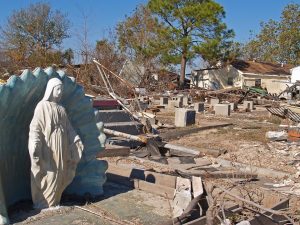 Since returning to lay life I have felt to varying levels of desolation and spiritual torment. These are hard to reflect upon, let alone describe, especially when you’re afraid to scandalize others. It feels as though everyone expects you to have your life together because you were a religious. And to make it worse, we often expect that of ourselves.
Recent Comments