Jan 25, 2017 |
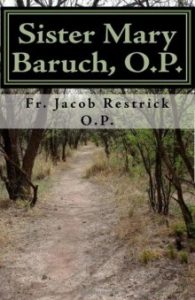 By Rosemaria.
“My name is Baruch; I know, it’s not a girl’s name, but it’s my name… Mary Baruch, which gives it a nice feminine flavor, yes?… Like all the nuns that came before me, I was dying to know what name I would receive… I was hoping for the name of one of the Apostles, or one of the Dominican saints… But I learned later that Mother wanted something from the Hebrew Scriptures… I didn’t know the Hebrew Scriptures all that well, and Baruch, for me, was the name of [that] college on Lexington Avenue and 24th Street…I’ve grown to love the name, however, as I know it means ‘Blessed.’… Before all that, I was just a nice Jewish girl from the Upper West Side of Manhattan…”
These quotes from the opening pages–and the lines of innumerable pages along the way–of the delightful fictional story Sister Mary Baruch: The Early Years may ring a bell or two within your heart. Anyone who has ever been in religious life for any amount of time will find this tale of a young Jewish woman in the 1960s who converts to the Catholic faith and enters a Dominican monastery to mirror some of her own story. Early on in the book, you will meet her devout Catholic friend who not only challenges her to go jogging (sure, but the tucked-away candy bars certainly help along the way!) but also is the reason she makes her way into a Catholic church to light a candle of hope and prayer one day and finds her life changed forever. As you follow the spiritual journey of Rebecca-turned-Sr. Mary Baruch, you may see yourself, but for sure, you will laugh, and you may even cry!
Written by a Dominican priest, Fr. Jacob Restrick, the story offers a true inside look at monastery life as you watch Sr. Mary Baruch grow in her walk of holiness. You will feel her struggles, laugh at her foibles, and rejoice at realistic stories of God’s grace. And when you get to the end and wish there were more… don’t worry, there is a sequel, Sister Mary Baruch: The Middle Ages. The only “complaint” I have about the book is that she is fictional: she seems so real that you will be tempted to pray to her!
Jan 4, 2017 |
 By Jacqui, re-printed from her blog Talitha Koum with kind permission. Please pray for her as she begins her volunteer work at at orphanage in India!
The past year has been such a journey. As we near New Year’s Eve, I am seeing more and more comments on social media about how terrible this year has been…as a whole. I have been conflicted in my response.
Yes, people died. We, as a society, have mourned the loss of many celebrities this past year. But, how many people have lost a friend or a loved one? How many parents have had to lay a child to rest too early? Personally, I have been to two infant funerals in 2016, and was not able to attend another. Dear friends of mine, who lost their babies all too soon.
I imagine their pain is overwhelming. Yet, I admire their determination and faith, that in the Lord’s time, all pain and sorrow will be healed. They have not dwelled only on their loss…they have found moments of joy and great blessing. They have chosen to look at the graces of 2016 and to look forward, in hope, to a new year. A new beginning. A fresh start in living out their lives of faith and trust in Divine Providence.
As I reflect on my own life, this past year, there are many moments of great pain and sadness. There are moments of death. Moments of utter abandonment. Moments where spiritually, there was only great darkness and a deeply penetrating feeling of despair or hopelessness. How easily I could look back and say, “Thank God, this year is finally over! It was such a terrible year. Hopefully 2017 will be better.” Yet, I choose to see God at work in my life. I choose to not focus only on my hard times, losses, etc.
In my looking back, this is what I see my year was:
I was living my life, as Sr. Emilia. I lived the life that, for as long as I can remember, I have always dreamed of. Then, in discernement, I began to pray about being called to an openness…to the idea…that I was being called to leave religious life to discern marriage. That was a huge time of fear, faith, trust in the darkness, excitement, etc. It was a gift…even in the pain.
I attended a Theology of the Body course retreat, in PA. That retreat literally, “changed my life!” I had no idea how beautifully painful that week was going to be. The Lord showed me throughout that week, His great and abiding love. The phrase I used after that week was, “…it felt like I had been stripped and beaten, then hung up to dry, alone.” It took me months to connect that imagery, to that of Christ, on His own Cross. Then, my pain (because it was on that retreat that I discerned I was called to marriage…which meant leaving my life and sisters at the monastery) became beautiful…because it was united with our Bridegroom’s Cross…the marriage bed of the Lamb.
(Now, a quicker version of the rest of the year…)
I left religious life in May. I lived with my Granny for a time. I lived on Kelley’s Island for three months. I applied and was accepted for a time of volunteering in India. I moved home to prepare for that mission. Now, we are just 6 days from my departure to India! I will live the first 5 months of 2017, on the other side of the world.
There were SO many days of great pain and sadness, as I adjusted to my new life outside of the monastery…without community…without such intense and beautiful prayer. Looking back, I see only growth and the gift of the Father’s love. There are no regrets. Yes, I could focus on the many wounds and struggles, the deaths of family and friends, etc. but I have chosen to look back at 2016, with gratitude. I choose to see the many gifts bestowed upon my life, as well as the times when I failed to live my life in holiness.
I choose to look forward to 2017…not in the hopes that “2017 will be better,” or “to forget 2016!” No, I look foward to this new year of blessings and growths…trials and pains…adventures and the unknown, while remembering the past year and how it helped to bring me to where I am.
I implore you, my friends, to take a look at your own lives and focus on the blessings…even in the face of pain. Seek to find the good. What graces were you given this past year? What moments did you see growth in? Have you taken it to prayer? Have you thanked God for His love and blessings?
Merry Christmas!
Happy New Year! May it be a year of abundant growth and happiness.
Aug 17, 2016 |
By Penny.
Get online on August 9!
So ran the slogan for the 2016 Australian census, which – for the first time ever – could be submitted online. We’d been assured it was unhackable, which inevitably turned out to be more or less the same as unsinkable. I got online on August 9 and found the website down, bombarded by so many millions of fake logins that the Australian Bureau of Statistics had hit the panic button and closed it down.
In filling out all the census questions a couple of days after the original deadline, I was reminded suddenly of the last time someone attempted to include me in a survey of this kind, which also didn’t work out as planned. Three-and-a-bit years ago, a letter from my former university arrived in the convent mailbox containing a Graduate Careers questionnaire for all alumnae. I dutifully filled it out:
What is your current occupation?
Postulant.
What are the primary responsibilities of this role?
Prayer, penance, and the witness of a holy life.
How many hours per week do you spend performing this role?
Ideally, every waking minute.
What is your current annual income?
Nil.
What is your anticipated annual income in five years’ time?
See above.
What is your level of seniority within the organization?
Non-existent.
What is your next anticipated career development?
Novice, about eight months from now.
What is the level of seniority of this position within the organization?
Non-existent.
At what age do you expect to retire from the workforce?
Death.
Sadly, although it gave the sisters a laugh at recreation, I didn’t end up mailing back the answers above; partly because I genuinely didn’t want to skew the results of their survey, and partly out of a sense that a religious vocation is not something that can be broken down into a tidy set of numbers as they would have to attempt to do. (Imagine an accountant trying to classify “a hundredfold in the life to come” as your superannuation, and you’ll see what I mean.) Had I still been in the convent this year, I assume my superior would have entered me on the census as an employee in a religious non-profit/charitable organization or some other odd contortion of language like that, because the census isn’t equipped to handle “spouse of Christ” any more than the census that brought Saint Joseph to Bethlehem two thousand and six Decembers ago had a category for “carpenter/foster-father of the Messiah” (#censusfailcaesaraugustus).
A census is a practical, quantitative tool, not a qualitative one: if I check “Catholic” in the religion category, a computer somewhere far away will go click and add one Catholic to its demographic information, and that’s the whole bewildering tapestry of my religious experience to date statistically done and dusted. It’s rather like the limitations of the Google Analytics data that I, with my Blog Mistress hat on, use to measure traffic through the Leonie’s Longing website. I might be delighted to see a spike on the graph showing that over a hundred people viewed a particular article, but that spike doesn’t tell me the most important thing of all: what that article meant to the real people who read it. My own cheerful postulant answers to the university survey were contrariwise all true, but contained not a single piece of information that they could use because everything that mattered was inside my soul and therefore unquantifiable. And although I’ve finally submitted my census, and hope that the government will be able to use the information I provided to help get an idea of the demographics of Australia in 2016, the act of filling my life out on a form is a reminder that although a human can be represented in numbers, the numbers will always fall short of the image and likeness of God.
Jul 25, 2016 |
A classic parlour game, with a Leonie’s Longing twist! Answers below.
a) My parents refused me permission to enter the convent because they could not give me a dowry. Several religious communities rejected my application to enter because I was poor and had little formal education.
b) I made three attempts to enter the religious life in active communities of sisters, none successful. Finally, I accepted my spiritual director’s advice to enter the Capuchin Poor Clares, a community to which I felt no attraction at all.
c) I entered the Sisters of Mercy in my early twenties, but my health collapsed and I returned home after eighteen months of religious life. I was unwell for nearly two years afterward. During this time of illness I began to feel called found my own religious community, but my spiritual director told me that this idea was a deception to be rejected.
d) As a young woman with poor health, I applied to the Sisters of Charity of Saint Vincent de Paul and was turned away. My sister was accepted by the Visitandines. I decided that, if I could not be a religious sister, I would raise a large family and dedicate my children to the Lord.
e) When I applied to the Passionists, the superior sent back a letter saying, “We will not have the convent contaminated by her.”
f) All of my sisters became nuns. My own first attempt at living the religious life lasted eight weeks; I made two more unsuccessful tries before persevering.
g) After years of struggling to keep up academically in my studies for the priesthood, I was dismissed from the seminary. I was re-admitted, and failed my examinations again. It took me eleven years to complete my studies and become a diocesan priest.
h) At the age of twenty-two, I applied to the Augustinian Canons of the Great Saint Bernard Hospice in the Swiss Alps, famous for rescuing pilgrims lost in the snow or endangered by the treacherous conditions. However, in order to be accepted I was ordered to learn Latin, a language which I found impossible; finally, I admitted defeat and accepted, to my great disappointment, that I did not truly have a religious vocation.
i) My spiritual director told me to put the idea of a religious vocation out of my head; I was poorly educated, and considered slow-witted. A few days later, however, he came back and asked me whether I really did believe that Jesus was calling me to religious life. When I said that I did, he asked me whether I could at least peel potatoes. Yes, I said, I can peel potatoes. So he told me to go to the convent to peel the potatoes, and I did!
j) I was enclosed in a church as an anchoress, and was resolved to stay there forever. There was fierce opposition when God called me out of my anchorhold to reform the Poor Clares; it was considered a betrayal of my vocation.
k) I applied to enter the Franciscans and was initially accepted, but later turned away after I confessed the details of my past life to one of the friars. I was devastated, and broke down in tears during my next Confession.
l) I was accepted as a novice by the Third Order Dominicans, and I made my first vows in the community; however, I found out that my true vocation lay in the cloistered life, and I left the Dominicans to become a Carmelite.
m) I was rejected by seven monasteries before I realised I was not called to religious life.
n) As a young seminarian, I felt a deep attraction to the life of a Carmelite friar, but my bishop told me to finish what I started, and would not permit me to transfer to the monastery. I finished my studies and became a diocesan priest instead.
And the answers…
a) Saint Maria Faustina Kowalska, mystic and Secretary of the Divine Mercy, canonized April 30th, 2000.
b) Servant of God Sister Consolata Betrone, mystic and victim soul.
c) Venerable Mary Potter, foundress of the Little Company of Mary.
d) Saint Zelie Martin, mother of Saint Therese of Lisieux.
e) Saint Gemma Galgani, mystic and victim soul, canonized May 2nd, 1940.
f) Servant of God Sister Francoise Therese (Leonie) Martin, sister of Saint Therese of Lisieux.
g) Saint John Marie Vianney, Patron Saint of priests, canonised 1925.
h) Saint Louis Martin, father of Saint Therese of Lisieux.
i) Saint Maria Bertrilla Boscardin, Dorothean Sister and nurse during the First World War, canonised June 8th, 1952.
j) Saint Colette of Corbie, foundress of the reformed branch of Poor Clares which bears her name, Colettine.
k) Father Thomas Merton, Trappist monk, priest and spiritual writer.
l) Blessed Elia of Saint Clement, spiritual writer.
m) Saint Benedict Joseph Labre, the pilgrim Saint, French mendicant and Franciscan tertiary, canonised December 8th, 1881.
n) Pope Saint John Paul II, canonised April 27th (Divine Mercy Sunday), 2014. Yes, really!
Can you add any others?
Mar 7, 2016 |
Just in time for International Women’s Day, Cinnamon turns on the snark.
After giving it some thought, I have concluded that the Catholic Church is irredeemably sexist and oppressive. I will have to strike out on my own and found one that doesn’t treat women as second-class citizens.
Seriously, the Catholic Church has a patron saint of housewives (the docile little Saint Martha)
but I challenge you to find a Catholic woman who ever led an army
or turned one back in its tracks
or faced down a lion like a boss.
All through the ages, women have been forced to submit blindly to the pope
to the bishops
and even to their own brothers!
In my church, however, women will be valued for more than their virginity
or their beauty
or their physical fragility and dependence on men for protection.
The heroines of my church will be scientists
philosophers
writers
and physicians.
No longer will we take as our inspiration the passivity of the Virgin Mary.
We will find a role model who can empathize with us in our sufferings.
I want to belong to a Church that respects and values women
and treats them as the equals of men.
Don’t you?
Image credits: the image of Blessed Margaret of Castello is used under Creative Commons License, CC BY S-A 4.0. The owner is Judgefloro.
Oct 3, 2015 |
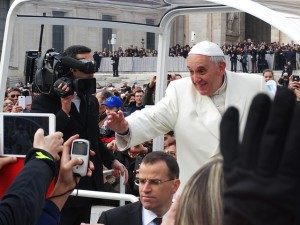
Last week, a Catholic friend was telling me about her parish priest. “He’s a very holy man,” she said, and added, “He’s really on the same wavelength as Pope Francis.”
To which I immediately replied, “I don’t think anyone’s on Pope Francis’ wavelength: I think he’s found one all his own.”
She thought for a second, then nodded agreement.
Pope Francis has a unique ability, wherever he goes, to make everyone – atheists and evangelicals, liberals and conservatives, traditional and fallen-away Catholics – sit back, tilt their heads to the side, and ask in unison, “What actually just happened?” It strikes me that this is probably not unlike the effect that a certain friar, not coincidentally also named Francis, would have stirred up around Umbria in the early 1200s. This rich merchant’s son began his religious life by stripping naked and abandoning all his worldly clothes in a heap in the town square, racing off to rebuild a crumbling church, and gaily inviting the whole world to come and join him. And thus comes a familiar chorus across the centuries:Â What on earth is Francis going to do next?
At first, it can seem paradoxical that deep, sincere humility and alarmingly unprecedented actions undertaken on one’s own authority can co-exist within the same person. At eight hundred years’ remove, however, we can see clearly that the humility of Saint Francis, the little poor man of Assisi, was the source of his openness to the Holy Spirit; he could hear the tiniest breath of grace and hare off after it without hesitation while everyone else tagged along behind him scratching their heads. Of course, mistakes can be made with this approach (Father Benedict Groeschel comments that St Francis’ greatest error was to allow indiscriminate entry to anyone who wanted to join his Order, with the result that by the time he died there were many in it who didn’t share his vision and oughtn’t to have been there) and confusion can be sown by off-the-cuff remarks (“Who am I to judge?”), but great good also comes from that openness.
Soon, we’ll leave the Year of Consecrated Life and enter the Year of Mercy – a year of reaching out to other Christians, ex-Christians, and non-Christians alike, to share with them the joy of the Gospel of Christ. Saint Francis, one of the greatest missionaries of true, unadulterated joy that the Church has ever known, would approve.
Saint Francis of Assisi, pray for us!

 By Jacqui, re-printed from her blog Talitha Koum with kind permission. Please pray for her as she begins her volunteer work at at orphanage in India!
 A census is a practical, quantitative tool, not a qualitative one: if I check “Catholic” in the religion category, a computer somewhere far away will go click and add one Catholic to its demographic information, and that’s the whole bewildering tapestry of my religious experience to date statistically done and dusted. It’s rather like the limitations of the Google Analytics data that I, with my Blog Mistress hat on, use to measure traffic through the Leonie’s Longing website. I might be delighted to see a spike on the graph showing that over a hundred people viewed a particular article, but that spike doesn’t tell me the most important thing of all: what that article meant to the real people who read it. My own cheerful postulant answers to the university survey were contrariwise all true, but contained not a single piece of information that they could use because everything that mattered was inside my soul and therefore unquantifiable. And although I’ve finally submitted my census, and hope that the government will be able to use the information I provided to help get an idea of the demographics of Australia in 2016, the act of filling my life out on a form is a reminder that although a human can be represented in numbers, the numbers will always fall short of the image and likeness of God.
 A classic parlour game, with a Leonie’s Longing twist! Answers below.




 Last week, a Catholic friend was telling me about her parish priest. “He’s a very holy man,” she said, and added, “He’s really on the same wavelength as Pope Francis.”
 At first, it can seem paradoxical that deep, sincere humility and alarmingly unprecedented actions undertaken on one’s own authority can co-exist within the same person. At eight hundred years’ remove, however, we can see clearly that the humility of Saint Francis, the little poor man of Assisi, was the source of his openness to the Holy Spirit; he could hear the tiniest breath of grace and hare off after it without hesitation while everyone else tagged along behind him scratching their heads. Of course, mistakes can be made with this approach (Father Benedict Groeschel comments that St Francis’ greatest error was to allow indiscriminate entry to anyone who wanted to join his Order, with the result that by the time he died there were many in it who didn’t share his vision and oughtn’t to have been there) and confusion can be sown by off-the-cuff remarks (“Who am I to judge?”), but great good also comes from that openness.
Recent Comments