Aug 5, 2016 |
 By Amata
Some years ago, I was talking with a dear friend. She and her husband had been struggling to conceive, and she was sharing with me how painful this experience was. However, she said, if this was something that she needed to go through, to suffer, so that she could become holy, then so be it. She said she’d rather go to Heaven than have a baby, if that was what it took to get to heaven, if this experience of infertility was purifying her and sanctifying her through her pain.
Her words that day stuck with me. She’d rather go to heaven than have a baby, if that was what it took. I continued to ponder and to be amazed by those words. I grew up in a large family, where babies are seen as one of the greatest gifts God can give, and now I feel myself drawn to marriage. I love babies, and I could see the pain in my friend’s eyes as she spoke. And yet, she would rather go to Heaven than have a baby. Her desire for God, for sanctity, and for doing God’s will was greater than her desire to have a child of her own.
St. Ignatius talks about the indifference that is necessary for sanctity. He is not talking about a world in which we have absolutely no desires. Rather, he is talking about a world where our desires match God’s desires for us, where we make decisions based on God’s will, and where we subject our own desires to God’s desires for us. When I first heard of this idea, I struggled to understand what it really means. What does this holy indifference really look like in today’s world?
I think I saw it in my friend’s eyes that day. She’d rather go to Heaven. She was placing her own desires at the feet of God and accepting His will for her as necessary for her own salvation. And even as she spoke, there was a joy behind the pain. Nobody was twisting her arm making her accept the will of God. Rather, mingled with her tears there was a genuine desire for Heaven and an excitement at the thought of seeing God Himself face to face for all eternity. She’d rather go to Heaven.
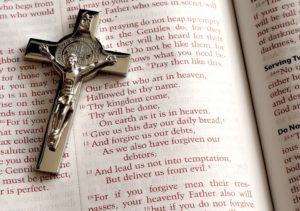
I think that, in many ways, the greatest sufferings in our life come from a lack of this holy difference. If we are really
able to say “blessed be God” no matter what comes, if we can learn to let go of something because it does not correspond with God’s will for us at this moment, then I think our lives would be so much easier. Easier said than done, I know.
As I continue to ponder my own journey of discernment of religious life, through living active life and nearly joining a cloistered community, these words have stuck with me. Would I like to still be in my religious community, joking that I’ll be buried out back? Yes. But, I’d rather go to Heaven, and if living in the world as a layperson is my path to sanctity, then so be it. Would I rather have had that cloistered vocation that I explored? Somedays, yes. But, I’d rather go to Heaven.
And now, as I discern married life and am surrounded by friends and siblings with families of their own, it is easy to be frustrated. I never imagined that at this point in my life I would still be so… unsettled. Would I absolutely love to have a family of my own right now, or at least a serious boyfriend, so that I can be closer to the vocation God seems to have in mind for me? Oh, yes, by all means!
But, I’d rather go to Heaven.
May 27, 2016 |
By Lucia
“You will not be alone, because I am with you always and everywhere. Near to My Heart, fear nothing. I Myself am the cause of your departure. Know that My eyes follow every move of your heart with great attention. I am bringing you into seclusion so that I Myself may form your heart according to My future plans” (Jesus to St. Faustina, 797)
April 27, 2014- One of the most difficult days of my life, and yet, a very important day for the Church- Divine Mercy Sunday when St. John Paul II, the “Divine Mercy Pope”, was canonized. This was the day that I came home from the convent, and yet as I reflect on it more and more, I see it as a reflection of God’s Mercy and love to me.
Mercy, we hear it so often at Mass and in Scripture. It is one of the greatest attributes of God, and yet, how many of us plunge into the depths of what it means? The Latin, Misericordia, comes from “miserere”, which means “misery”, and “cor”, which means “heart”. So, this word literally means the act of a heart entering into another’s misery. So Divine Mercy is the message that not only does God enter into our misery with us, but that He comes and brings an even greater good out of every evil and suffering.
Coming up on the two year anniversary of my leaving, God blessed me with the beautiful grace to go on pilgrimage to the country that radiates God’s Mercy. He truly took me on a journey to experience the reality of this heart reaching out to me in my misery, especially in the experience my coming home from the convent. How? Redemptive Suffering. The people of Poland have experienced so much suffering, from the destruction of cities like Warsaw during World War II, to the incomprehensible terrors that resulted in concentration camps like Auschwitz. And yet, while these people have been through evils unimaginable, they have a heart for the Lord and hope unlike any other I have experienced.
This really blew me away… How can people who have experienced such immense suffering live like this? How can they have joy and hope, when everything they loved seemed to be taken away from them? How can they rejoice in Christ when they clearly came face to face with their own weaknesses and lived through so much fear?
In my own pain coming home from the convent, I have found that it has brought me face to face with fear and my own weakness. I have often given into discouragement, thinking that I can only love God once I move past the “ups and downs” of grieving the convent. But the people of Poland really helped me to see things in a new way through the lens of God’s Mercy.
As I progressed through my pilgrimage, the answer to my questions became clear to me. Teresa Benedicta of the Cross, Maximilian Kolbe, Faustina, John Paul II…These people were not immune to fear or death…Actually they were steeped in it. But what made these people saints they were meant to be?
They encountered the immense power of Divine Mercy. They experienced evil, came face to face with fear and suffering, and yes, knew ever deeper of their helplessness amidst such evil. But they made a choice- they chose to use it as an opportunity to cling to Christ and to take part in His suffering with Him. They saw their crosses in life through a twofold lens- that God was with them in their cross, and that they could unite their cross for another. They made the decision to allow the merciful Christ to be with them in their own pain, to receive His love gushing forth from his heart, and to be one with Him on the cross. And not only did they live out their suffering with Christ, but they had faith in God in whom they trusted would keep His promises. They had the hope in the reality that the resurrection comes after the cross, and that Christ not only brings good out of evil, but an even greater good!
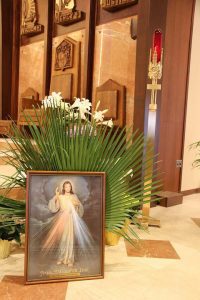
The image of Divine Mercy shows this reality well. In this image, Jesus is appearing after He rose from the dead, and yet, He bears his wounds…the wounds of His Love. His wounds are glorified, and radiate the depths of God’s Mercy to us. It is Jesus saying to me and to you, “I love you this much. I am here with you and will lead you through this.”
And perhaps what is most important is the words at the bottom. “Jesus, I trust in You.” Yes, these words seem to reflect the attitude and call that Christ presents to us in this Jubilee Year of Mercy. Jesus is asking us to trust Him, amidst worries, struggles, and even joys! When coming face to face with our weakness in our own specific journeys coming home from the convent, He wants us to trust in His goodness and in the reality that the resurrection comes after the cross. Just like Himself, He wants our wounds to be glorified- we need only to entrust them to Him!
Apr 7, 2016 |
By Girasol.
In my former community, we would comment–in a somewhat light-hearted way–about the age of thirty-three being the “year of crucifixion.” Perhaps those community sisters of mine who had already passed that age spoke with more truth than I realized. While there are certain moments of more intense suffering and offering at different stages of life, independent of age, the “year of crucifixion” didn’t pass by without reminding me very clearly of the cross.
At thirty-one, I said goodbye to my community family and embarked upon a new way of life. At thirty-two I met a knight in shining armor and seriously opened myself to the possibility of marriage. And not more than a day after my thirty-third birthday, my knight and I–after a long conversation and many tears–decided that we needed to step back from the relationship. God had not given me the peace I needed to move forward in that vocation.
In some ways it was more painful to end an eight-month relationship than it has been to leave my community of many years. Or perhaps the one was now compounding the other. I was working through not one loss but two. In spite of feeling peace in the rightness of the decision, the sadness continued for many months.
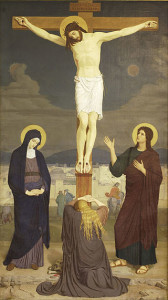
Providence would have it that I had already intended to renew my Marian Consecration on the feast of the Exaltation of the Cross. The Consecration day itself had its share of crosses, not the least of which was my inability to attend Mass due to my “worldly duties.” Yet on the following day–the feast of Our Lady of Sorrows–I had a moment of heart-to-heart prayer with My Mother. The previous few months had been painful. I needed to be with her at the cross. I wrote this reflection:
“With Mary I stand at the foot of the cross. No…I don’t stand. I fall. It’s hard, so hard. It’s painful. Why? Because of love. Love can hurt. I may have to leave at the altar of the cross something that I love dearly. Why? Because the love of Christ is more, and if He is asking the sacrifice, I can’t refuse it.
But I really have nothing on Mary when it comes to pain, suffering, and loss. Talk about a broken heart! No…her heart was pierced but not broken. She knew suffering like no other yet was not driven to despair. She hoped against all hope. She offered, she loved. And it is with her that I walk through this valley of tears. I’ve renewed my consecration to her – and if I take this act seriously, how much more does she? She is my faithful companion. I know that she does not abandon her children.”
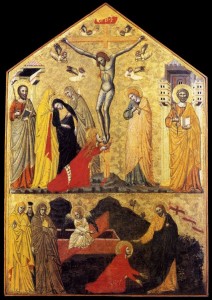
The tears didn’t magically disappear that day, my heart wasn’t healed in an instant,nor did the twists and turns suddenly make sense. But I had a new awareness of Mary’s presence in my life. If Mary could maintain faith and hope in the midst of unimaginable suffering, can she not help me to do the same in my sufferings, small by comparison? She accompanies me at the foot of the Cross, consoles me and reminds me that I have reason to hope. Because if thirty-three is the year of crucifixion, it is also the year of resurrection. We all have that to look forward to, my friends – in small ways in this life and a glorious way in the next.
Mar 17, 2016 |
Hello everyone!
It’s a milestone for us: three years ago on the 17th of March, our first-ever post went live on the Leonie’s Longing blog!
For a look back at where it all began, check out “Nun Ya Beeznus” by Rosa Mystica at https://www.leonieslonging.org/nun-ya-beeznuss/
To all our readers, supporters and volunteers, old and new, thank you for joining us on the journey so far – and may you have a blessed Feast of Saint Patrick!
Sep 30, 2015 |
By AfterEpiphany.
St Therese of Lisieux, when pondering the symbolism of the garden for which she has become so famous, wrote that she realised that we couldn’t all be roses and lilies. She personally identified more with a smaller, less significant flower, and she discovered beauty in being that flower rather than some of the others she had once longed to be.
The Little Way of St Therese is indeed a message of comfort to we former sisters, if only one can get past the contempt that comes with an over-familiarity with the general notion of The Little Way, and actually embrace it and live it.
In my former community I celebrated my feast day on the 1st of October and St Therese of Lisieux was my personal patroness. Anyone who knows me well knows that I tend to gravitate towards grand plans and big ideas… I really need a saint like Therese praying for me, teaching me to be who I am and flourish as such in the Father’s Garden!
Once, I dreamed I’d be a religious sister and I hoped I’d be a holy one. I longed to be a saint. I longed for union with God. I felt convinced that He had called me to be a garden enclosed – His sister, His bride. Some years on, I find that I am NOT a religious sister, nor am I holy – neither lily, nor rose, much less that garden enclosed. I still long to be a saint, and I still long for union with God… and thanks be to Him that through the life and witness of St Therese He has shown me that there is still a way… albeit a little way.
As I learn to live The Little Way out here in my “post-convent” reality, the 1st of October is still special to me.
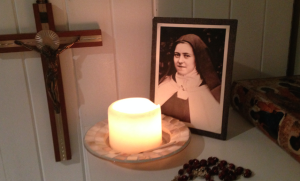
I celebrate it almost as if it were my birthday… because any excuse for a party will do… but more seriously, because the day still has a significance that I can’t quite articulate. Unless you’re a close friend or family member, you may not notice anything different about the way I go about my day. OK… so I generally eat “solemnity food” (i.e. I indulge in sugar just a little bit), and if there are lunchtime meetings that interfere with my Mass plans, guess which one wins? I have a picture of St Therese in a cardboard frame that I received from one of my former sisters on the day I received the habit… I’ve kept that picture and it receives pride of place in my “prayer corner” on October 1st. I still think of it as “my feast day” and I still consider it a day to “ask big” with a trust in the Father so characteristic of St Therese… through her intercession. I pray in a special way for all my former sisters who shared that feast day.
All of these external things are so little… so little… but they help to make the day special internally. My friendship with St Therese has been such an important feature of my post-convent healing. She has been such a faithful friend and has helped to keep the lines of communication open with our Heavenly Father when my heart was hurting most and I was tempted to turn away.
I don’t know how successful this would be, but I’d love to open up some discussion here in the comments below, among you, the Leonie’s Longing readers. We’re a community, after all, and we share a life experience that unites us in Him. Each one of us once longed to be a part of that garden enclosed… perhaps lily, perhaps rose. Some of you will have been in religious life long enough to have had a religious name and/or feast day. Those of you who returned home before receiving a name, or who belonged to communities that retained Baptismal names, may still have had a particular saint you considered your patron. And so I ask you.. do YOU still celebrate your “feast day”? If so, how do YOU make it a special day?
This October 1st, my feast day, I will again “ask big” – this time for each of you, my sisters in Him.

 By Amata
 I think that, in many ways, the greatest sufferings in our life come from a lack of this holy difference. If we are really
 The image of Divine Mercy shows this reality well. In this image, Jesus is appearing after He rose from the dead, and yet, He bears his wounds…the wounds of His Love. His wounds are glorified, and radiate the depths of God’s Mercy to us. It is Jesus saying to me and to you, “I love you this much. I am here with you and will lead you through this.”
 By Girasol.
 Consecration day itself had its share of crosses, not the least of which was my inability to attend Mass due to my “worldly duties.” Yet on the following day–the feast of Our Lady of Sorrows–I had a moment of heart-to-heart prayer with My Mother. The previous few months had been painful. I needed to be with her at the cross. I wrote this reflection:
 The tears didn’t magically disappear that day, my heart wasn’t healed in an instant,nor did the twists and turns suddenly make sense. But I had a new awareness of Mary’s presence in my life. If Mary could maintain faith and hope in the midst of unimaginable suffering, can she not help me to do the same in my sufferings, small by comparison? She accompanies me at the foot of the Cross, consoles me and reminds me that I have reason to hope. Because if thirty-three is the year of crucifixion, it is also the year of resurrection. We all have that to look forward to, my friends – in small ways in this life and a glorious way in the next.
 It’s a milestone for us: three years ago on the 17th of March, our first-ever post went live on the Leonie’s Longing blog!

 By AfterEpiphany.
Recent Comments